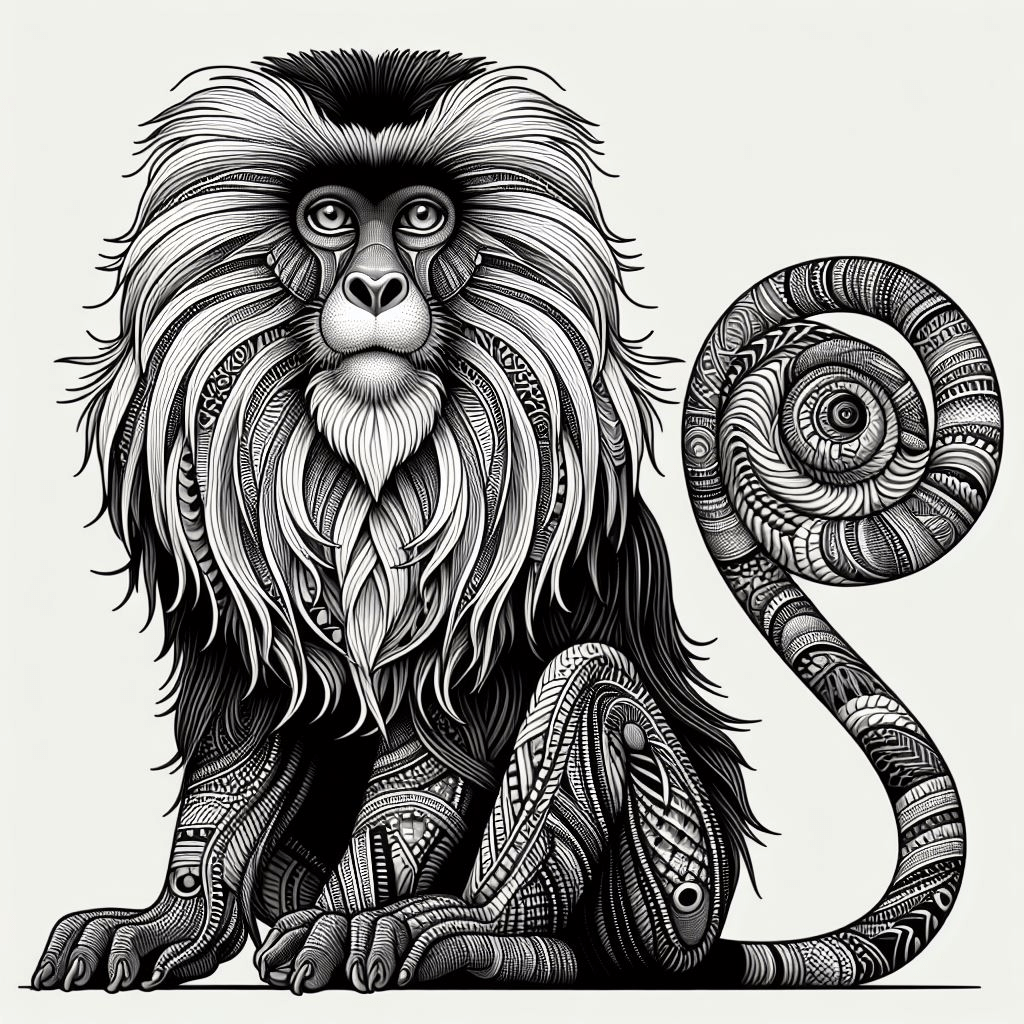
In the lush depths of the Western Ghats, a sage-like figure known as Aranya, the wise old wanderoo, held sway. His silver mane shimmered like moonbeams, carrying the whispered secrets of the forest. Aranya’s duty was no ordinary one; he guarded the sacred fig tree, repository of ancient wisdom and bearer of fruits said to bestow enlightenment upon those who partook.
Animals from all corners of the forest sought Aranya’s guidance, for he was revered among them. But tranquility was threatened when humans encroached upon their domain, disrupting the delicate equilibrium of nature.
In a bid to safeguard his home, Aranya chose a young human, Kishan, known for his reverence for the forest, to share the secret of the sacred fig tree. One night, under the glow of the full moon, Aranya led Kishan to the hallowed tree. Offering him a fruit, Kishan consumed it, his mind flooding with the wisdom of the forest. Aranya spoke of the imperative harmony with nature and the dire repercussions of its desecration.
Enlightened, Kishan became the voice of the forest, persuading his tribe to adopt sustainable living practices. Through his efforts, the forest flourished anew.
Aranya, the venerable wanderoo, continued to oversee the forest, his legacy perpetuated through tales that spanned generations, underscoring the timeless connection between humans and nature.
This fictional narrative mirrors the intertwined folklore and biodiversity of the region, emphasizing the imperative of conservation and the pivotal role each creature plays in the grand tapestry of the ecosystem.
In the heart of the Western Ghats resides the lion-tailed macaque (Macaca silenus), a captivating primate endemic to South India. Here are some intriguing details about this remarkable species:
Characteristics:
- Cloaked in ebony fur, lion-tailed macaques boast a striking silver mane enveloping their visage, a feature present in both genders.
- Their faces, devoid of fur, sport a dusky hue, though appearing pinkish in juveniles.
- True to their name, their elongated, slender tail, terminating in a tuft akin to a lion’s, measures approximately 25 cm.
- The irises of their hazelnut eyes are complemented by ebony eyelids.
- Equipped with capacious cheek pouches, they adeptly store food.
- Quadrupedal with opposable thumbs, they navigate their arboreal domain with finesse.
Behavior and Ecology:
- Lion-tailed macaques are diurnal creatures, exclusively active during daylight hours.
- Preferring the canopy of tropical evergreen forests, they shy away from human presence.
- Living in hierarchical groups of 10 to 20, typically led by a few males and numerous females, they employ a polygynous mating system.
- Their diet encompasses fruits, leaves, buds, and insects, adapting as per environmental fluctuations.
Conservation:
- Sadly, the lion-tailed macaque is classified as endangered by the IUCN Red List.
- Habitat loss, primarily due to agricultural expansion, commercial farming, and infrastructure development, imperils their existence.
- Notably, the Silent Valley National Park in Kerala harbors a significant population of these primates, where conservation endeavors aim to safeguard their dwindling habitat.
Together, these narratives encapsulate the essence of coexistence and the imperative of preserving our natural heritage for generations to come.
As a Power Animal, Totem Animal, and Spirit Guide:
- Power Animal: The wanderoo, with its aura of wisdom and connection to the forest, serves as a potent symbol of guidance, inner strength, and resilience. Calling upon the energy of the wanderoo can empower individuals to navigate challenges with grace and wisdom.
- Totem Animal: For those who resonate with the wanderoo as their totem animal, it represents a deep affinity with nature, a reverence for ancestral wisdom, and a commitment to preserving the sanctity of the natural world. The wanderoo inspires individuals to embrace their instincts, honor their lineage, and tread gently upon the earth.
- Spirit Guide: As a spirit guide, the wanderoo offers profound insight, guiding seekers on a journey of self-discovery, spiritual growth, and ecological stewardship. With its keen intuition and ancient wisdom, the wanderoo leads the way towards harmony, balance, and interconnectedness with all living beings.

#w- Wanderoo.
Scientific name: Macaca silenus
Classification:
- Kingdom: Animalia (Animals)
- Phylum: Chordata (Chordates)
- Class: Mammalia (Mammals)
- Order: Primates (Primates)
- Family: Cercopithecidae (Old World Monkeys)
- Genus: Macaca
- Species: Macaca silenus
Inputs by Xammi Xamman for blogchatter A2Z challenge.
 Parwatisingari's Weblog
Leave a comment