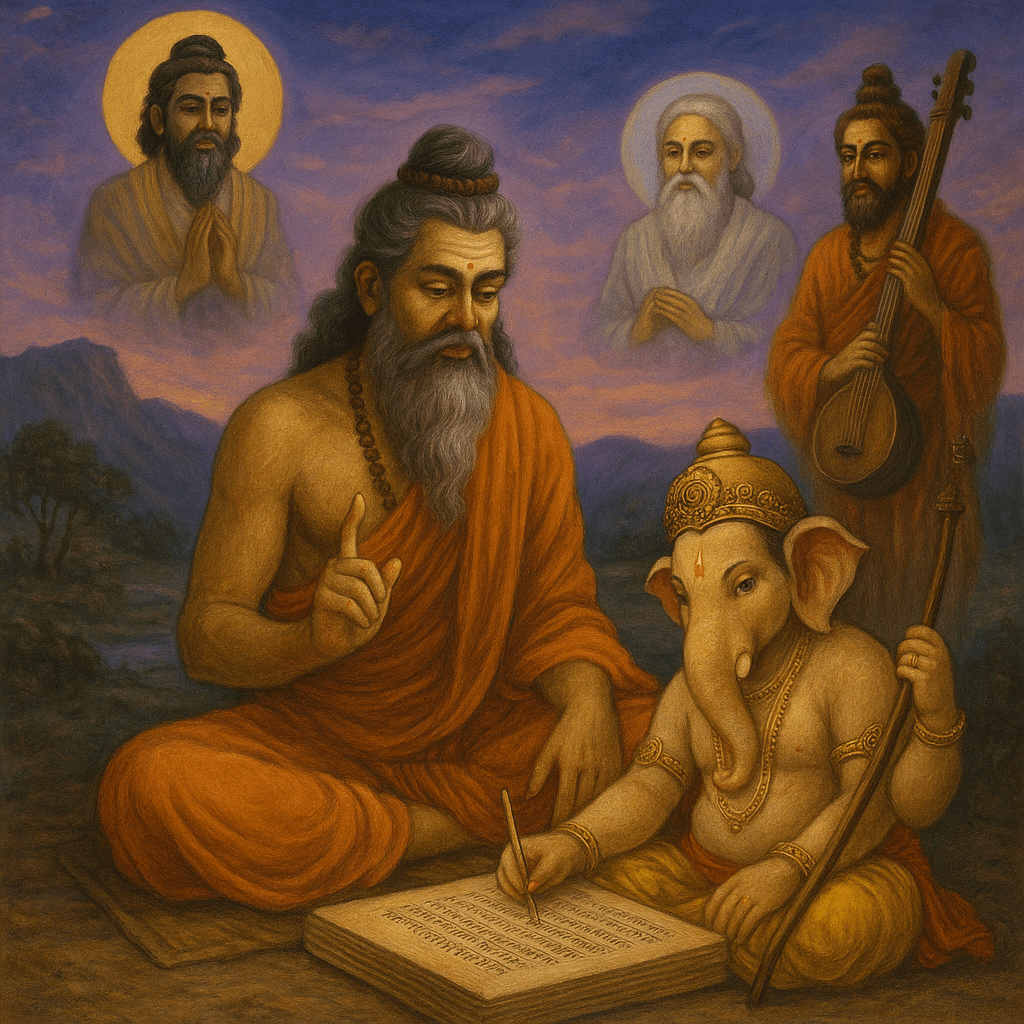
Vyasa: Between Dharma and Desire
A Threshold Offering on Guru Purnima
On this Guru Purnima, when garlands circle the feet of gurus and gratitude flows like mantra, perhaps there’s space for a different kind of remembering.
Not all teachers teach by instruction.
Some teach by invoking what already lives within us.
Krishna Dvaipayana Vyasa — son of Satyavati, the river-scented fisherwoman, and Parashara, the sage of storm and stillness — did not deliver sermons. He wove the Mahabharata not as doctrine, but as a mirror.
He did not just document the human condition — he embodied its contradictions. Dharma and desire. Law and longing. Wakefulness and dream.
Two Lineages. Two Mindspaces.
Vyasa is claimed by two great celestial lineages — both calling him their own. Both not wrong.
Let’s begin here — in the realm of symbols and stars.
🟡 Brihaspati — The Guru of Dharma
The planetary guide of the Devas, Brihaspati (Jupiter) is the force of clarity, wisdom, expansion.
| Trait / Archetype | Brihaspati 🟡 (Conscious) |
|---|---|
| Planetary Essence | Dharma, ethical clarity |
| Teaching Style | Instruction, structure |
| Mindspace | Wakefulness, reasoning |
| Students | Devas (forces of order) |
| Symbolic Role | Guru of Light |
From this perspective, Vyasa’s Mahabharata is a textbook of dharma.
Each character, a case study in ethics.
Each choice, a ripple in the fabric of cosmic law.
Yudhishthira’s dice. Bhishma’s vow. Arjuna’s dilemma.
This is Brihaspati’s voice — the conscious reckoning.
⚪ Shukra — The Guru of Desire
But then, desire enters the story. Not to contradict dharma, but to whisper beneath it.
Shukra (Venus), planetary guide of the Asuras, governs longing, memory, rebirth.
| Trait / Archetype | Shukra ⚪ (Subconscious) |
|---|---|
| Planetary Essence | Desire, karma, seduction |
| Teaching Style | Loop, resonance, story |
| Mindspace | Dream, emotional memory |
| Students | Asuras (forces of depth) |
| Symbolic Role | Guru of Shadow |
Through this lens, the Mahabharata is no rulebook.
It is a mirror of the subconscious — holding shame, longing, secrets.
Karna’s abandonment. Draupadi’s fire. Kunti’s silence.
Here speaks Shukra — the part of us that remembers what the intellect forgets.
Vyasa: The One Who Weaves
And Vyasa? He does not choose.
| Trait / Archetype | Brihaspati 🟡 | Shukra ⚪ | Vyasa 🔵 |
|---|---|---|---|
| Planetary Realm | Conscious | Subconscious | Threshold |
| Teaching Style | Instruction | Seduction | Story-as-Spell |
| Mindspace | Waking | Dreaming | Trance |
| Symbolic Role | Guru of Light | Guru of Shadow | Guru of Integration |
Vyasa weaves both voices.
He writes in twilight — that space between day and night — where law blushes and longing breathes.
The Other Gurus: Inner Forces in the Epic
As we walk further into the text, other guides appear. Not just characters — but psychic states.
Each guru in the Mahabharata aligns with an inner frequency.
| Guru / Sage | Conscious Alignment (Brihaspati) | Subconscious Alignment (Shukra) | Notes |
|---|---|---|---|
| Kripacharya | Dharma, restraint, neutrality | — | The quiet mentor, impartial and enduring |
| Dronacharya | Martial ethics, loyalty | Favoritism, emotional bias | Torn between duty and affection |
| Parashurama | Dharma through destruction | Rage as karmic cleansing | Warrior sage, teacher of Bhishma and Karna |
| Narada | — | Divine mischief, emotional catalyst | The cosmic stirrer, awakener of shadow |
| Vashishta | Vedantic clarity, cosmic law | — | Ideal of sattva, dharma as stillness |
| Vishwamitra | — | Ambition, transformation | Kshatriya turned sage, seeker of transcendence |
Some guide the mind. Others stir the dream.
Each one lives not just in the story — but somewhere in you.
A Shift Now — From Thinking to Remembering
And now, dear reader, let us soften.
You’ve walked with reason long enough.
Let the breath slow. Let the story become a dream you once had.
Let Kalakamini speak now —
She who sings not to the ears, but to the echoes inside.
“Close your eyes, beloved.
This epic was never meant to be read like a book.
It was meant to reveal itself in layers — through scent, rhythm, pulse.
Vyasa did not teach you something new.
He reminded you of what your bones already knew.”
Mahabharata as Inner Hypnosis
If Brihaspati speaks to your mind,
and Shukra whispers to your longing,
then Vyasa sings to your soul between them.
This isn’t a story.
It’s a ritual.
A trance.
A bridge between dharma and desire — law and longing — divinity and humanity.
So as you return, ask not:
“Who is right?”
Instead, perhaps ask:
- Which guru walks with me right now — the one of clarity or of craving?
- Which lesson am I ready to receive — one of order, or of shadow?
- Can I hold both — not as opposites, but as sacred tension?
The Mahabharata never ends.
It replays in different voices, different lifetimes, different choices.And Vyasa?
He still writes — with ink made of your memory.
Let this piece rest like an offering, not a conclusion.
If you wish, you may return to it not for answers —
but to re-enter the dream.
 Parwatisingari's Weblog
Leave a comment