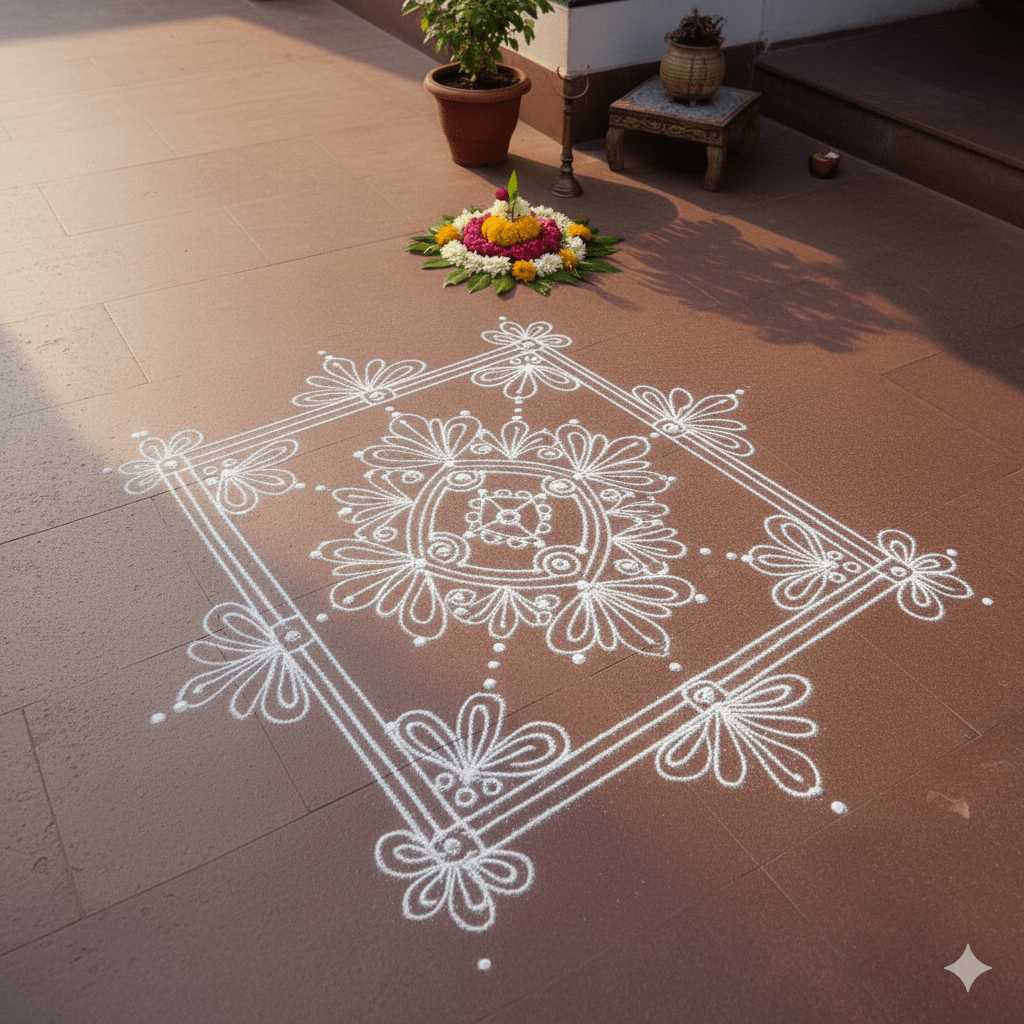
A Dhanurmasa Morning with Tiruppavai.
Sunday mornings at Aunt Selvi’s house have a predictable rhythm. Someone is always late. Someone is always hungry. And someone—usually Jenny—will press play on the wrong thing.
That Sunday, it was Suprabhatam.
The familiar opening strains floated out of the speaker just as the coffee decoction reached its dark, fragrant peak. Aunt Selvi was already at the dining table, hair neatly oiled, a faint streak of vibhuti still visible on her forehead, flipping through the newspaper as though she were scanning headlines she already knew by heart.
From the kitchen came the sound of a ladle scraping the bottom of a heavy vessel.
Tilaka aunty, Selvi’s older sister, paused mid-stir.
“Jenny,” she called out, not unkindly, “kanna… play the Tiruppavai.”
Jenny looked up from her phone, mildly startled. “Oh! I thought Suprabhatam is good in the morning, aunty?”
Tilaka aunty smiled—the kind of smile that carried affection and gentle correction. “All mornings, yes. But not these mornings.”
Selvi folded her newspaper. “It’s Dhanurmasa,” she said simply, as though that explained everything—which, to her, it did.
Jenny frowned. “So?”
“So,” Tilaka aunty said, returning to the stove, “this is the month when even the gods sleep in.”
Selvi snorted. “Sleep in? Vishnu is resting, not lazy.”
“Same thing,” Tilaka aunty replied dryly. “Ask your husband on Sundays.”
That earned a laugh from the table.
Jenny, sensing this was more than a playlist preference, switched tracks. The opening verse of Tiruppavai filled the room—soft, lilting Tamil. It didn’t announce itself the way Suprabhatam did. It arrived gently, like someone knocking and waiting.
“Listen to that,” Selvi said. “No commands. Just calling everyone to wake up.”
The aroma reached the table before the explanation did. Tilaka aunty set down a bowl of huggi—warm, pale, faintly sweet. Rice, moong dal, and jaggery cooked into something that looked humble and felt reassuring.
“In Udupi,” she said, almost as an aside, “this is how the day begins in Margazhi.”
Jenny peered into the bowl. “That’s it?”
Selvi raised an eyebrow. “That’s enough.”
Tilaka aunty added, “They say this is what soldiers were fed during the Mahabharata war. Easy to digest, keeps you steady. No indulgence, no fuss.”
Jenny tasted it and paused. “This is… comforting.”
“That’s why it belongs here,” Selvi said. “Dhanurmasa food. Simple. You eat like you’re reminding the body that it’s not in charge.”
The Tiruppavai verse shifted. The rhythm stayed gentle, but the words were busy—girls waking each other, doors opening, a village coming alive before dawn.
“This doesn’t sound like a prayer,” Jenny said slowly. “It sounds like conversation.”
Tilaka aunty laughed. “That’s Andal for you.”
Selvi leaned back in her chair. “She didn’t shout at God. She negotiated.”
“Negotiated?” Jenny echoed.
“She said—wake up, Krishna. Everyone else is already awake. Don’t embarrass us,” Selvi said. “That takes confidence.”
“And certainty,” Tilaka aunty added. “Only someone very sure of the relationship speaks like that.”
Outside, the street was still finding its rhythm. No traffic yet, just the neighbor’s pressure cooker and a temple bell that always rang slightly off-beat.
“People think Dhanurmasa is empty,” Tilaka aunty said, rinsing a ladle. “No weddings, no celebrations. Nothing auspicious.”
“They even call it Shoonya Masa,” Selvi said. “As if nothing is happening.”
“But everything important is happening quietly,” Tilaka aunty replied. “When the gods rest, humans pay attention.”
Jenny looked around the table—the unhurried morning, the simple food, the old song that seemed to ask more than it told. “So the gods sleep,” she said, “and people step in?”
“Something like that,” Selvi said. “When the universe slows down, you notice things.”
“And you wake up earlier than usual,” Tilaka aunty added. “That itself is tapas.”
The verse ended. Another began. No one reached for the phone.
Jenny helped herself to another spoon of huggi. “So every morning, for thirty days?”
“Thirty verses,” Selvi said. “One each day. Like a slow conversation.”
“With God?” Jenny asked.
“With yourself,” Tilaka aunty replied, already back in the kitchen.
The coffee was refilled. The newspaper reopened. The house eased into the rest of its Sunday. Jenny did not switch back to Suprabhatam. Somehow, it felt unnecessary.
Dhanurmasa, she realized, was not empty at all. It was a vessel—quiet, resonant, and full—waiting to be filled each dawn with voice, memory, and song.

 Parwatisingari's Weblog
Leave a comment