Akshar had stopped pretending to listen.
“Celtic art,” Nagesh said, warming up, “is composed in sets of three.”
Akshar’s eyes drifted to the painting behind him—Minerva, holding a cornucopia spilling fruit, an animal crouched at her feet, a child clinging to her leg. Abundance, instinct, innocence. Or just a very busy composition.
“Interesting,” Nagesh added, when Akshar didn’t respond.
“Oh. Yes,” Akshar said, late. “Oak, ash, and thorn. The fairy triad.”
Sarah blinked. Nagesh looked pleased.
“Fairies live where they grow together,” Akshar muttered, mostly to himself.
“Where oak, ash, and thorn grow together,” Nagesh clarified, gently correcting him, which somehow made it worse.
The conversation should have ended there. Naturally, it didn’t.
Someone invoked Google. Someone else invoked shamans. Apparently, from a Celtic shamanic viewpoint, the number three represented initiation: past, present, future. The shaman, we were told, stood in all three worlds at once, which sounded exhausting and poorly regulated by HR.
“I don’t know about that,” Nagesh said, generously. “But they were definitely obsessed with threes. Three Brigids. Three trials for heroes. Three stages of every journey. Very repetitive, if you ask me.”
Akshar considered pointing out that repetition was the point. He didn’t.
“Why stop with the Celts?” Sarah said. “The Greeks loved threes too.”
She was off.
Three Fates. Three Furies. Three Gorgons. Cerberus with three heads—because one clearly wasn’t enough. Apollo’s tripod. If it wasn’t three, it was a multiple of three. Nine muses. Twelve Olympians. Divine bureaucracy at its finest.
Someone, recently returned from a leadership summit, said, “If we’re talking global—”
“Trimester,” another voice added.
“Trilogy.”
“Trident.”
The room filled with words, none of them urgent, all of them loud. When the noise finally died, Akshar noticed something quietly unsettling.
The triangle.
The first shape that didn’t collapse. Three points. Stable. Solid. No wobble. A thing that could exist without apology. Completion disguised as simplicity.
So that was it, then. Three meant done. Finished. Whole.
He felt mildly cheated.
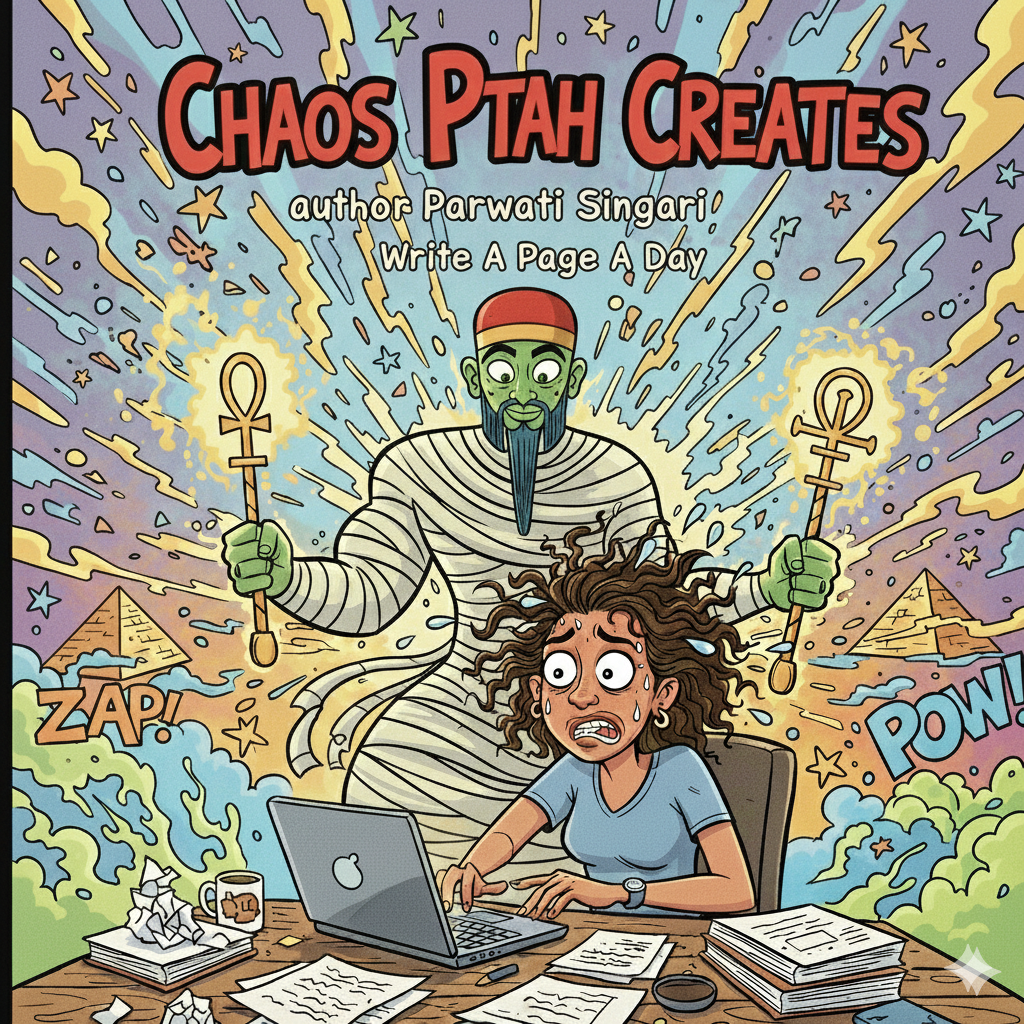
That was when Ptah appeared—uninvited, as usual—leaning against the edge of Akshar’s thoughts like a smug consultant.
“We’ve had an epiphany, haven’t we?” the god said. “Let me help you complete it.”
Akshar did not respond. Ptah never needed permission.
“Past, present, future. Thought, word, deed. Subject, predicate, copula. Major premise, minor premise, conclusion.” Ptah ticked them off lazily. “Omniscience, omnipresence, omnipotence. Mineral, vegetable, animal. Everything meaningful comes in threes.”
He smiled.
“And since this entire mess emerged from a conversation,” Ptah added, “perhaps you should harness it.”
Akshar thought of the breakthroughs. The breakdowns. The goddess he had met and immediately misunderstood. The temptress with her temporary trophies—fascinating, repulsive, exhausting. The strange peace of unconditional acceptance. The humiliation of impotence. The terror of omnipresence.
He had mistaken movement for progress. Noise for meaning.
The journey, it seemed, had shifted again. Another plane. Another demand.
This time, it wasn’t asking him to add anything.
It was asking him to cut.
“Cut the noise, keep the triangle—creation isn’t about piling on, it’s about knowing exactly what to throw away.”
 Parwatisingari's Weblog
Leave a comment