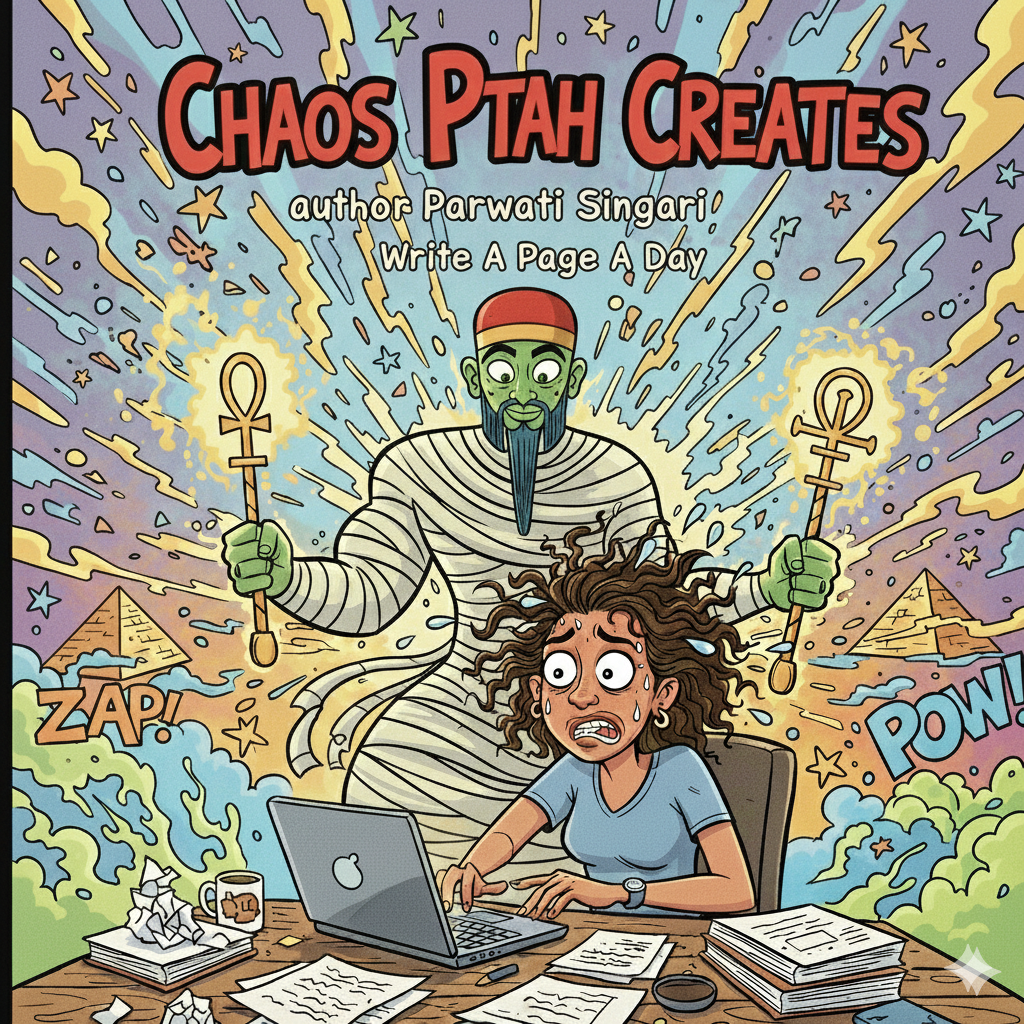
Who the hell are you? Akshar thought, unkindly.
A hypnotherapist would have called Ptah literal. His answer arrived immediately.
“Anyone you want me to be, buddy,” Ptah said cheerfully. “I turn into what you want most in this moment.”
Akshar hated this already.
Something tugged at his memory. Words. Picture. Creation. A half-remembered trip to Egypt. A museum afternoon that had felt oddly personal. A friend who insisted folk religion made more sense than theology.
Oh.
“This is ridiculous,” Akshar muttered. “You’re—”
“Yes,” the man said, smiling. “That one.”
The Egyptian god of creation stood before him, looking deeply pleased with himself. He had chosen a form that suggested authority without effort, mischief without consequence. A god who knew exactly how irritating he was being.
“All creation,” Ptah said lightly, “exists in the realm of words. Thought spoken into form. So here I am—to help.”
Akshar considered several responses and rejected all of them.
“By the way,” Ptah added, lowering his voice conspiratorially, “I wouldn’t talk to the people dropping in and out of your life right now.”
Akshar stiffened.
“Your visuals may change,” Ptah continued. “The story might vanish. And that would be sad. At present, only the words have disappeared. The pictures are refusing to show up.”
He shrugged.
“Don’t blame the AI for this.”
Akshar stared at him. “You just blamed… me?”
Ptah grinned. “Creation is collaborative.”
There it was again—that irritation disguised as wisdom. Akshar felt the familiar tug: the desire to argue, to clarify, to regain control of the narrative. Instead, nothing came. The images remained stubbornly absent. Blank. Like a stalled slideshow inside his head.
Ptah watched him with professional patience.
“You keep trying to see,” he said. “That’s the problem.”
“Then what should I do?” Akshar snapped.
“Use words,” Ptah replied. “You’re already doing it badly. Why stop now?”
The god glanced around, as if taking stock of the space they occupied—a place made of half-formed ideas, abandoned metaphors, and a faint smell of recycled paper.
“All of this,” Ptah said, gesturing vaguely, “exists because you keep circling instead of moving.”
Akshar bristled. “Circling keeps things intact.”
“Circling keeps things safe,” Ptah corrected. “Movement ruins them. Or completes them.”
That word again.
Before Akshar could object, Ptah straightened and clapped his hands once, decisively.
“So,” he said, “shall we go for a walk?”
The question landed gently, which made it worse. No thunder. No portals. Just an invitation, like one offered between meetings.
Akshar hesitated. He had the distinct sense that walking would change things. That something would be cut. That something would not survive the movement.
Still, standing still hadn’t helped.
He nodded.
They began to walk.
Not forward exactly—movement here was more of a suggestion than a direction. The ground rearranged itself politely beneath their feet, like a well-trained illusion. Akshar noticed that with every step, a thought loosened its grip. Not the important ones, of course. Those stayed. It was the clever observations, the sharp metaphors, the lines he had been saving for later that quietly slipped away.
“Relax,” Ptah said. “You don’t lose anything essential.”
“That’s not reassuring,” Akshar replied.
“It should be,” Ptah said. “Most of what you’re afraid to lose isn’t doing any real work.”
Akshar stopped. “So what survives?”
Ptah looked genuinely thoughtful. “Whatever you’re willing to write badly.”
Akshar felt something settle then—not clarity, not peace—but a reluctant acceptance. The kind you develop when you realize resistance has more stamina than you do.
He understood, finally, that inspiration wasn’t missing. Discipline wasn’t absent. Meaning wasn’t hiding.
The only thing that had vanished was his ability to pretend this was going to be elegant.
Ptah smiled—not triumphantly, but as if the answer had never been in doubt.
 Parwatisingari's Weblog
Leave a comment