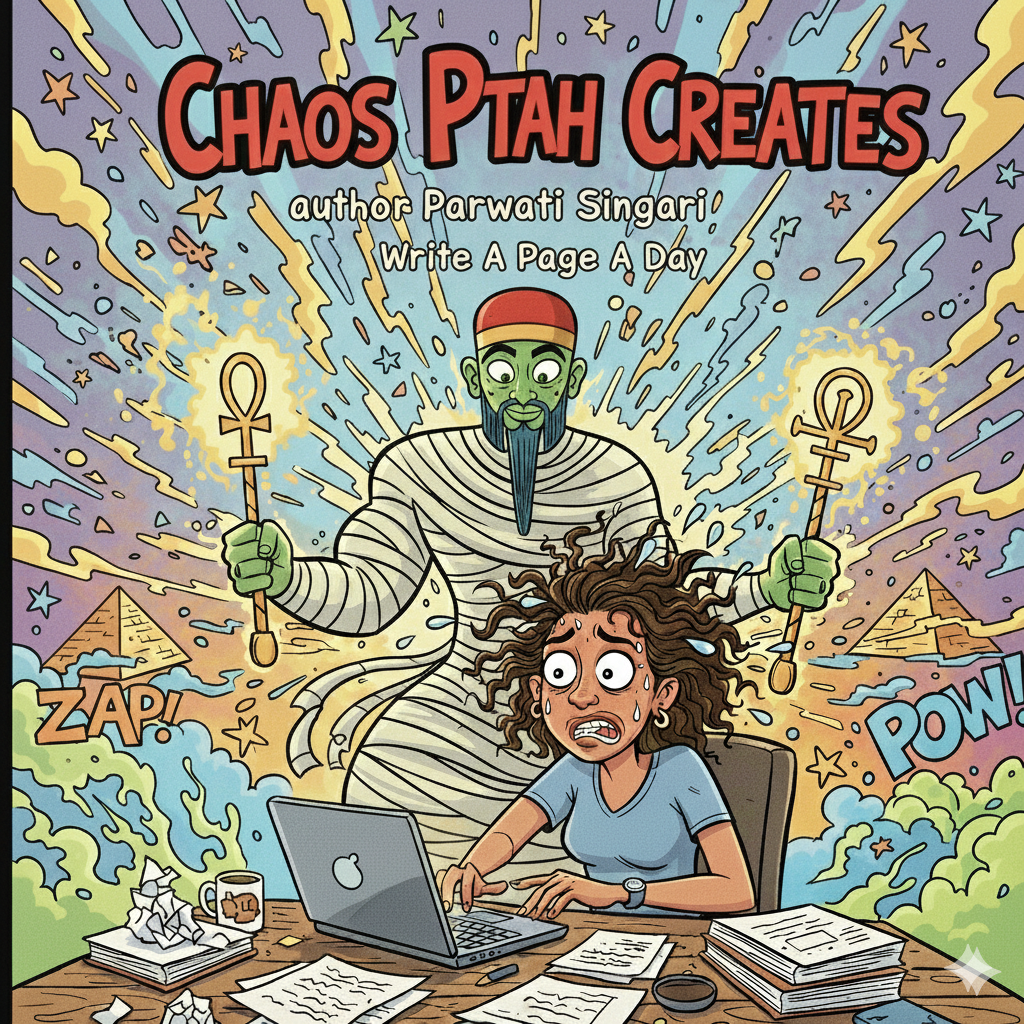
Unfinished Gods
Writer’s block was on.
Not metaphorically. Institutionally.
Write a page a day was on too, which felt like a disciplinary measure. The novel had begun—an administrative error. Yesterday’s page had been written only to prove it could be deleted.
Akshara considered saying Ptah. Egyptian gods were literal; they arrived without irony. He hesitated. Could Ptah become female? And if so, what would he be called?
The question collapsed. Fine. Ptah.
“Bro,” Ptah said, already present, “when your thought does not exist—”
“Don’t.”
“—your conversation does not exist. When your conversation does not exist—”
“Stop.”
“—you don’t.”
“Ptah, are you saying I don’t exist?”
Ptah had lost the headdress. He now resembled a senior who once said you have potential and meant you have time to fail. Greying. Relaxed. Immortal in the way bullies are.
He vanished mid-smile.
Absence was worse. You couldn’t cross-examine it.
Akshara understood Snow White’s stepmother. Being told you are not the best is humiliating. Being told you are not—that’s theological vandalism.
“Mirrors don’t reflect,” Ptah’s voice returned. “They only mirror.”
Since Ptah, the world had lost its balance. Still, he was preferable to Saraswati—Sharada—the one Akshara had grown up with. Finished. Sanitised. Laminated.
She was not contemporary.
She was incapable of being so.
White sari. White lotus. Veena at a pre-approved angle. Book eternally open to nothing. Calendar art. The visual syllabus. Ravi Varma’s final solution.
ರವಿವರ್ಮನ ಕುಂಚದ ಕಲೆಯ ಬಲೆ ಸಾಕಾರವೋ
ಕವಿ ಕಲ್ಪನೆ ಕಾಣದ ಜಾಲವೋ
Was this the net of Ravi Varma’s brush made flesh—
or imagination caught and framed?
Akshara had memorised the line without ever risking the question.
“First things first,” a voice said, exhausted, “let me get out of this fancy dress.”
Sharada appeared—exactly as expected, and deeply offended by it.
As she reached for the sari, it began to dissolve.
“Ravi Varma arrested me mid-gesture,” she said calmly. “Everyone else renewed the sentence.”
The lotus evaporated.
The veena flattened into data.
The book hardened into a tablet.
She now stood in an ivory-and-beige business suit. Academic. Administrative. Dangerous.
Akshara opened his mouth.
“Stop gaping,” she snapped. “Have you forgotten? I am Shatarupa. Origin of forms. This isn’t change—it’s inventory.”
Ptah reappeared, amused. “Told you she scales.”
“White,” Sharada said, “is not purity. White is bandwidth. Space before interference.”
A hymn crashed in, badly timed.
Ya kundendu tushara dhavala—
White as jasmine, moon, snow—
or the glow of a screen refusing mercy.
“Namaste Sharade Devi—”
“Yes, yes. Varade. Kashmira-pura-vasini,” she cut him off. “When you refuse to learn, I am dragged into political warfare in the grief of me. Save your devotion.”
She looked at him without warmth.
“That HOD you’re flattering with citations?” she said. “That’s me. Personified.”
Ptah laughed. “Tenure is eternal.”
Hymns overlapped. Icons argued. Gods spoke over one another. No silence survived.
The page stayed blank—not empty. Overcrowded.
Ptah leaned in.
“So—tell me—”
Sharada finished it.
“Is writer’s block the absence of gods—”
“—or,” Ptah smiled, “too many of us speaking at once?”
The page refused to answer.
For once, it was right.
 Parwatisingari's Weblog
Leave a comment