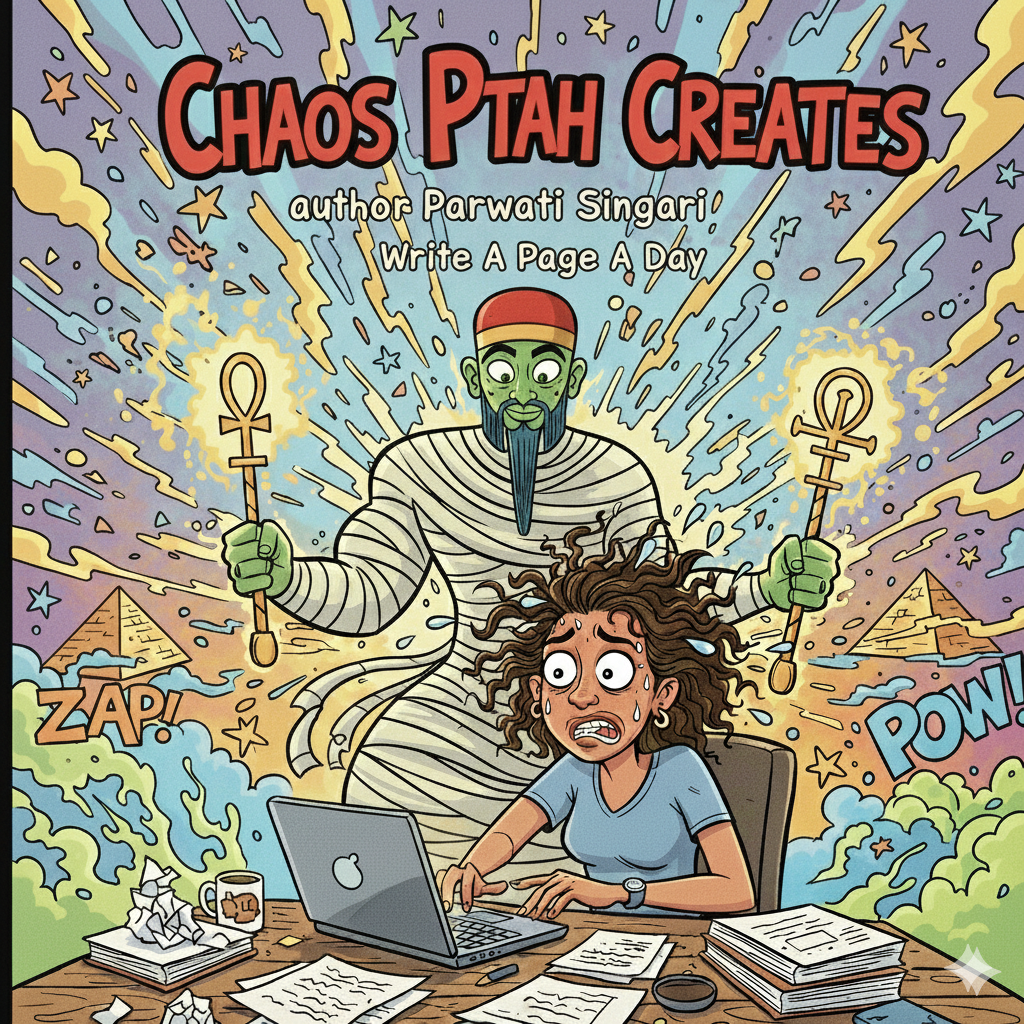
written Feb.13th Published Feb.19
Title: The Tarot Reader Who Outsourced Horror
I had been staring at the blinking cursor long enough to suspect it was mocking me.
“Write a horror story,” I told myself.
“Write a grocery list,” said the block. “Start small.”
Ptah materialized on my desk in his SriJi avatar, looking like a god who had read too many drafts.
“You’re constipated,” he said.
“With creativity,” I snapped.
“With everything,” he corrected. “Expiration is not only for milk. Ideas rot too.”
Point of expiration one: I tried opening with thunder.
The thunder yawned.
Point of expiration two: I described a haunted apartment in Bangalore.
The apartment demanded better ventilation.
Point of expiration three: I introduced Raveena, who had been afraid of staying alone since she was seven and got lost in Lakshadweep market.
That, at least, had texture.
Seven-year-old Raveena. Coconut vendors. Sea wind. The sharp, metallic smell of panic. A small hand slipping out of a mother’s sari. The world enlarging. The market folding into a maze.
“She was not lost,” Ptah said, rearranging my plot cards. “She was initiated.”
“Into what? Retail trauma?”
“Into aloneness.”
Raveena grows up. Moves to Bangalore. Shares an apartment with a friend who is in a relationship with two women and eventually chooses one to marry—because nothing says stability like triangulated indecision.
The discarded one: Kanika.
Kanika copes beautifully. Until she doesn’t.
Raveena finds her one evening—lacerations, bleeding, clinging like ivy. Kanika says she has no idea how she harmed herself.
“That’s convenient,” I mutter.
“It’s dissociation,” Ptah says. “Don’t be pedestrian.”
They clean the apartment. In the cupboards they find things that look suspiciously like black magic paraphernalia—lemons pierced with nails, ash, cryptic diagrams that look like they were downloaded from a poorly designed occult blog.
Kanika announces she’s going back to Lakshadweep.
No ticket is booked.
The murk thickens between Kanika, the jilted lover, and his current fiancée. Raveena, who already fears being alone, now fears being alone with someone who might not be alone in her own head.
“This is good,” Ptah says. “Now introduce the tarot.”
“You’re the tarot reader,” I remind him.
He grins. “Of course.”
So here we are: a dimly lit room. Candles. I, Akshara, the writer pretending to consult a tarot reader who is actually Ptah pretending to be human.
The cards fall.
The Tower.
The Moon.
The Three of Cups—awkwardly.
Ptah taps the Moon. “Raveena’s fear of being alone did not start in Lakshadweep. That was only the rehearsal.”
And then he pivots the story.
Long ago, Raveena—three years old—watched her maternal grandfather vomit blood. Pundits chanted. They said he was possessed. Ritual smoke. Adult whispers thick with superstition. After a while, the grandfather died.
“She hypnotized herself,” Ptah says lightly. “Children are excellent hypnotists. She chose possession over mortality. It’s tidier.”
“And Kanika?” I ask.
“A replay. Trauma recognizes trauma and says, ‘Ah. A stage.’”
I try to make it horrifying. I describe Kanika’s blank eyes. The way she insists she doesn’t remember harming herself. The way Raveena feels the walls narrowing.
But the horror keeps slipping.
Because every time I sharpen the knife, Ptah replaces it with a mirror.
“What if Kanika isn’t cursed?” he suggests. “What if she is merely performing a script written by a three-year-old who preferred demons to death?”
“That’s not horror,” I protest.
“It is,” he says. “But bureaucratic.”
Point of expiration four: I attempt an exorcism scene.
Ptah turns it into group therapy.
Point of expiration five: I attempt a murder.
Ptah asks who would file the paperwork.
We argue about the ending.
“She must confront the possession narrative,” he insists. “Realize the pundits were managing their own fear.”
“And Kanika?”
“Needs a psychiatrist, not incense.”
“That’s not dramatic.”
Ptah shrugs. “The real horror is how eagerly humans outsource accountability—to spirits, to lovers, to fate.”
I sigh. The blinking cursor has stopped mocking me. It is listening now.
“So how do we close this?” I ask.
Ptah gathers the tarot cards and looks directly at me.
“You, Akshara, are afraid of the same thing as Raveena.”
“Being alone?”
“Being alone with reality. You keep trying to summon possession when what you need is ownership.”
The candles flicker out.
No ghost. No demon. No ritual gone wrong.
Just a writer, a god of creation, and the quiet understanding that sometimes the scariest thing in the room is the story we told ourselves to avoid the truth.
Ptah smiles.
“Now,” he says, “stop blaming the block. You hypnotized yourself into believing it exists.”
 Parwatisingari's Weblog
Leave a comment