The cobra files a complaint.
Akshara announces his comeback from writer’s block the way emperors announce wars: prematurely and without strategy.
“I’m writing again,” he tells the ceiling.
The ceiling does not applaud.
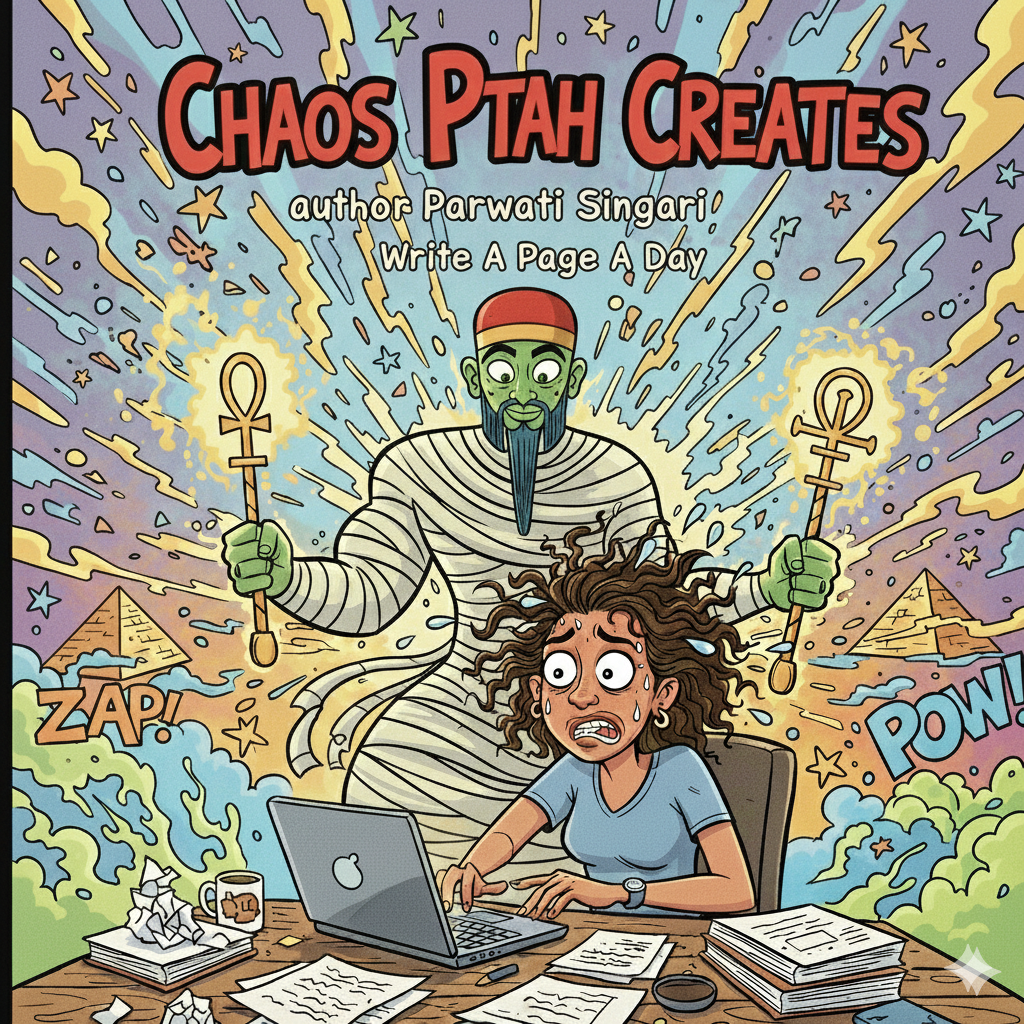
Ptah materializes anyway. Not in thunder. Not in flame. Just leaning against the bookshelf like a disappointed editor.
“Excellent,” Ptah says. “Now write something that doesn’t sound like a therapy invoice.”
Akshara glares. “It’s a dream narrative. It’s layered.”
“It’s laminated,” Ptah corrects. “Peel it.”
So Akshara begins again.
There is a girl. No—there is a baby. Crawling. Endless room. Black and white tiles like God couldn’t decide between optimism and dread. Walls white. No sky. Budget cuts in heaven.
“She’s been dreaming this since fourth standard,” Akshara says, pacing. “The week she heard her father had died.”
“Good,” Ptah says. “Dead fathers are narratively efficient.”
Akshara winces. “That’s dark.”
“You invited me.”
Fine. The parents separated when she was two and a half. Old enough to form attachment. Young enough to have it ripped out without subtitles. Originally from Maharashtra. Later relocated to Goa after her mother remarried. Geography changes. Nervous systems don’t.
“She stops dreaming when she’s in love,” Akshara adds.
“Of course,” Ptah says. “Infatuation is a temporary exorcism.”
Back to the room.
The baby crawls. Then the cobra arrives.
Not a symbolic ribbon. Not a metaphor with background music. A cobra. Efficient. Focused. It glides toward her face like a tax notice from the afterlife.
“She can’t move,” Akshara narrates, getting into it now. “Legs numb. Upper body frozen. Eyes open but locked. Then—bam—she’s at the other end of the room.”
“Teleportation,” Ptah nods. “Trauma’s favorite trick. Relocate the body. Keep the fear.”
“The snake follows,” Akshara says. “Again and again.”
“Of course it does. Grief hates being ghosted.”
Akshara scribbles faster. He likes this version. It bites.
“She wakes up anxious,” he continues. “Anything that moves—slow curtains, fast shadows—triggers her. Since last year she feels the snake crawling up her legs even while awake. Legs shiver. Upper body numb. Limbs vibrating like she swallowed a low-voltage demon.”
Ptah claps once. “Now we’re writing.”
“She told her mother,” Akshara says.
“And?”
“Her mother says she gets snake dreams too. In her version, the snake bites.”
Ptah grins. “Ah. Intergenerational venom. A family heirloom.”
Akshara laughs despite himself. The block is cracking.
“She does a symbolic reading,” he continues. “TASSO. Tarot. Whatever. The snake turns out to be her father.”
“Turns out?” Ptah says. “He was never hiding.”
“The adult her doesn’t recognize him,” Akshara insists. “But the two-and-a-half-year-old does.”
“Children always recognize abandonment,” Ptah says softly. “Adults call it ‘closure’ and misplace it.”
Akshara pauses. The room in his head sharpens.
“There’s another dream,” he says. “An old woman offers her a lift. Suddenly they’re on a mountain. Naked young men everywhere. Cops arrive—not in uniform. Authority without branding. The old woman speeds off. Nancy gets thrown.”
Ptah tilts his head. “Classic. Seduction by chaos. Followed by gravity.”
“So what’s the core issue?” Akshara challenges.
Ptah ticks them off on spectral fingers. “Unprocessed grief. Fear of abandonment. A father wound wearing reptile skin.”
“Therapeutic flow?” Akshara asks mockingly.
“Grounding exercises,” Ptah says. “Inner child work. Cord cutting with grief. Safety nets. Detailed history—family, school, sleep, appetite, bowels, menstruation, addictions, spiritual beliefs. Ask if she prays. Ask if she believes in past lives. Humans love outsourcing accountability to reincarnation.”
Akshara stops pacing.
“You’re enjoying this,” he accuses.
“I enjoy precision,” Ptah replies. “The cobra isn’t attacking. It’s approaching. It wants to be acknowledged. The paralysis isn’t punishment. It’s unfinished mourning.”
Akshara stares at his notebook.
“So the story isn’t about a snake,” he says slowly. “It’s about a father who never got to say goodbye. And a child who never got to scream.”
Ptah smiles. “Now make it funny.”
“How?”
“Have the cobra behave like a civil servant. Relentless. Underpaid. Just doing its job: ‘Excuse me, ma’am, I represent unresolved grief. May I have a moment of your time?’”
Akshara bursts out laughing.
The ceiling, this time, almost approves.
He writes the final line with a grin sharp enough to cut tile:
The snake is not there to bite her. It’s there to collect emotional arrears—with interest.
 Parwatisingari's Weblog
Leave a comment