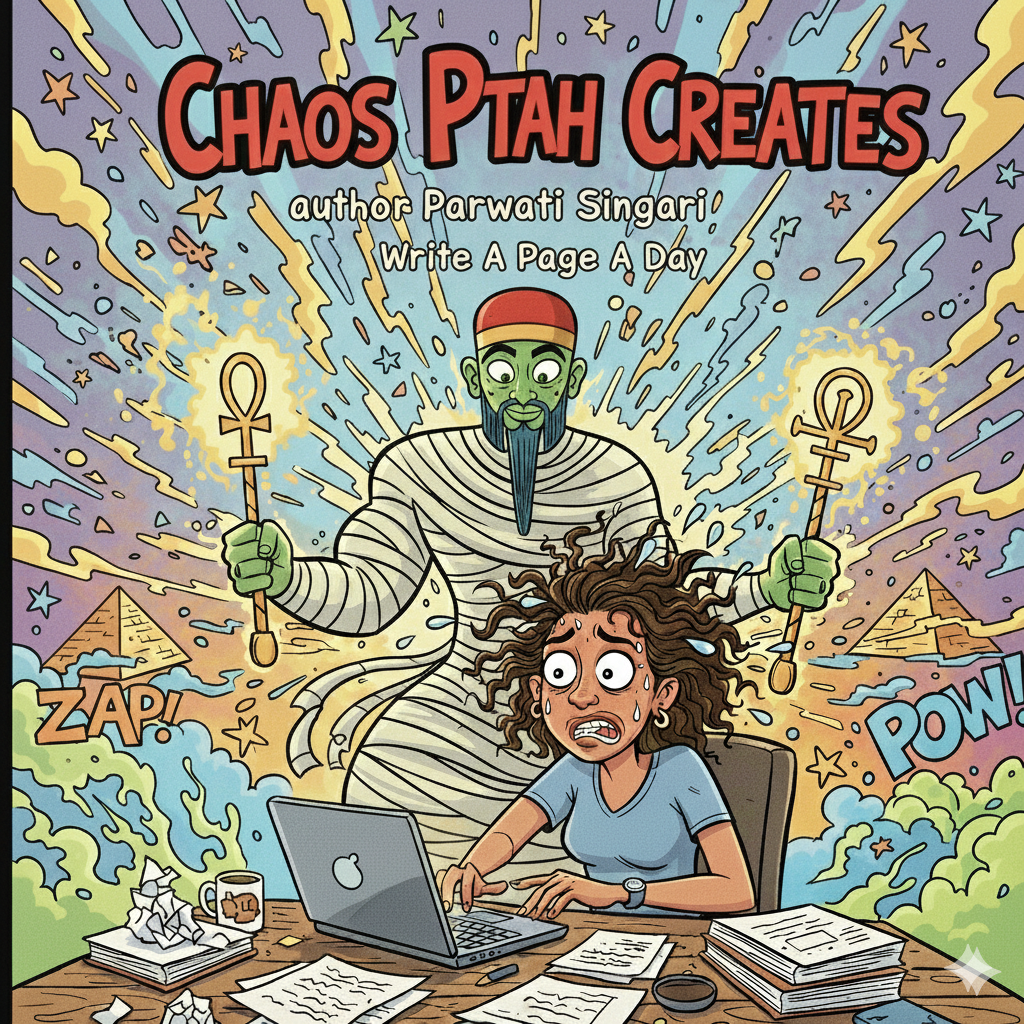
(Akshara insists it’s crisp. Ptah mutters, “Add irony.” Akshara adds asphalt.)
Debate Piece — Highways to Heaven, Potholes on Earth: A Loud Argument with a God
I am trying to write a serious debate. Ptah, ancient deity of creation, stands behind me like an irritated editor with divine credentials.
“Make it sharp,” he says.
“I am sharp,” I reply. “I’m practically a bureaucratic file.”
The motion: Highways to Heaven, Potholes on Earth.
Translation? We construct immaculate four-lane expressways to guide pilgrims toward spiritual liberation, while children hop over literal potholes on their way to schools that may or may not have functioning toilets.
Ptah clears his celestial throat. “Do not merely describe. Accuse.”
Fine.
We adore spectacle. We bathe it, light it, drone-shot it. Take the magnificent frenzy of Kumbh Mela. A marvel of faith and logistics. The state unfurls highways like red carpets for the divine. Billboards bloom. Helicopters hum. News anchors beam as though salvation has been budgeted.
Meanwhile, a farmer squints at a sky that refuses to cooperate. A village waits for water. A government school waits for chalk.
“Balance,” Ptah whispers.
Yes, yes. Faith is not the villain. Nor is infrastructure. But priorities have become theatrical. We invest in optics before oxygen. In ribbon-cutting before root systems. If climate change had a PR team, perhaps we would have planted trees by now.
The media, bless its dramatic soul, prefers fireworks. It dissects scandal, inflates outrage, and packages complexity into prime-time gladiator matches. Nuance dies quietly in the green room. Instead of interrogating unemployment or agricultural distress, we debate who offended whom and how loudly.
“Now bring in ideology,” Ptah commands.
Ah yes—socialism and secularity. Once the earnest twins of the republic, now reduced to nostalgic hashtags. Welfare has become a footnote. Neutral coexistence is treated like an optional subscription. In the vacuum, identity politics performs acrobatics while consumerism sells popcorn.
But here is where Ptah pokes me with a metaphysical pen: “Collective responsibility.”
I sigh. This is the inconvenient paragraph.
We blame governments, media, systems. Yet we queue eagerly for spectacle. We forward the sensational headline. We applaud the grand event. And at Gera School, parents lovingly carry the backpacks of perfectly capable ninth graders.
“Metaphor,” Ptah says.
Yes. We are raising citizens allergic to weight—literal and moral. If we remove every burden from a child’s shoulders, why are we surprised when accountability feels like oppression later?
Spectacle over sustainability. Comfort over competence. Hype over homework.
The dark joke is this: we are paving highways to heaven while tripping over civic responsibility on earth. We pray for prosperity but outsource participation. We demand justice but resist inconvenience.
Ptah folds his divine arms. “So who is responsible?”
I look at my reflection in the laptop screen.
Perhaps the destructive leader is not an anomaly but an echo. As Conversations with God suggests, leadership mirrors collective consciousness. If our consciousness prefers fireworks to foundations, we should not be shocked when governance does the same.
So here we are.
Highways to Heaven, Potholes on Earth.
The debate is not about faith versus policy. It is about whether we can admire a spectacle without neglecting a syllabus. Whether we can build a highway and still remember the well. Whether we can carry belief without dropping responsibility.
Ptah smiles faintly.
“Creation,” he says, “requires maintenance.”
I close the document.
And consider planting a tree before writing the next sentence.
 Parwatisingari's Weblog
Leave a comment