16th Febraury unblocked.
Akshara insists he is not blocked. He prefers the term “creatively observing a strategic pause.” I, as the reluctant journal keeper of his daily wrestling match with inspiration, call it what it is: a stalemate with adjectives.
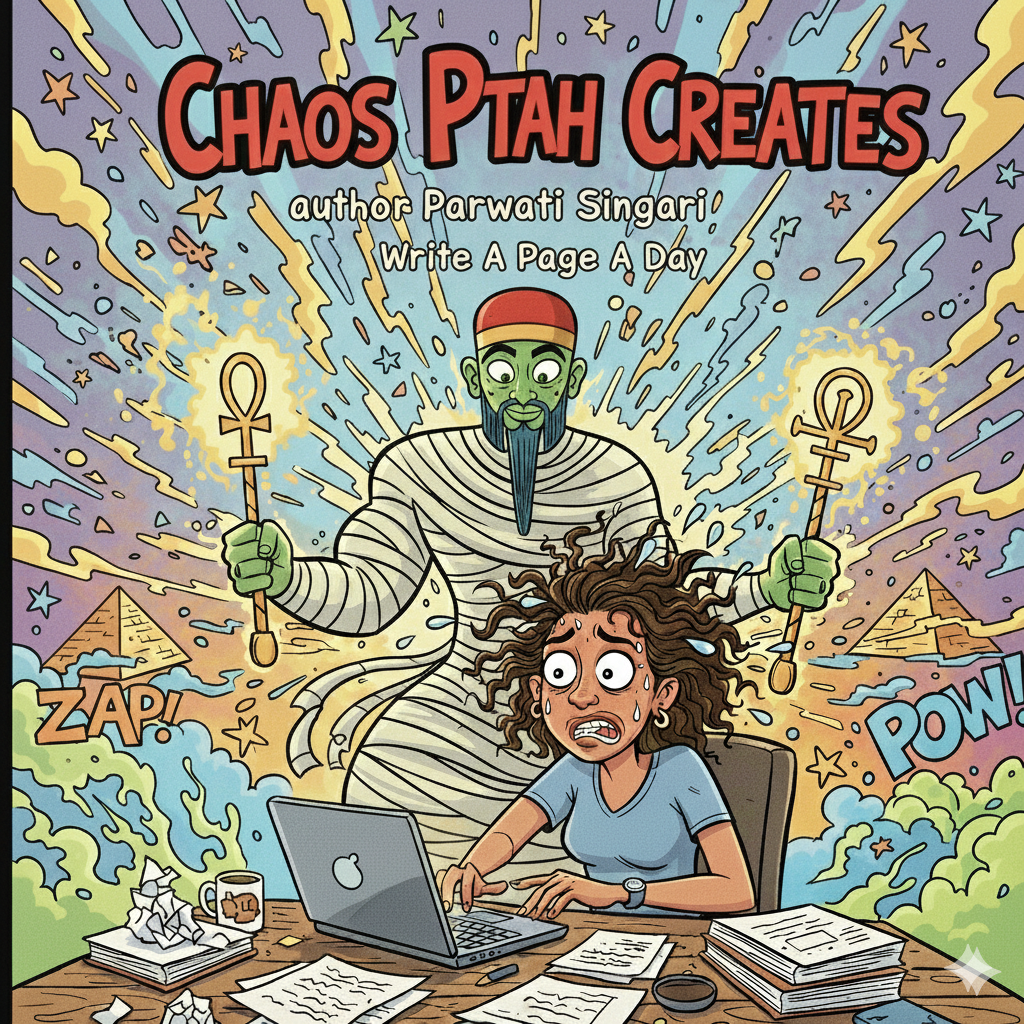
Enter Ptah — patron saint of craftsmen, architects, and apparently writers who have over-romanticized their own despair. Unlike dramatic muses who arrive in thunderstorms, Ptah shows up like a chartered accountant of the cosmos.
“Stop looking for epics,” he tells Akshara. “Look at invoices.”
Akshara is offended. He was hoping for thunderbolts, not tally marks.
So, in a fit of practical obedience, he goes to dinner with his banker friend. The conversation is a sedative: balance sheets, debt instruments, non-performing assets, regulatory capital. Akshara pokes at his food while the banker explains how civilizations are essentially trust systems quantified in columns.
Debit. Credit. Asset. Liability.
“Every entry tells a story,” the banker says. “A loan is hope. Interest is time. Default is tragedy.”
Akshara laughs, but something shifts. He has spent years worshipping poets and warriors in his pages. But here, in the sterile glow of fiscal vocabulary, is drama without ornament. Entire empires rise on surplus and collapse on miscalculation.
On impulse — writers are impulsive when cornered — he drives to Tirupati Balaji Temple. There, amidst chants and crowds, floats the old tale: when Lakshmi walked away from Vishnu, he borrowed from Kubera to sustain the cosmic household. Humanity, legend says, is still repaying that celestial loan.
Divinity, it appears, runs on credit.
We worship Lakshmi with fervor. We draw the Sri Yantra with geometric devotion. Yet we wrinkle our noses at “wealth management,” as if spreadsheets are morally contagious. The contradiction would amuse the gods if they were not already balancing karmic accounts.
Akshara mutters this to himself while circling the temple corridors. If wealth is sacred enough to deify, why is the management of wealth treated as spiritually inferior? Why do we romanticize renunciation but rely on meticulous accounting to fund the very temples where we renounce?
On the drive back, he spirals into civilizational anthropology. We remember the poets because they sang. We remember the warriors because they bled. But who remembers the ledger keepers who ensured grain reached ports, that caravans were insured, that taxes built roads?
Somewhere in his reading, he recalls Revana Siddha Baraha — associated with early mercantile records, port documentation, and what scholars consider precursors to Kannada lipi. Trade left marks before poetry did. Accounts were etched not for aesthetics but for survival. Those inscriptions recorded shipments, duties, exchanges — proto-stories of movement and ambition.
Documents, unlike epics, rarely exaggerate. They capture practical life: who owed whom, what sailed where, which guild prospered. Over centuries, poets absorbed these dry bones of fact and clothed them in metaphor. The ledger became lore.
Ptah, invisible in the passenger seat, nods approvingly.
“Creation,” he reminds Akshara, “is craft. Craft is repetition. Repetition is discipline. Discipline is accounting.”
Akshara resists the temptation to argue theology with a deity who invented masonry.
His thoughts drift to Chitragupta, the meticulous keeper of karmic ledgers. To Bhaga, divine distributor ensuring fairness in allocation. Even the Abrahamic traditions, suspicious of avarice, insist obsessively on honest weights and measures. The moral universe, it seems, is double-entry.
Justice itself is a balance sheet.
Suddenly the metaphor is unavoidable: accountants are the unsung poets of civilization. Their stanzas are columns. Their metaphors are margins. Their tragedies are bankruptcies. Their epics are fiscal years.
Akshara feels the faintest crack in the wall of his writer’s block. Not a thunderous breakthrough. More like a neat journal entry labeled: Inspiration — accrued.
The page before him no longer demands dragons. It asks for detail. For the poetry hidden in procurement logs. For the sacred geometry of profit and loss. For the quiet heroism of those who keep society solvent.
As his journal keeper, I record this modest surplus in the account of creativity. No fireworks. No violins. Just a writer who finally understands that myth and mundane were never separate ledgers.
They were always reconciled.
And somewhere, I suspect, Ptah is auditing the prose.
 Parwatisingari's Weblog
Leave a comment