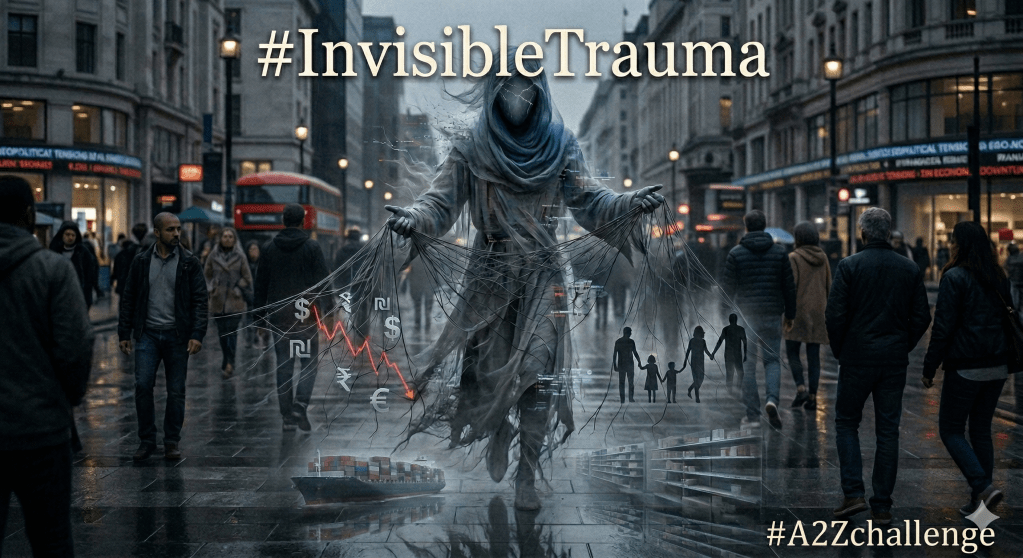
When a conflict erupts—whether it’s the Gulf War, the World Wars, Kargil, or the Russia–Ukraine situation—the damage to education is the obvious kind first. Schools shut down. Exams get postponed. Campuses fall silent, as if someone pulled the plug on an entire generation’s routine.
But that’s just the visible layer.
Something deeper, quieter, and far more permanent begins to shift. And unlike buildings, this damage doesn’t get rebuilt with time or funding.
War introduces uncertainty. And uncertainty is toxic to structured learning.
Education depends on predictability—fixed schedules, clear milestones, a sense of “what comes next.” War removes that certainty. The question changes from “What will I study next year?” to “Will life even look the same next year?”
This shift rewires thinking.
- Students move from long-term goals to short-term survival
- Educators shift from depth to basic delivery
- Continuity becomes more important than quality
The result? Students don’t just miss classes. They miss out on developing a stable way of thinking.
And while we sit at home, glued to screens, consuming war like it’s a live series—updates, visuals, commentary—the reality is that an invisible history is being written in parallel. Not in headlines, but in minds.
We’ve already seen a diluted version of this after COVID. A generation that should be confidently stepping into adulthood instead hesitates—delaying decisions, avoiding risks, unsure if stability is real or temporary.
Now imagine that uncertainty, but with actual conflict.
History quietly confirms this pattern. After World War II, Europe didn’t just rebuild cities—it struggled to rebuild intellectual continuity. Some groups of students never fully recovered academically. Not because they lacked ability, but because the rhythm of learning had been broken.
In the Russia–Ukraine war, millions of students have experienced fragmented education—switching countries, languages, and systems. It’s like trying to finish a book where every few chapters are written in a different language.
These disruptions reshape more than academics:
- Career paths
- Confidence levels
- Risk appetite
A child studying through instability learns a very different lesson from one in a stable classroom. One learns subjects. The other learns that plans are fragile.
And that lesson tends to stick.
Uncertainty also quietly recalibrates what feels “worth pursuing.”
After major conflicts, patterns emerge:
- Creative ambitions shrink (“Maybe that’s too risky.”)
- Stable careers rise (“Let’s just secure something predictable.”)
- Migration becomes an educational goal, not just an economic one
In countries like India, where education is already treated as a form of insurance, this mindset intensifies. Learning stops being about curiosity. It becomes protection. A fallback plan against a world that has proven it can change overnight.
There’s also another process at work—less visible, but critical: unlearning.
To understand this, it helps to look at a concept from medicine: triage.
Triage originated in wartime medical settings, where resources were limited and decisions had to be made quickly. Doctors would categorize patients into three groups:
- Those who would survive without immediate treatment
- Those who could not be saved even with treatment
- Those who could survive if treated right away
The focus was on the middle group—the ones where intervention made the difference. It was not about fairness. It was about survival efficiency.
Harsh. Logical. Necessary.
Education under crisis starts to behave in a similar way.
- Some knowledge becomes irrelevant overnight
- Some skills lose value instantly
- Some learners fall through the system entirely
What survives is what is immediately useful—adaptive, practical, portable.
So the real question isn’t just: “What did students fail to learn?”
It is: “What did they have to unlearn just to function?”
There is, uncomfortably, a small upside to all this.
War forces efficiency.
Like triage, it strips away the non-essential:
- Redundant learning disappears
- Decision-making sharpens
- Systems become outcome-driven
This can lead to:
- Faster adoption of technology
- More skill-focused learning
- Leaner, more practical curricula
But there’s a cost.
Efficiency increases. Depth decreases.
Curiosity becomes optional. Exploration feels indulgent. Learning for the sake of thinking—not immediate utility—starts to seem unnecessary.
And that loss is hard to measure.
We track wars through:
- GDP loss
- Infrastructure damage
- Casualty numbers
But we don’t measure:
- Interrupted thinking cycles
- Lost intellectual momentum
- Generational hesitation
These don’t show up in reports. But they linger.
Every war writes two histories.
One is recorded—territories, treaties, timelines.
The other remains invisible—how people learned differently, how their beliefs shifted, how coping replaced curiosity.
And somewhere in the process of surviving, adapting, and becoming efficient…
We may have quietly triaged away something essential.
Curiosity didn’t disappear dramatically.
It just stopped being a priority.
This post was written for the Blogchatter A2Z Writing Challenge. Learn more here: https://www.blogchatter.com
 Parwatisingari's Weblog
Leave a comment