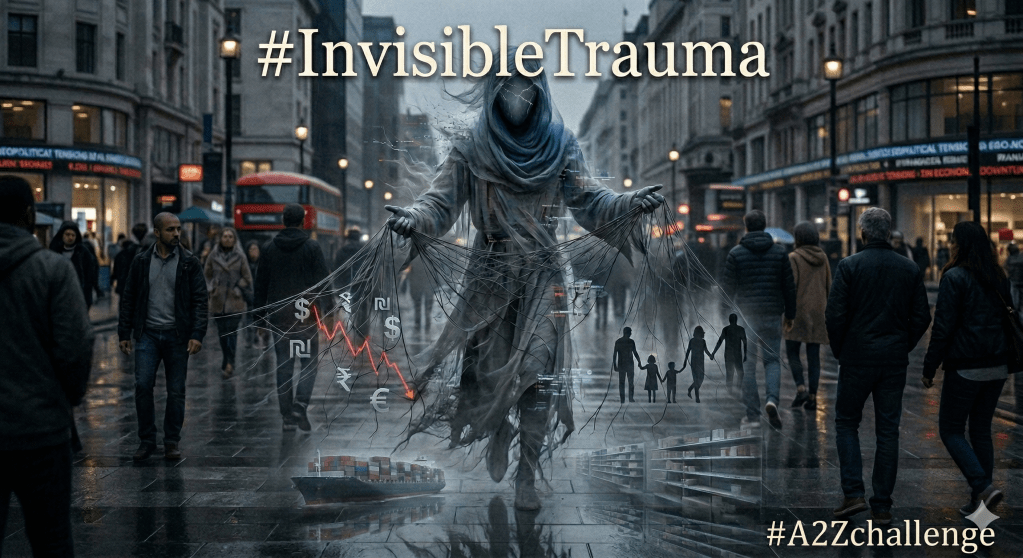
Gender roles, like most prescriptions we pretend are natural, behave less like biology and more like hospital protocols—strictly enforced in crisis, conveniently forgotten in recovery, and rarely audited for long-term side effects. War, of course, is the ultimate mass-casualty event, and if you watch closely—not at the borders, but in living rooms, WhatsApp groups, and biometric databases—you begin to see how Gen Z is being triaged into roles they never consented to.
She was not technically my patient. A referral, really—third generation, if we are being academically honest. The originating event traces back to the Gulf War. Acute phase resolved. Chronic dysfunction ongoing. What sat across from me was Gen Z, but the pathology felt inherited, almost epigenetic in its social expression.
Her complaints were diffuse: restlessness, hyper-vigilance, a persistent sense of being watched. On examination, she described constantly calibrating—her clothing, her routes, her tone, even her ambition—based on perceived safety. Not actual danger, but the anticipation of it. That distinction matters.
Her history revealed a familiar pattern: instability → contraction. Opportunities reframed as risks. Mobility rebranded as recklessness. Education placed on a sliding scale of “practicality.” Each decision reasonable in isolation. Collectively, diagnostic of internalized containment.
At some point, her narrative echoed what Gloria Steinem observed—societies in distress often prescribe exaggerated femininity as a stabilizing mechanism. The softness of Marilyn Monroe becomes a cultural sedative. In contrast, the controlled, almost androgynous composure of Jacqueline Kennedy Onassis belongs to environments stable enough to tolerate ambiguity.
My patient oscillated between these templates. Stability allowed fluidity. Instability demanded performance. It was not identity—it was adaptation.
Historically, this is not new. The World War I pushed women into caregiving roles at scale. The World War II expanded that into industrial labor—factories, logistics, production. Each war redistributed women’s labor while preserving the underlying hierarchy.
What we are witnessing now is a third shift. Not just the home. Not just the factory. The war room. In places like Iran, women exist within a matrix of digital surveillance, ideological enforcement, and psychological warfare. The battlefield is now algorithmic. Participation is no longer optional—it is ambient.
And yet, for every visible expansion, there is an invisible contraction. For every woman entering strategic spaces, many more are pulled back into domestic containment under the language of safety. This is where the real damage lies—the invisible war crimes.
Opportunities do not disappear; they erode. Careers are not denied; they are deferred. Education is not blocked; it is deprioritized. The outcome is the same—only quieter, harder to indict.
For Gen Z, this raises an uncomfortable question: are we progressing, or are we reverting?
The evidence suggests a selective rollback. Under stress, systems simplify. Gender roles become binary, efficient, and rigid. Men are nudged back into provider-protector archetypes, their emotional range narrowed in the name of utility. Women are stretched across contradiction—hyper-visible in some spaces, hyper-contained in others.
From a Psychology lens, the consequences are predictable. Among women: sustained hyper-vigilance, decision fatigue, and identity fragmentation. Among men: emotional suppression and moral injury—the strain of inhabiting roles misaligned with internal values.
If this were a clinical chart, it would read:
Diagnosis: Sociocultural role regression
Etiology: Chronic instability (economic, political, digital)
Course: Fluctuating with episodic regressions
Complication: Identity rigidity
War, it turns out, does not need to enforce old roles explicitly. It simply creates conditions where reverting feels rational.
That is the real pathology. The visible war crimes will be documented. The invisible ones—the shrinking of ambition, the narrowing of identity, the quiet normalization of constraint—will pass as culture.
And like most chronic conditions, by the time we recognize them, they will already feel like baseline.
 Parwatisingari's Weblog
Leave a comment