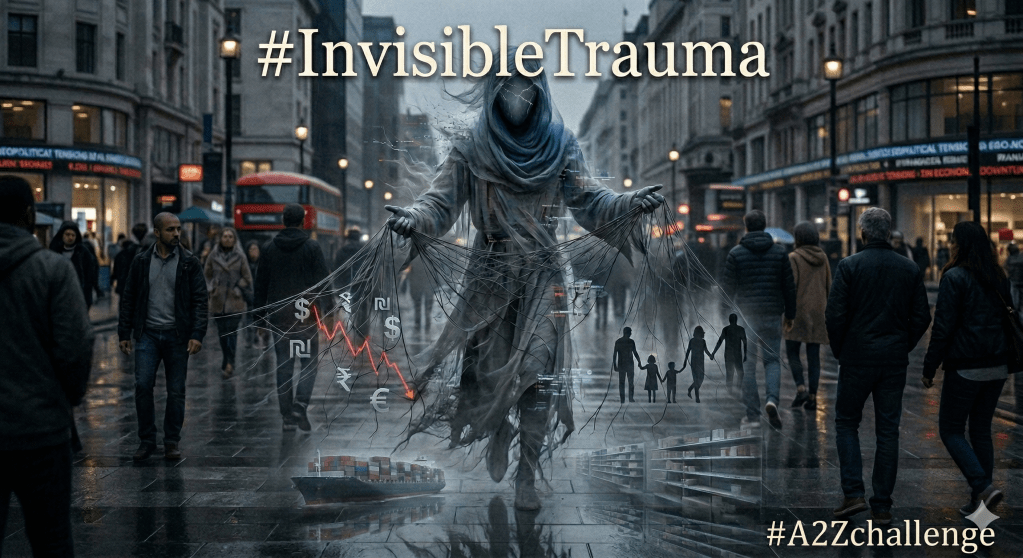
Undercover Disruptions of War.
Displacement Diaries: Notes from a Mind That Refuses to Stay Put
As a mental health professional, I often say this—the body moves first, the mind lags behind. War simply accelerates that gap.
Over the past few weeks, as I’ve followed the unfolding displacement in Iran—now crossing 3.2 million internally displaced people—I’ve found myself revisiting the work of Prof. Durgesh Bailoor. During his time in the war-torn Gulf, he documented refugee narratives that later became The Story of Zenia trilogy.
It was not easy reading.
It was not meant to be.
What stayed with me was not the scale of war—but the quiet absurdity of survival. A mother worrying about her child’s homework while fleeing bombardment. A man negotiating rent for a house he knew he wouldn’t stay in. Dark humour, almost inappropriate—except it wasn’t. It was survival.
And here we are again.
Except this time, the displacement is largely internal. No dramatic border crossings. No long refugee caravans—yet. Just families quietly packing their lives into cars, leaving Tehran for the “safety” of the north.
Because apparently, safety now comes with quotation marks.
In clinical terms, what we are witnessing is not just displacement. It is cognitive dissonance at scale.
Patients—if I may call them that, though they have not walked into clinics yet—are experiencing:
- Hypervigilance masked as preparedness
- Denial disguised as optimism (“we’ll be back in a week”)
- Emotional numbing dressed up as practicality
The human brain is remarkable. It edits reality in real time—just enough to keep functioning.
But it keeps receipts.
What Prof. Bailoor captured so poignantly in Zenia was this:
Displacement is rarely dramatic in the moment. It is administrative.
Forms. Documents. Temporary shelters. Phone calls. Waiting.
And somewhere in between—identity quietly dissolves.
Today’s Iranian displacement echoes that same pattern:
- Urban professionals becoming rural dependents overnight
- Children losing not just schools, but predictability
- Families splitting—not out of choice, but logistics
And then there are those who don’t move at all.
Because displacement, like privilege, is unevenly distributed.
Those with resources leave early.
Those without… develop resilience.
(A word we in healthcare sometimes overuse when we don’t have solutions.)
There is also a layer we don’t speak about enough—the secondary displacement of the already displaced. Afghan refugees within Iran now find themselves navigating a crisis within a crisis.
Imagine already being uprooted… and then watching your temporary refuge destabilize.
It’s like being told: “Please evacuate your evacuation.”
Dark humour aside, this is where the psychological toll deepens:
- Chronic uncertainty replaces acute fear
- Hope becomes conditional
- Belonging becomes negotiable
And perhaps most concerning—this displacement is being framed as temporary.
In my experience, “temporary” in conflict zones has a way of stretching into years… sometimes generations.
Just ask history.
Or better yet, read Zenia.
Because what Prof. Bailoor documented was not just war.
He documented afterlives—how people continue to exist in fragments.
And that is what we are beginning to see again.
Not just people moving across geographies—
But lives being rearranged into something smaller, quieter, and harder to recognize.
War, in its visible form, destroys buildings.
But in its undercover form, it dismantles:
- Routine
- Identity
- Continuity
And if you ask me—as a doctor, and as someone who has listened to far too many stories that begin with “we thought it would pass”—
That is the real displacement.
Not from land.
But from self.
 Parwatisingari's Weblog
Leave a comment