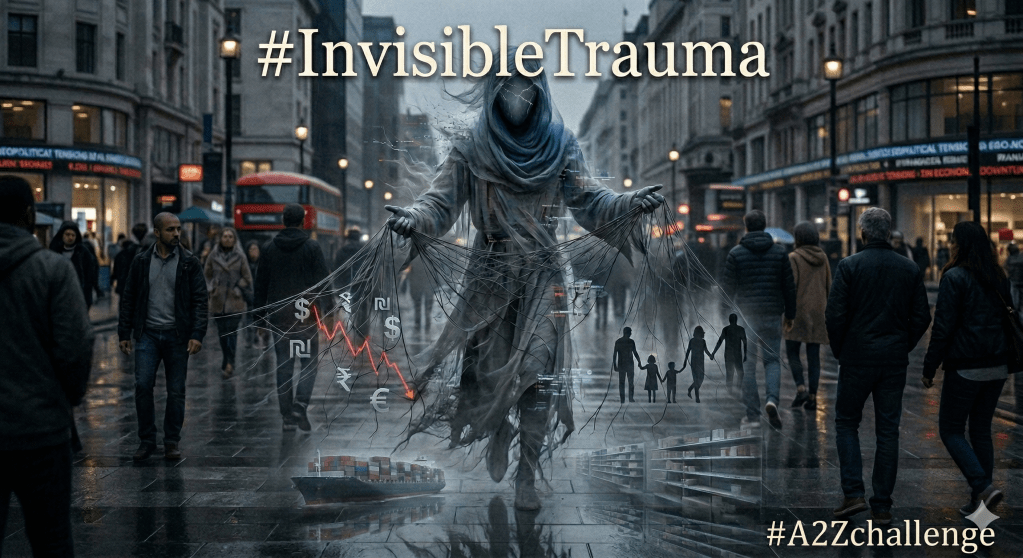
Undercover Disruptions Of War.
There is something oddly civilised about watching war from a sofa. Tea in hand, notifications pinging, the world burning in high definition. As a doctor, I sometimes feel we have reduced conflict to a series of visible injuries—blood loss, fractures, amputations—tidy things we can diagnose, code, and occasionally fix. But war, rather inconveniently, refuses to remain visible.
It lingers. It mutates. It settles into the body quietly, like an uninvited guest who never quite leaves.
In my clinic, I have already seen echoes of this from something far less dramatic—COVID lockdowns. Children who never saw a battlefield presenting with what looked like pseudo-autistic behaviours: social withdrawal, communication delays, sensory overwhelm. Not autism in the classical sense, but something shaped by isolation, fear, and disrupted development. If a virus and a lockdown can do this, what exactly do we imagine missiles and chemical exposure will leave behind?
History, if we care to listen, is not subtle about this.
Take the First World War. Mustard gas did not simply kill; it lingered in lungs for decades. Men who survived trenches went on to develop chronic bronchitis, emphysema, tuberculosis. The heart, too, behaved oddly—what they called “disordered action of the heart,” which sounds poetic until you realise it meant lifelong breathlessness and fatigue. And then there was “shell shock”—a term so quaint it almost disguises its brutality. Anxiety, nightmares, irritability, lives that never quite stitched themselves back together. Many survived the war only to lose years off their lives later. A delayed invoice, if you will.
The Second World War raised the stakes. Radiation entered the chat. Survivors of Hiroshima and Nagasaki didn’t just walk away glowing in cinematic slow motion—they developed leukaemia within years, cancers decades later, cataracts, heart disease. The body kept score long after the headlines moved on. Interestingly—and perhaps grimly reassuring—there wasn’t strong evidence of genetic damage passed to their children. Small mercies, one might say, though it feels like praising a storm for not also stealing your shoes.
Veterans from that era carried quieter burdens too: higher rates of heart disease, lung cancer (helped along generously by free cigarettes), diabetes, chronic pain. War, it turns out, is excellent at accelerating ageing.
Then came the Gulf Wars, which introduced us to something even more elusive—Gulf War Illness. No dramatic lesions, no single smoking gun. Just a constellation of symptoms: fatigue, pain, poor memory, insomnia, rashes, breathlessness. Roughly a third of those deployed were affected. Decades later, many still are. Medicine, for all its confidence, does not like illnesses it cannot neatly explain. Patients, unsurprisingly, like them even less.
And now we arrive at Ukraine—and yes, Iran and other simmering conflicts not far behind—where the pattern is repeating in real time, except we are watching it unfold between scrolling sessions.
The obvious damage is there: trauma, burns, loss. But the invisible ledger is already filling up.
Mental health, for starters. Millions at risk of PTSD, depression, anxiety. Children growing up fluent in the language of sirens and shelters. Veterans who will carry the war home in ways no suitcase can contain. If history is any guide, these are not temporary conditions; they are lifelong companions.
Then there is the quiet collapse of routine healthcare. Hypertension doesn’t pause for war. Cancer does not politely wait for peace treaties. When hospitals are bombed and supply chains disrupted, chronic diseases become far deadlier than any headline-grabbing missile. People don’t just die from war; they die because their insulin ran out, their chemotherapy stopped, their blood pressure was never controlled.
And let us not forget the environment, which absorbs everything we throw at it with depressing efficiency. Depleted uranium, chemical pollutants, damaged industrial sites, threatened nuclear facilities—these are not immediate catastrophes alone; they are slow-burn disasters. Contaminated soil, unsafe water, increased cancer risk years down the line. The sort of problems that do not trend on social media but quietly redefine public health for generations.
From a medical standpoint, war is less an event and more a chronic condition.
From a social standpoint, it is even more unsettling. We are becoming adept at distancing ourselves from it. War as content. Suffering as something we can pause, rewind, or scroll past. The James Bond fantasy of a glamorous figure strolling through radiation is comforting precisely because it is absurd. Reality is far less cinematic and far more bureaucratic—forms, diagnoses, waiting lists, pensions, and lives lived at half-capacity.
Dark humour aside, the truth is this: the most expensive part of war is not paid upfront. It accrues interest.
As a doctor, I will continue to see its aftershocks in clinics—in bodies that don’t quite function as they should, in minds that refuse to rest, in children shaped by environments they never chose. As a social observer, I suspect we will continue to underestimate it, because delayed consequences are notoriously easy to ignore.
Until, of course, they arrive.
This post was written as part of the Blogchatter A2Z Challenge. You can explore more here: https://www.blogchatter.com
 Parwatisingari's Weblog
Leave a comment