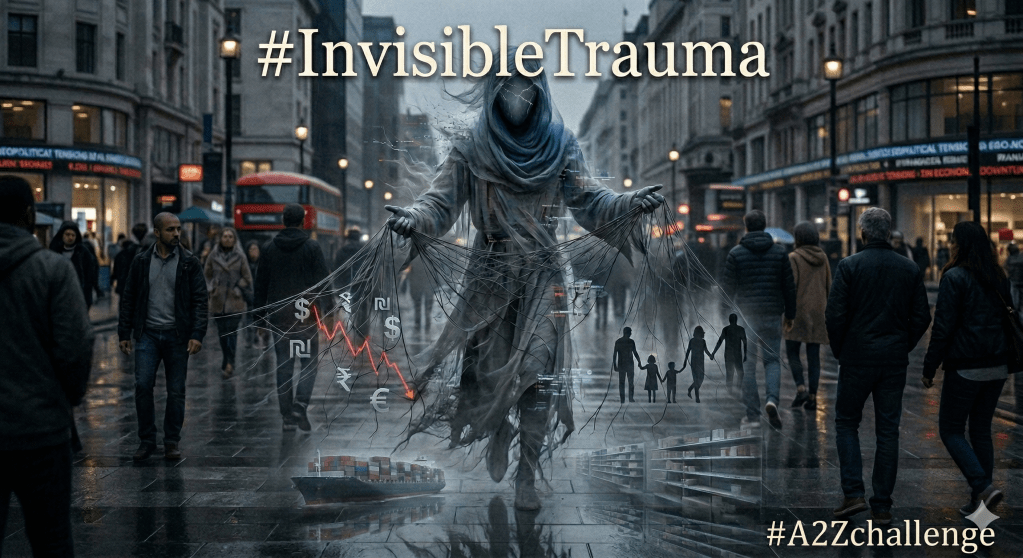
Undercover Disruptions Of War
There is something deeply ironic about watching gold prices fall while everything else in life quietly becomes more expensive. The one thing we were told would be a safe haven is suddenly on discount, while fuel, food, and electricity behave like they’ve discovered ambition.
You sit there, maybe halfway through that video, thinking this should mean stability, confidence, a world that is not quietly unravelling. But then you step out, fill your tank, buy groceries, pay a bill—and realize inflation didn’t get that memo.
Because inflation doesn’t arrive dramatically. It doesn’t march in with tanks or breaking news. It seeps in—through energy spikes, disrupted supply chains, and shipping risks like the Strait of Hormuz—until your everyday life feels just a little tighter.
War, especially the kind simmering in the background, has a way of disguising its consequences. Missiles are visible. Logistics breakdowns are not. Oil tankers reroute, insurance costs rise, transit delays stack up—and quietly, prices increase across everything you touch.
And yet, gold falls.
It almost feels personal.
The logic is neat on paper—interest rates rise, the dollar strengthens, investors shift assets, and gold loses shine against yield-bearing instruments. Sensible. Predictable. Clean.
Meanwhile, your grocery bill inflates and your budget shrinks.
This is where the real story begins—the undercover disruption. Inflation is not just an economic statistic; it is behavioral rewiring. It changes how you think, how you spend, how you plan.
You begin small. You switch brands. Then quantities. Then habits. Suddenly, you are calculating price per unit, reconsidering fuel usage, questioning every “need.” You become a reluctant participant in micro-economics, optimizing survival in real time.
There is a dark humour to it. We spend years trying not to think about money—and then inflation makes it a full-time hobby.
Gold declining, in this moment, feels like a contradiction. The symbol of financial safety weakens, while the cost of living crisis strengthens.
But the truth is, gold is not the story.
The story is what happens quietly beneath the surface.
Deferred decisions begin to pile up. Healthcare is postponed. Repairs are delayed. Vacations disappear. The future becomes negotiable, and the present becomes expensive.
You tell yourself it’s temporary. That markets will stabilize, that wars will end, that supply chains will normalize. And they might. But in the meantime, life unfolds in this uncomfortable middle ground of persistent inflation and uncertain recovery.
That uncertainty leaks into everything—career choices, family planning, risk-taking, even generosity. Everything becomes slightly more cautious, slightly more calculated.
And then comes the quiet shift—the one no CPI report captures—the erosion of trust.
You trust prices less.
You trust savings less.
You trust the idea of stability a little less.
So people adapt.
They build side incomes. They prefer cash transactions. They cut corners. They hoard small essentials. They participate, often unknowingly, in an expanding informal economy.
Not rebellion. Just adjustment.
History tells us this is how it begins—not with collapse, but with adaptation under pressure. Not dramatic enough to panic, but persistent enough to change behaviour.
And so you sit there again, watching gold prices fall, wondering if this is a signal of economic resilience or just another layer of contradiction.
Maybe it’s neither.
Maybe markets operate on logic, while people live through impact—and the gap between the two is where this entire story exists.
Because while economists debate yields, commodities, and policy responses, the real economy continues elsewhere—in kitchens, fuel stations, pharmacies, and school fee lines.
That is where inflation lives.
That is where war arrives quietly, without ever crossing your border.
And that is where you feel it most—subtle, persistent, and quietly relentless.
The true cost of war is often paid not at frontlines, but at checkout counter.
 Parwatisingari's Weblog
Leave a comment