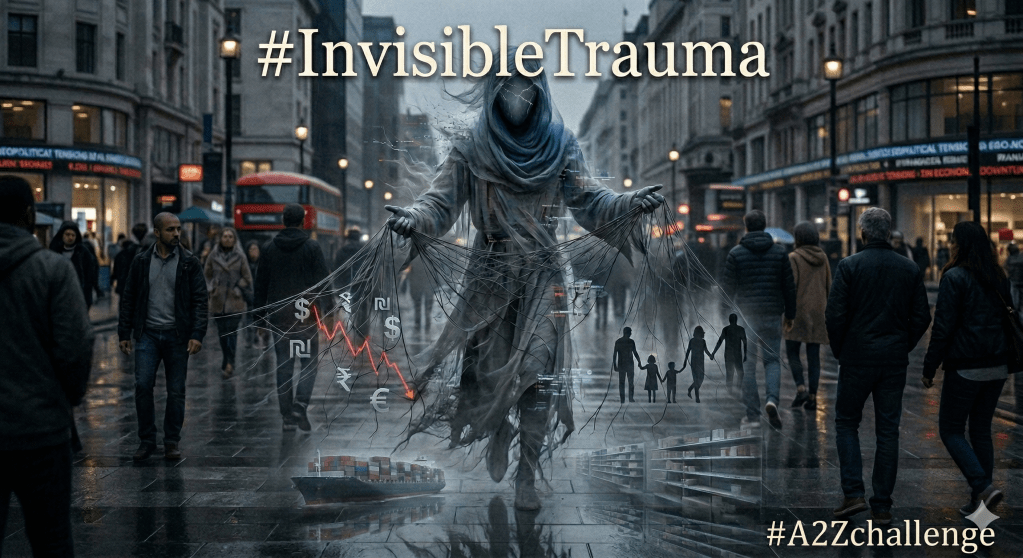
Undercover Disruptions Of War.
If you sit in a clinic long enough, you realise people no longer come in quietly with illness. They arrive armed with information—generous quantities of it, none of it agreeing with the rest, and all of it delivered with the confidence of a specialist. My grandfather, Dr. H. V. Hande, used to insist that in wartime the most reliable symptom is not fever but silence. “Watch what people don’t say,” he would remark, peering over his spectacles as though truth were hiding just beyond the frame. At the time, I thought he was being cryptic. In retrospect, he was being precise.
Take World War I—a conflict that did not just kill men but also edited their sentences. Letters home arrived looking like reluctant confessions: bits missing, emotions trimmed, reality politely rearranged. Governments, under laws like Britain’s Defence of the Realm Act, took it upon themselves to improve human correspondence by removing anything remotely honest. A soldier could lose a limb but was expected to describe the experience as “quite well, dear mother.” Grandfather once recalled a man worried not because his son had stopped writing, but because the letters had become too polite. That, he said, was when one should truly worry. When censorship sharpens its scissors, imagination picks up the knife. Families filled the gaps with dread, and silence did what it always does—worked overtime.
By the time the world matured into the Cold War, communication had stopped pretending to be honest and taken up theatre full-time. Truth did not vanish; it simply learnt better manners. There were the well-meaning broadcasts from Radio Free Europe, slipping inconvenient facts across borders like contraband, and then those delightfully absurd numbers stations, reciting digits with all the emotional range of a tax form—messages meant for people who knew better than to look surprised. Meanwhile, ordinary citizens perfected coded speech. Conversations became linguistic gymnastics: a joke that wasn’t funny, a compliment that wasn’t kind, a silence that said everything. Grandfather called it “polite paranoia,” which is rather like calling a cyclone a light breeze.
In my clinic last week, between advising a gentleman to reduce his salt intake and gently explaining to another that social media is not a substitute for medical training, a young man leaned forward and asked, “Doctor, what do you think is actually going on?” Not about his blood pressure, but about the world. That is when you realise that modern war has not abandoned old habits; it has simply acquired better gadgets. During the 2026 Iran War, communication did not merely slow—it disappeared with efficiency. Internet blackouts reduced entire populations to whispers. Connectivity dropped so low that even confusion struggled to circulate. And when information vacuums appear, speculation rushes in like an overenthusiastic intern—confident, loud, and almost entirely wrong.
In such conditions, rumour networks do what they have always done—expand enthusiastically and verify nothing. Casualties increase with each retelling, victories shrink modestly, and certainty grows in inverse proportion to evidence. Even my patients now arrive with diagnoses that include international relations. “Doctor, this headache—stress, or something geopolitical?” One is tempted to prescribe both paracetamol and a temporary ban on speculation.
Dr. Sonal calls this adaptive communication, which sounds impressive enough to be included in a conference. I prefer a less flattering term: survival theatre. When speech becomes risky, people do not stop talking; they simply become better actors. Sentences shorten, pauses lengthen, eyebrows do most of the heavy lifting. Entire conversations occur without committing a single punishable word. Trust becomes a limited resource, carefully allocated, and society begins to resemble a waiting room where everyone is present but no one is entirely available—or entirely honest.
From a clinical perspective, the symptoms are remarkably consistent. There is chronic anxiety without a clear cause, hypervigilance where people listen more to what is omitted than what is stated, and a certain exhaustion that comes from maintaining what psychologists politely call doublethink—the ability to hold two contradictory ideas and pretend neither is inconvenient. Grandfather saw it in letters that said too little; I see it in patients who read far too much into everything. Progress, it seems, has merely reversed the problem.
The conclusion, unfortunately, is not subtle. Communication in war does not merely transmit facts; it re-engineers behaviour, quietly dismantles trust, and edits reality with alarming efficiency. Censorship produces silence, silence encourages rumours, and rumours fracture societies with admirable speed. Somewhere along the way, truth survives, but only by learning the fine art of disguise.
Grandfather, who disliked both exaggeration and authority in equal measure, summarised it with irritating accuracy. “War,” he said, “is not when people stop talking. It is when they stop saying what they mean.” In my clinic, I am beginning to suspect that this is less an observation and more a standing diagnosis.
This Post is written for Blogchatter #A2Zchallenge.
 Parwatisingari's Weblog
Leave a comment