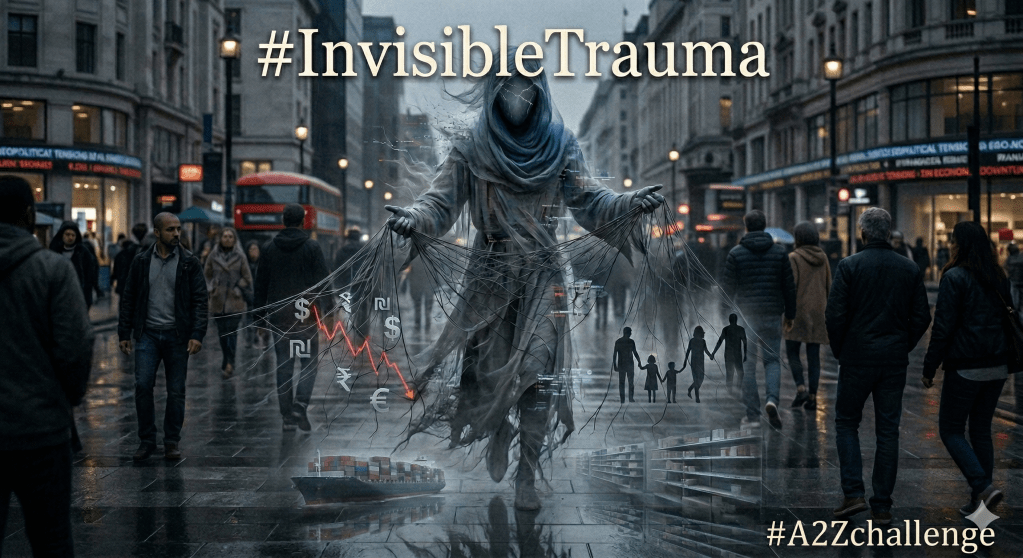
The Undercover Disruptor of war.
As a doctor, I am supposed to examine patients, not society. Society, unfortunately, refuses to stay out of my clinic. It walks in daily—unbathed, irritable, sleep-deprived—and sits across from me pretending it only has “a little acidity.”
These days, the chief complaint is not acidity. It is movement. Or rather, the lack of it.
We have discovered, rather late in our evolution, that human beings do not like being told to stay put. You can advise them, request them, even scare them—but restrict their movement, and they begin to behave like caged philosophers. They think too much, speak too sharply, and laugh at things that are not particularly funny.
The invasion, the blockades, the endless news—these are grand words. On the ground, the crisis is far simpler. Can I go to work? Can I come back without a detour worthy of a pilgrimage? Do I have enough fuel, patience, and emotional stability to stand in a queue that does not move?
My grandfather, H. V. Hande, had a neat way of judging people. He said, “Watch how they behave when they are inconvenienced.” By that measure, we are currently conducting a nationwide personality test, and the results are… mixed.
The daily commute, once a dull and dependable misery, has now become an adventure sport. People leave home not with confidence, but with hope. Routes are discussed like military strategy. Shortcuts are whispered about as if they are state secrets. A working bus is treated with the kind of gratitude usually reserved for divine intervention.
And then there are the fuel stations. Civilisation, I have realised, is a thin layer. Remove a few litres of petrol, and it begins to peel. Perfectly respectable citizens transform into impatient negotiators, amateur economists, and, occasionally, philosophers of doom. Queue etiquette becomes flexible. Tempers become short. Everyone believes the person ahead is getting more than they deserve.
At home, the story is no less entertaining. Families, forced into prolonged proximity, rediscover each other with mixed enthusiasm. Conversations that were earlier postponed due to “lack of time” now happen in excess. Small habits become large irritants. Silence becomes a political statement.
Children, poor things, adapt fastest. Their world shrinks without protest. Fewer outings, fewer distractions, more adults. They become restless, then quiet, then inventive in ways that worry their parents. Adults, on the other hand, become experts in low-grade anxiety. They do not panic. They simmer.
Communication does not help. It fragments. Information arrives late, half-true, or unnecessarily alarming. Rumours travel faster than buses. “I heard…” has become the most reliable source of unreliable news. People plan their day based on speculation and end it with mild disappointment.
Yet, in all this, there is also cooperation—grudging, inconsistent, but present. Neighbours share rides. Colleagues adjust timings. Someone always knows someone who knows a better route. Human beings, when sufficiently inconvenienced, discover community. Not out of virtue, but necessity.
As a doctor, I see the effects in small, persistent symptoms. Irritability. Poor sleep. A sense of fatigue that rest does not cure. Patients say they are “fine,” which is usually my first clue that they are not. There is no dramatic breakdown, only a steady wearing down.
What fascinates me is how quickly this becomes normal. The extraordinary turns routine. People begin to plan less, expect less, move less. Freedom, like good health, is appreciated most after it is compromised. Until then, it is taken for granted, like a well-functioning digestive system.
We compensate, of course. With humour. Dark, efficient humour. We joke about planning a trip to the grocery store as if it were an international expedition. We laugh at our own helplessness. It is either that or admit that we are deeply annoyed by things we cannot control.
In the end, life does not stop. It adjusts. Badly at first, then with increasing skill. The radius of existence shrinks, but within that smaller circle, activity continues. People manage, complain, cooperate, and occasionally behave well.
As for me, I continue to see patients and, unwillingly, society. Both present with similar symptoms. Both insist they are under control. Both are slightly more fragile than they appear.
Treatment, I am afraid, is limited. Fresh air, free movement, and a little less uncertainty would help. None of these are currently in stock.
 Parwatisingari's Weblog
Leave a comment