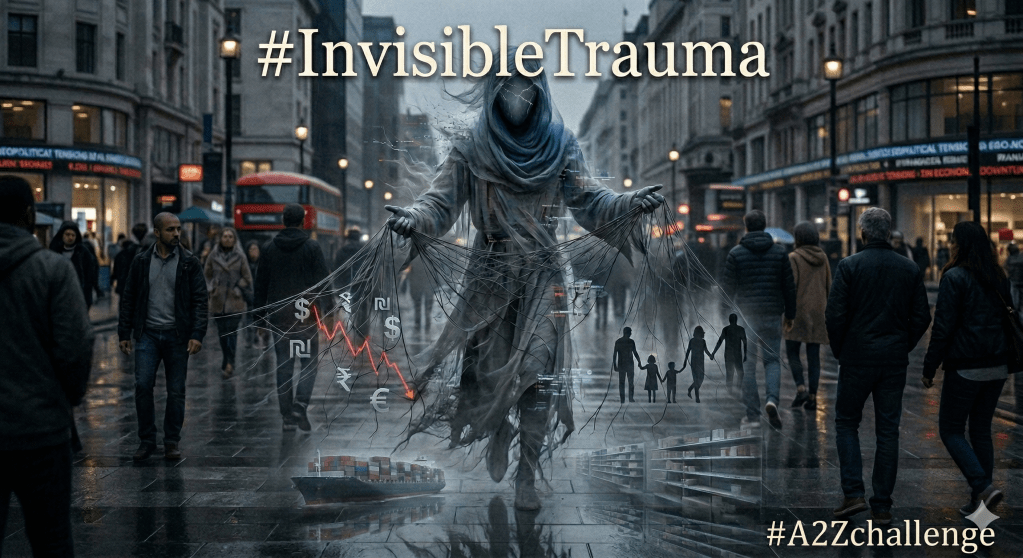
Invisible Disruptions Of War
As a doctor, I am trained to look for patterns—symptoms, triggers, outcomes. Unfortunately, war produces some of the most reliable patterns I’ve ever seen. And right on cue, whenever supply chains falter, the black market walks in—uninvited, efficient, and completely shameless.
I watch it unfold almost clinically.
First, a missing LPG cylinder. Then a delayed refill. Then queues that begin before sunrise and tempers that don’t last till noon. Somewhere between irritation and desperation, the system quietly mutates. And just like that, an informal economy takes over—no paperwork, no ethics, only outcomes.
My grandfather, Dr. H. V. Hande, would have probably chuckled at this point—dryly, of course. “Systems don’t collapse,” he might say, “they simply outsource themselves to more ‘enterprising’ citizens.”
History, as always, has already written this prescription.
In WWII prison camps, men built entire economies using cigarettes as currency. Not metaphorically—literally. Prices fluctuated, inflation existed, and markets behaved with surprising sophistication. The tragedy? A smoker could quite literally burn through his net worth in an evening. Addiction was not just a health problem—it was bad economics.
Fast forward to the Gulf conflicts, and we see fuel assuming the same role. Under sanctions and chaos, oil stopped being a national asset and became a portable currency of survival. It moved through trucks at midnight, boats without paperwork, and checkpoints with flexible morality. Everyone took a cut. Including, one suspects, those officially tasked with preventing it.
Now I see the same script playing out again.
The Strait of Hormuz disruption has done what no policy debate ever could—it has made the humble LPG cylinder a high-value asset. Prices have doubled, tripled, sometimes quadrupled. Suddenly, cooking gas is no longer a utility. It is a negotiation.
I observe behaviour shifting in phases—almost like stages of a disease.
Initially, there is cooperation. Neighbours share. Families improvise. Someone lends a cylinder; someone else stretches a meal. It’s heartening, almost enough to restore one’s faith in humanity.
Almost.
Because scarcity is relentless. It wears down virtue with the patience of a chronic illness.
Soon, hoarding begins. Then price gouging. Then the inevitable phrase: “I know a guy.” At this point, the black market is no longer emerging—it is established, organized, and thriving.
Grandfather would have raised an eyebrow here. “Morality,” he’d say, “is inversely proportional to shortage.”
And he wouldn’t be entirely wrong.
What fascinates—and concerns—me is the psychological toll. This is not just economics; this is everyday stress pathology.
I see anxiety becoming ambient. Not dramatic, not episodic—just constantly present. Patients don’t always say it directly, but it leaks out. Sleep disturbances, irritability, low-grade panic. The uncertainty of something as basic as cooking a meal becomes a persistent cognitive load.
For many households—especially those run by women—this is not inconvenience. It is chronic stress exposure.
Then comes the subtler damage: erosion of trust.
The neighbour who shared last week now refuses. The distributor who once followed rules now has “side channels.” Officials develop selective blindness. The system doesn’t just weaken—it redefines acceptable behaviour.
And the black market? It rewards exactly the wrong traits.
Opportunism over integrity. Speed over fairness. Access over ethics.
The man who secures a cylinder is admired. How he got it is… professionally ignored.
India, with its heavy import dependence, becomes a perfect host for this condition. One disruption at Hormuz, and the effects cascade—from geopolitics to the kitchen stove. It is, frankly, an impressive demonstration of systemic fragility.
The government responds, predictably and necessarily—raids, rationing, subsidies, supply diversification. These are important. They buy time. They reduce fever.
But they do not cure the disease.
Because the black market is not a bug in the system. It is a feature of collapse. It emerges to solve immediate problems while quietly creating long-term ones—inequality, criminalization, normalization of rule-breaking.
Grandfather might have delivered the final line with that characteristic half-smile:
“People don’t break laws in crises,” he’d say. “They renegotiate them.”
And that, I think, is the most unsettling diagnosis of all.
Because long after the war de-escalates, after supply lines normalize and prices stabilize, something less visible lingers—the memory of uncertainty, the habit of workarounds, and the quiet understanding that, when systems fail, survival often comes at the cost of principles.
War, I’ve learned, doesn’t always arrive with explosions.
Sometimes, it arrives as an empty cylinder—and a phone number you were never supposed to have.
This Post Is written as part of Blogchatter A2Z challenge. hosted by blogchatter.
 Parwatisingari's Weblog
Leave a comment