Undercover Disruptors Of War
As a doctor, I am supposed to listen to lungs, not to society wheezing in the background. Unfortunately, both insist on being examined together. A man comes in complaining of insomnia. By the time I reach for my prescription pad, we are discussing not his sleep, but his uneasy feeling that something is not quite right with the world.
Not illness. Not pain. Just… misplaced memory.
My grandfather, Dr. H. V. Hande, had a simpler time. Patients came with fever, left with medicine, and occasionally paid their bills. Nobody arrived carrying half-digested history, WhatsApp theories, cinematic patriotism in their bloodstream.
War, you see, has become a chronic condition. It no longer ends. It simply changes departments.
The old wars—World War I, World War II—were properly managed affairs. After all the killing was done, governments did what any respectable authority would do: they organized the memory. Built monuments. Lit flames. Wrote speeches. Trimmed the inconvenient bits.
The result? A neat package—sacrifice, heroism, victory. Easy to digest. Easier to repeat.
And then there were the voices that shaped how those wars would be remembered. When Winston Churchill stood before a nation and declared they would “fight on the beaches,” he was not merely rallying morale. He was authoring memory in real time. The cadence, the defiance, the clarity of good versus evil—it offered not just courage for the present, but a template for how the war would be recalled. A clean narrative, resilient and exportable.
That template proved remarkably durable. It slipped easily into cinema, into textbooks, into the quiet heroism of black-and-white frames. The war became, over time, not just history but genre. Films, novels, documentaries—each iteration polishing the same arc: peril, sacrifice, triumph. Complexity did not disappear, but it was edited for coherence. Romanticization is perhaps too soft a word; it is more precise to say that memory was curated for emotional utility.
Patients from that generation rarely complain. They carry their memories like old suitcases—heavy, locked, and never opened in public.
Then came Vietnam. A war that refused good manners.
No clean ending. No agreed story. Only arguments. Veterans who spoke too much, governments that had said too little, and a public that trusted neither. Even the memorial refused to cooperate—just names, no glory. People saw their own reflections in it, which is always a dangerous thing.
That is when memory stopped being a ceremony and became a battleground.
And now, we have something even more peculiar unfolding with the invasion of Iran—or whatever polite phrase we are currently using for it.T
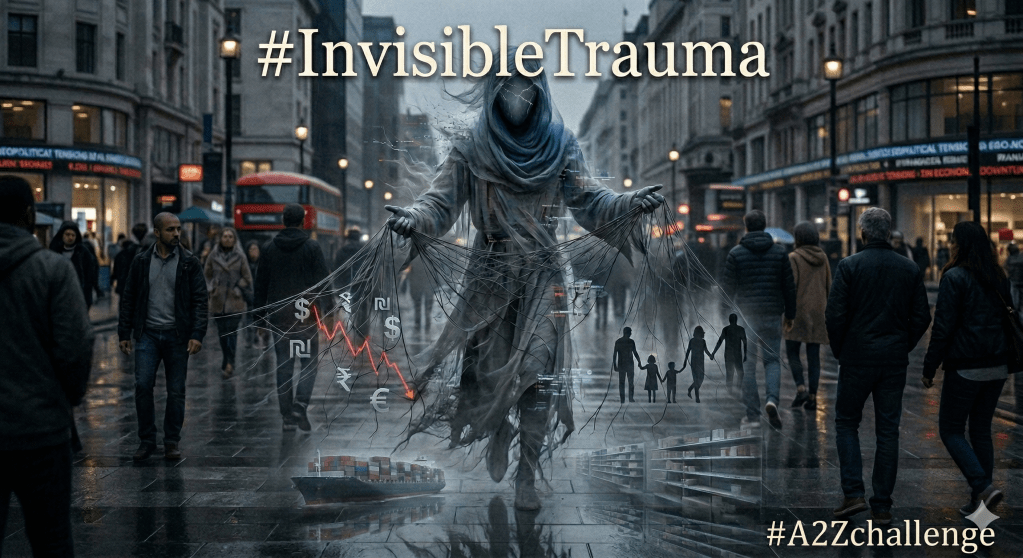
Unlike earlier wars, this one is being fought simultaneously in three places: the battlefield, the network, and the mind.
Inside Iran, there are blackouts. Outside, there is a flood. A curious asymmetry. On one hand, civilians struggle to even communicate; on the other, the world is saturated with images, clips, interpretations, and confident conclusions—many of them engineered. (The Washington Post)
Both sides, it appears, are not merely exchanging fire—they are exchanging narratives. Carefully curated, emotionally calibrated. Some emphasize victimhood, others precision strikes, all designed to shape how the war is remembered before it has even ended. (ICT)
There is also something new—almost artistic in its absurdity. AI-generated images, surreal propaganda, meme-driven warfare. One might laugh, if it were not so effective. Reality is no longer denied; it is diluted. (The Verge)
And beneath all this is something older, almost predictable. Iran, like many civilizations with a long historical memory, does not experience this as an isolated event. It is layered—echoes of past invasions, martyrdom narratives, inherited identity. The present conflict is simply being stitched into an already crowded archive. (USA – Iran Radar)
From a clinical perspective, this is fascinating—and slightly worrying.
Earlier wars told people what to remember. This one overwhelms them with so much that they are left unsure what is real enough to remember at all.
Patients reflect this shift.
They are not divided into camps of belief. They are suspended in a state of cognitive fatigue. Too many versions. Too many angles. Too much certainty from unreliable sources.
“Doctor,” they say, “every version sounds convincing.”
That is new.
If I may borrow again from game theory, this is no longer just a coordination problem. It is closer to a distortion equilibrium—where multiple actors flood the system with narratives until clarity itself collapses. (The Times of India)
The outcome is not persuasion. It is exhaustion.
Clinically, it presents the same way—insomnia, anxiety, low-grade paranoia, emotional numbing. The body, once again, keeps score. Even when the mind has given up trying to.
Children, as always, inherit the residue. Not ideology, not politics—but uncertainty. A world where truth feels negotiable tends to produce adults who are perpetually on guard.
And then we wonder why everyone is tired.
So when a patient leans forward and asks, “Doctor, what is actually going on?”—it is not a philosophical question. It is a very practical one.
What is going on is this:
Memory is no longer a record. It is an active theatre.
Earlier, it was scripted by speeches and polished by cinema.
Now, it is contested in real time, edited by states, amplified by machines, and consumed by minds that were never designed for this volume of ambiguity.
And somewhere between a rousing wartime speech, a well-shot war film, and a perfectly timed viral clip from a distant battlefield, we have learned not just to remember—but to doubt our own remembering.
That, I’m afraid, is harder to treat than insomnia.
Footnote: This post was written for the A2Z Challenge by Blogchatter.
 Parwatisingari's Weblog
Leave a comment