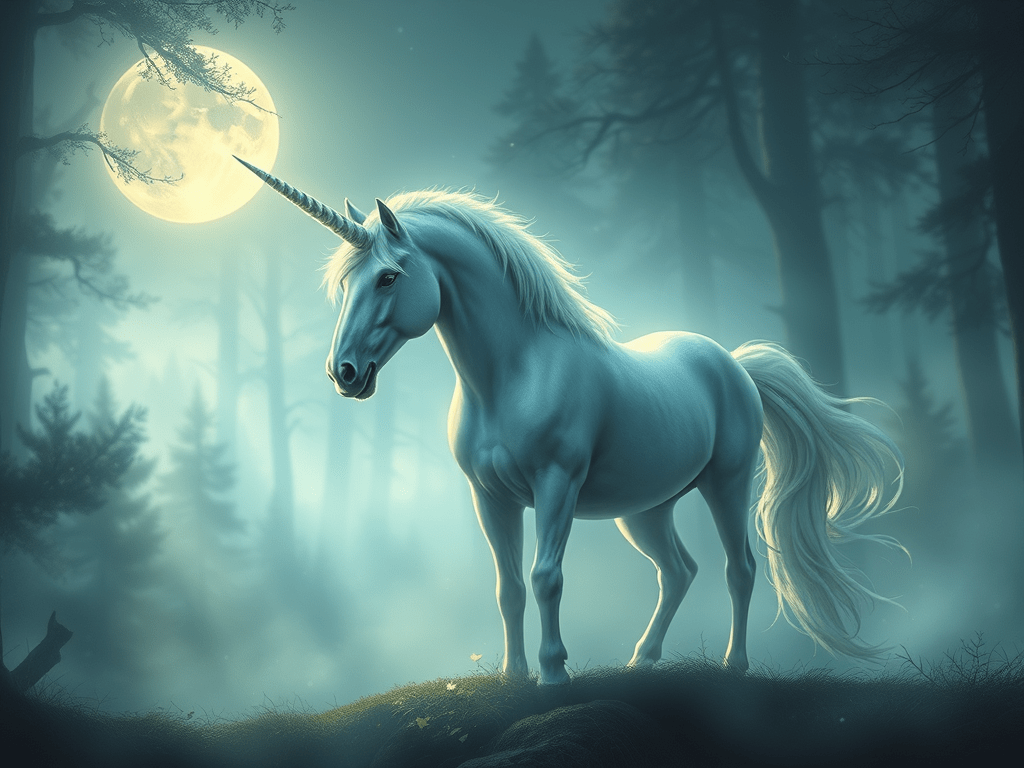
🕊️ Invocation
O Ekashringa, luminous one, guardian of the liminal—
You who walk between breath and belief,
Let your horn pierce the veils of illusion,
So we may remember the rare within ourselves.
Today, on World Unicorn Day, we celebrate not just a creature of myth, but a current of meaning that has galloped beside us through the ages. For the unicorn, or Ekashringa, is more than horn and hide—it is a symbol, a force, a living metaphor.
In the beginning, before cities rose and empires fell, when the world still shimmered with the breath of creation, there came into being a creature both silent and luminous—Ekashringa, the One-Horned. Neither deer nor horse, neither god nor beast, he was born of moonlight and riverfoam, and he galloped between realms: myth and memory, dream and doctrine.
To those first watchers of the world—ancient sculptors in the Indus Valley, mystics of Persia, monks of medieval Europe—Ekashringa was not just a creature. He was a force. The singularity of his horn symbolized focus, intensity, and the power to pierce illusion. He wasn’t merely seen—he was felt. His presence stirred something ancient and aspirational within the human soul: a longing for the rare, the radiant, the untainted.
Over time, he changed shape. Sometimes a chimeric beast, a herald of peace as in Chinese lore; sometimes a fierce protector in Persian deserts; often a gentle emblem of Christ in European iconography. Always rare. Always luminous. A being who could only be approached with reverence—and never possessed.
And then, just as myth yields to metaphor, so too did Ekashringa pass into a new age.
With the rise of capitalism and innovation, the unicorn resurfaced—this time not in a forest or scripture, but in the heartbeat of the global economy. In 2013, when venture capitalist Aileen Lee used the term “unicorn” to describe rare startups valued at over $1 billion, it was no accident. The metaphor was potent. Here again was something elusive, extraordinary, charged with potential.
But what is this value we assign? What is money, if not belief solidified—shared hallucination turned real? In this sense, money itself is energy: fluid, shifting, shaped by intention. And so is Ekashringa. The creature of old myth returns as an energetic symbol—of aspiration, innovation, and the magic of aligned creation.
Today, when financial influencers like Hiranya Karodowallah proclaim, “Awaken your inner unicorn,” they are, perhaps unknowingly, channeling an ancient echo. Their charts and hashtags mask a deeper invocation: to recognize that true wealth, like the unicorn, begins as unseen force. That which is rare, radiant, and real is first born within the imagination—then manifested with clarity, courage, and faith.
Ekashringa has always represented the bridge between worlds. Between visible and invisible. Between animal and divine. Between fantasy and finance.
On this World Unicorn Day, we remember that to invoke the unicorn is not to chase glitter, but to honor energy—to understand that some forces move through time, culture, and consciousness not because they are fanciful, but because they are vital.
Ekashringa still gallops—not only in forests of memory, but across the ether of ambition, through the networks of dreams, riding the currents of human will.
Rare. Radiant. Real.
“The rarest magic is the one you bring to the world by believing in your own light.”
 Parwatisingari's Weblog
Leave a comment