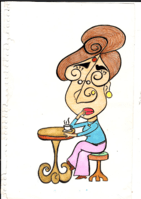
On the Curious Virtues of Disobedience
“Kelu,” they say — listen to me. But what they often mean is: obey. From our earliest years, obedience is presented not just as virtue, but as safety. It protects us, ensures harmony, greases the wheels of family and society. And yet, even as it shelters, it shackles. The obedient child is praised, the questioning one corrected, or worse — silenced.
Indian epics offer a ready syllabus in the pedagogy of obedience. Rama, the obedient son par excellence, walks into 14 years of forest exile without so much as a documented “Why?” (One suspects he had questions, but they were either redacted or footnoted into irrelevance.) Nachiketa, sent to Death by an irate father, does not slam the door or argue — he goes. Dhruva, humiliated and denied affection, doesn’t protest at home; he meditates himself into the cosmos. Obedient boys, all — and all rewarded.
Interestingly, our mythology remembers obedient sons, but seldom obedient daughters. Perhaps because obedient daughters don’t cause narrative tension — they’re expected to disappear into duty. The one time disobedience emerges, it’s cast in moral ambiguity. In Tulsidas’s Ramcharitmanas, the famed Lakshmana Rekha — a boundary invented in the later retellings of the Ramayana — becomes the test of Sita’s obedience. She crosses it, and thus, the tragedy begins. Was this a failure of obedience or an act of agency? Does duty to the domestic override duty to the suffering (the mendicant in need)? Sita’s “transgression” invites more debate than her abduction.
But let us leave the epic canvas for the more intimate realm of family. My grandmother, Singari, refused to shave her head or don widow’s colours after her husband died. In South India, these colours — sindhoori, pitambara, purple — are not simply garments, they are declarations of social standing and surrender. Her own mother insisted she comply. She didn’t. Was she disobedient? Yes. Was she disruptive? Also yes. But she educated her daughters, invited tutors home, and later allowed her daughter to teach in a Christian school — a mild scandal in its time. Disobedience, it turns out, can be hereditary.
So what does obedience tell us about personality?
Psychologically, obedience correlates with traits like agreeableness, conscientiousness, and deference to authority. It keeps systems functioning — classrooms, armies, marriage. But it can also signal compliance at the cost of personal agency. Disobedience, on the other hand, is often associated with openness, risk tolerance, and higher ethical reasoning. It is messy, unpredictable — the stuff of moral imagination.
Collectively, disobedience becomes more than personality; it becomes power. When one person says “no,” she’s a rebel. When a thousand say it, it’s a movement. Gandhi, of course, made disobedience fashionable, even divine. His Salt March was not about sodium chloride but about sovereignty — a refusal to obey an empire’s logic. The British, in their powdered wigs, saw an old man and his followers bending to pick up salt as criminal defiance. History, on the other hand, saw revolution.
But let’s not romanticize too quickly. Disobedience comes at a price. In personal spaces, it fractures relationships. In public, it invites surveillance, imprisonment, erasure. The machinery of obedience is vast and well-funded. The machinery of disobedience, meanwhile, is usually funded by guilt, indignation, and sometimes a Nobel Peace Prize.
Disobedience is not always noble. It can be selfish, even reckless. But obedience, too, is not always wise. It can become inertia dressed as virtue. We tend to admire obedient children, obedient citizens, obedient workers — until we realize they are also the ones who didn’t stop the machinery, didn’t question the rules, didn’t refuse the unjust order.
So perhaps the question is not whether to obey or disobey, but when. And more crucially: who gets to disobey and be forgiven, and who must obey to even survive?
On this Disobedience Day, it’s worth remembering that disobedience has always been a form of listening — not to orders, but to conscience. And sometimes, the most radical act is simply refusing to “kelu.”


 Parwatisingari's Weblog
Leave a comment