I did not set out to observe No Interruptions Day. I noticed it the way one notices an unexpected silence—by assuming something had gone wrong.
No messages. No last-minute clarifications. No one “just checking in.” The digital equivalent of a horror-movie pause, where the audience knows something is about to leap out. I waited. Nothing did.
And in that nothing, something distinctly psychological began to unfold.
I am used to interruptions. I suspect most of us are. They have become so constant that we mistake them for structure. Hypnotherapy would call this a light trance: attention fractured just enough to keep us compliant, alert, and perpetually unfinished. Every interruption is a trance-break, yes—but also a loop-opener. Each one leaves something dangling.
On No Interruptions Day, the dangling becomes visible.
I found myself mentally reaching for things that were no longer there—emails I had already answered, tasks I had postponed with such confidence that I had almost convinced myself they were complete. The mind, deprived of fresh disruptions, began rummaging through its backlog like an anxious intern.
This is when the Zeigarnik effect makes itself known, usually without asking permission.
The Zeigarnik effect, for the uninitiated (and the overly initiated), is the brain’s charming habit of refusing to forget what is unfinished. Completed tasks exit politely. Unfinished ones linger, stare, and occasionally tap you on the shoulder at inopportune moments. They are why half-written thoughts feel heavier than unstarted ones, and why the mind prefers open loops to actual rest.
Without interruptions, I noticed just how many loops I had been carrying—not dramatic failures, not tragic incompletions, but small, persistent almosts. Messages drafted and never sent. Ideas half-abandoned but never formally retired. Emotional conversations postponed until everyone involved achieved immortality.
The absence of interruption didn’t calm me immediately. It did something worse. It made me aware.
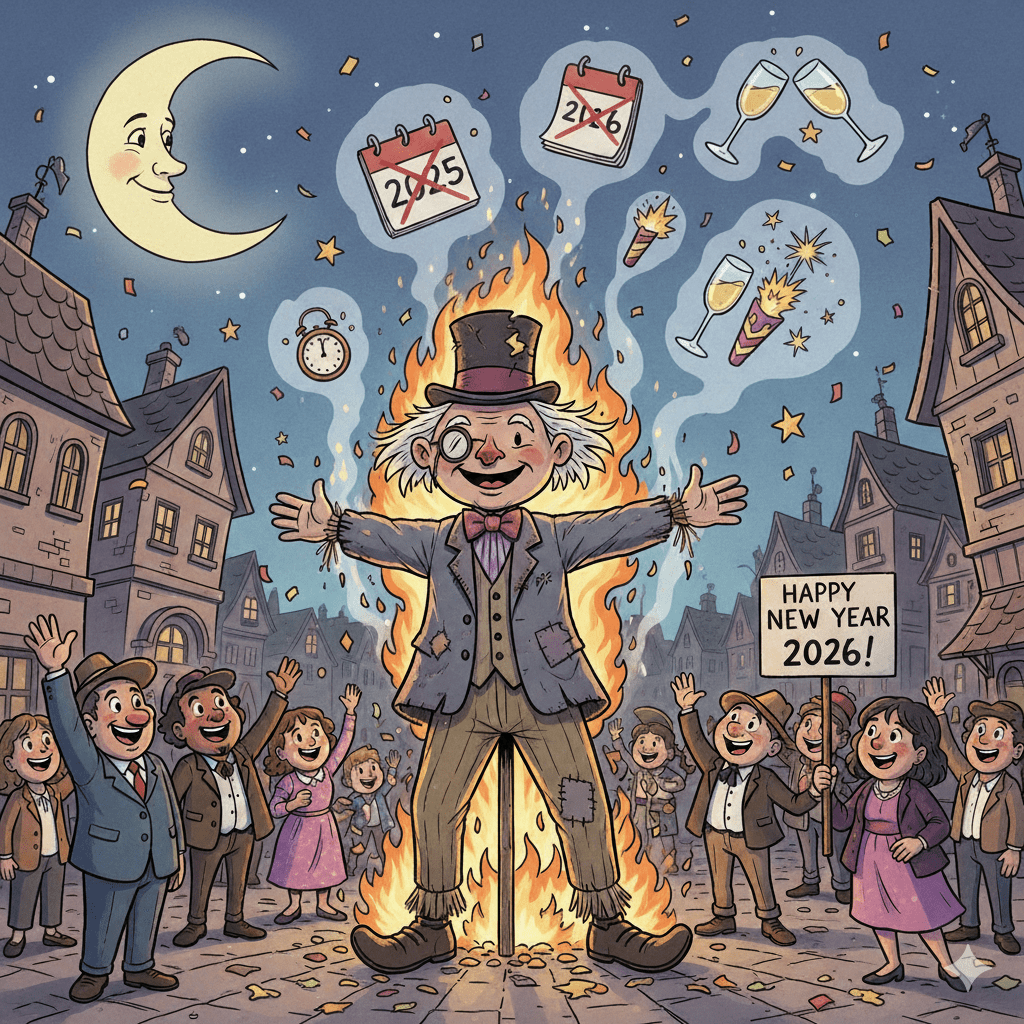
Which, culturally speaking, is precisely why this moment exists. Hogmanay and Ōmisoka are not celebrations so much as audits. They sit at the hinge of the year and insist—quietly, firmly—that something must be accounted for. Not everything resolved. Just acknowledged.
I have written before about this threshold in First Foot and the Great 30th, reflecting on how Hogmanay and Ōmisoka hold space for endings without demanding redemption. That piece still feels relevant, perhaps uncomfortably so:
https://parwatisingari.com/2023/12/31/first-foot-and-the-great-30th/
What struck me this time was how little drama these traditions require. No fireworks necessary. No declarations. Just a pause long enough for the psyche to catch up with the calendar.
The Universal Hour of Peace operates on the same principle, though at a larger scale. It is essentially a global group trance, minus the robes and chanting. At an agreed-upon hour, people stop. They breathe. They do not solve anything. And somehow, that is the point.
Hypnotherapy understands what happens next. When attention synchronizes—even loosely—suggestion amplifies. Peace does not need to be defined; it only needs to be experienced long enough to be remembered. A color. A rhythm. A sensation anchored somewhere in the body, ready to be recalled later when the world resumes its preferred volume.
What surprised me was how this collective pause interacted with my private unfinished business. The Zeigarnik loops, so insistent moments earlier, began to soften. Not close, exactly. More like loosen their grip.
I realized something then, with the kind of clarity that feels mildly irritating: the mind does not demand completion. It demands closure. Those are not the same thing.
Completion is logistical. Closure is psychological.
No Interruptions Day does not help you finish your list. It helps you decide which items no longer deserve residency in your head. Some loops close through action. Others close through recognition. A few close simply because you finally look at them long enough to say, “Not this year.”
There was relief in that. A darkly humorous kind, admittedly—the relief of realizing that much of my mental strain had been self-maintained, like holding a door open for someone who has already gone home.
Before the year turns fully, there is space here for an end-of-year meditation——for those who prefer listening to thinking, and who understand that silence sometimes needs a soundtrack to be tolerable.
[End-of-Year Meditation — https://open.spotify.com/episode/7r1oG5vnamJt7cBj1bI0Bn?si=1JNYWXJYRR-tBDIvJYVH0w
I do not feel finished with the year. That would be suspicious. But I do feel less interrupted by it.
And for now, that feels like enough.
 Parwatisingari's Weblog
Leave a comment