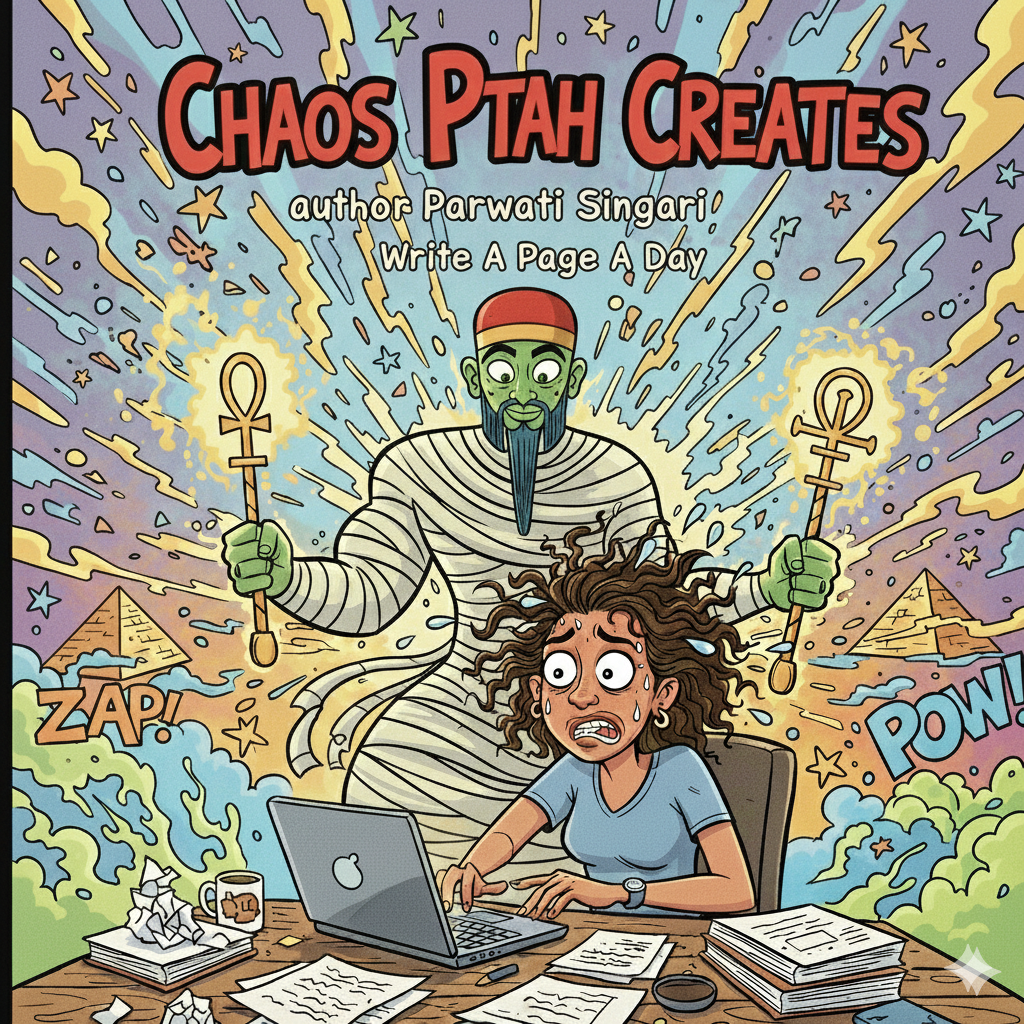
Unblocking Feb. 23rd– Writer changes Name, Accountability Missing!
February 13th arrived with the soft menace of an unopened email. It was meant to be publication day. Instead, it became Procrastination Day—national holiday of the chronically almost-brave.
Akshara stared at the blinking cursor. It blinked back with judgment.
“Ha,” he muttered, “the Good Enough Syndrome.”
From the corner of his desk, where rejected drafts went to fossilize, rose the polite baritone of Ptah. “Do you have a Hindu god of wild risks?” he inquired, as though ordering tea.
Across the Wi-Fi ether shimmered Saraswathi, veena balanced like a weaponized metaphor. “Just as much as you have one of quality control,” she replied.
Akshara coughed. Quality control had, in fact, been outsourced to Fear.
Then the message from his boss surfaced like a bureaucratic shark:
Get a different name!
He blinked. “Now what?” he wondered aloud.
“That,” snapped Saraswathi, “is precisely what this day is dedicated to.”
February 13th. The eve of declarations. Lovers rehearse courage. Brands rehearse rebranding. Writers rehearse excuses.
“You mean—” Akshara began.
“Yes. Use another name. Pseudonym. Neo-nomenclature. Mask, veil, alias, avatar. Take your pick.”
Akshara felt personally audited. A name, after all, is the first draft of identity. It precedes your crimes and your achievements. It signs cheques. It receives rejection slips. It trends or it vanishes.
“Isn’t that… identity theft?” he ventured.
Ptah adjusted the cosmic lighting. “Identity theft is when someone steals your name to commit fraud. A pseudonym is when you steal from yourself to commit art.”
“Semantics,” Akshara said.
“Survival,” Saraswathi corrected.
He imagined the headlines: Writer Changes Name, Accountability Missing. He pictured future biographers arguing over whether Akshara was brave or merely branded. A pseudonym felt like witness protection for the timid.
Yet names carry voltage. They code caste, class, geography, gender. They summon prejudice before the first sentence has stretched its legs. A different name could slip past gatekeepers like a well-dressed imposter at a literary gala.
“Impact,” Ptah mused. “A name is a headline you must survive.”
Akshara opened a blank document and typed alternatives:
A.K. Shadow.
N. February.
Anonymous (Too honest).
Courage Pending.
Each felt like trying on someone else’s spectacles—clearer vision, but the nose protested.
“What if I vanish?” he asked.
“You already are,” Saraswathi replied dryly. “You postponed publication.”
There it was. The real theft was not of identity but of voice. He had robbed himself of the audacity to speak under his own signature. February 13th had become a rehearsal dinner for fear.
Ptah leaned closer. “Creation,” he said, “is an act of authorized impersonation. You impersonate certainty. You impersonate wisdom. Eventually, it sticks.”
“So the name doesn’t matter?”
“Oh, it matters immensely,” Saraswathi said. “But not as much as the sentence.”
Akshara stared again at the blinking cursor. It blinked less judgmentally now, more like a co-conspirator.
He understood. A pseudonym is not a counterfeit passport; it is a laboratory. You test the weight of your words without the ballast of biography. You measure whether readers love the music or merely the musician’s mythology.
The boss wanted a different name. The gods wanted a different spine.
February 13th was not about roses or rebranding. It was about rehearsal—trying on courage the way one tries on syllables.
Akshara typed his original name at the top of the post.
Then, beneath it, in parentheses, he added another.
Not stolen. Not hidden. Just multiplied.
Identity, he realized, is not a single signature. It is a draft history of risks taken—and finally, published.
 Parwatisingari's Weblog
Leave a comment