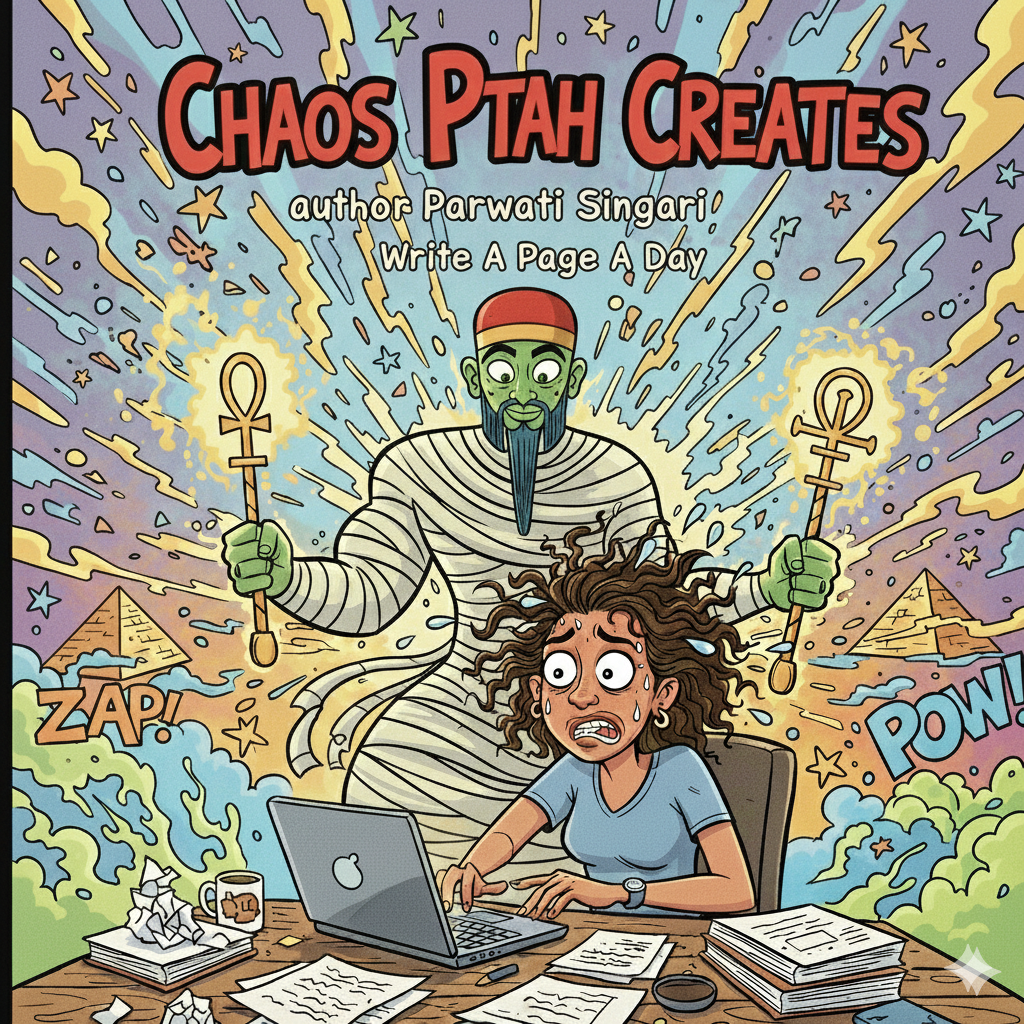
Akshara adjusted his spectacles and began typing.
“Title?” Ptah asked, materializing near the bookshelf with the mild irritation of a god who disliked poor framing.
“I hadn’t thought of one.”
“That is obvious,” Ptah said. “Call it The Ledger of the Boarding House. It has both metaphorical and fiscal integrity.”
Akshara sighed and typed.
The Ledger of the Boarding House
Banno woke before the sun, before the birds, before even regret. At five o’clock she entered the kitchen like a junior clerk punching in for a shift no one acknowledged. Three cups of tea. Two tiffins. One breakfast adjusted to her mother-in-law’s fluctuating theology of digestion. Gas on. Gas off. Dishes rinsed. Laundry sorted.
“Add the time,” Ptah interrupted. “Time is inventory.”
Akshara frowned but complied.
Two hours and seventeen minutes before the household stirred. Unpaid.
Dhando—no, Dando, he corrected himself—had once worn crisp shirts and corporate ambition. Now he wore khadi kurtas and the moral superiority of a man who had chosen academia in a small-town university. He called it sacrifice. He called it perfection. Mostly, he called it management.
“He believes himself to be a benevolent autocrat,” Ptah observed.
“Yes, I see that.”
“Then write it.”
Dando managed the house as though it were a failing subsidiary. Instructions were issued to the cook, the maid, the plumber, the electrician, and occasionally to oxygen. His mother nodded approvingly, a silent chairperson of the board. Banno existed in the minutes of meetings but never in the discussion.
Whenever she attempted to speak, Dando’s corrections arrived before her sentences did.
“That is inefficient.”
“That is not how we do it.”
“That is my house.”
Akshara paused. “Is this too bleak?”
“It is accurate,” Ptah replied. “Accuracy is a form of mercy.”
One evening, after a dinner where three separate meals had been prepared to accommodate three separate egos, Dando announced, “This is not a home. It is a boarding house. Everyone functions independently.”
“Good line,” Ptah said. “Keep it. Villains must self-incriminate.”
Banno stood by the sink, water running over plates and wrists. A boarding house. She rolled the phrase around in her mind like a coin.
If it was a boarding house, then there were services rendered.
If there were services rendered, there were charges due.
“Ah,” Ptah leaned forward, pleased. “Now we arrive at dhando.”
Akshara stopped typing. “You mean dhanda—business?”
“I mean dhando,” Ptah corrected gently. “The spirit of transactional clarity. And Banno—she is the banner under which invisible labor marches. They are not people merely; they are principles.”
“That’s too allegorical,” Akshara muttered.
“You are writing about accounting as rebellion. Allegory is inevitable.”
Banno began her ledger the next morning. A plain notebook, blue cover, twenty rupees from the corner shop. She wrote in neat columns.
Tea preparation – ₹30
Breakfast (3 variants) – ₹120
Laundry (machine + hand-wash delicates) – ₹80
Dishes – ₹60
Emotional buffering between husband and mother – incalculable (temporarily ₹200)
Akshara laughed despite himself. “Emotional buffering?”
“Underpriced,” Ptah said dryly.
Each day she recorded entries. She researched local wages in whispers to the maid. She calculated market rates. She included depreciation of her own back.
By the end of the month, the total stood at a figure that made her fingers tremble.
Not because it was high.
Because it was real.
Dando continued to critique the salt content of lentils and the philosophical decline of modern universities. His mother continued to speak across Banno as though she were ventilation. The boarding house functioned efficiently, its unpaid manager increasingly aware of her balance sheet.
“Give her a moment of dark humor,” Ptah advised. “Your series feeds on it.”
Akshara typed:
One afternoon, when Dando repeated, “Toe the line or leave my house,” Banno mentally added a new entry.
Housing provided by employer – market rent ₹15,000
Domestic management services – ₹38,450
Net payable to employee – ₹23,450
She almost smiled.
Akshara leaned back. “Is she going to confront him?”
“Must she?” Ptah countered. “Recognition precedes revolution. Let the arithmetic ferment.”
Akshara felt irritation rise. “You keep interfering.”
“And yet you keep listening.”
Silence stretched between man and god.
Banno closed her ledger each night and slid it under her pillow. Not as evidence for court. Not yet as ultimatum. But as proof against erasure.
Numbers did what affection had failed to do: they witnessed her.
Akshara reread the draft. It was darker than he intended. Funnier too, in the quiet way that hurt.
“Are you comfortable?” Ptah asked.
“No.”
“Good,” said the god of craftsmen and creators. “Comfort produces sermons. Discomfort produces stories.”
Akshara did not dismiss him.
Not yet.
He saved the document.
Tomorrow, he would calculate further.
 Parwatisingari's Weblog
Leave a comment