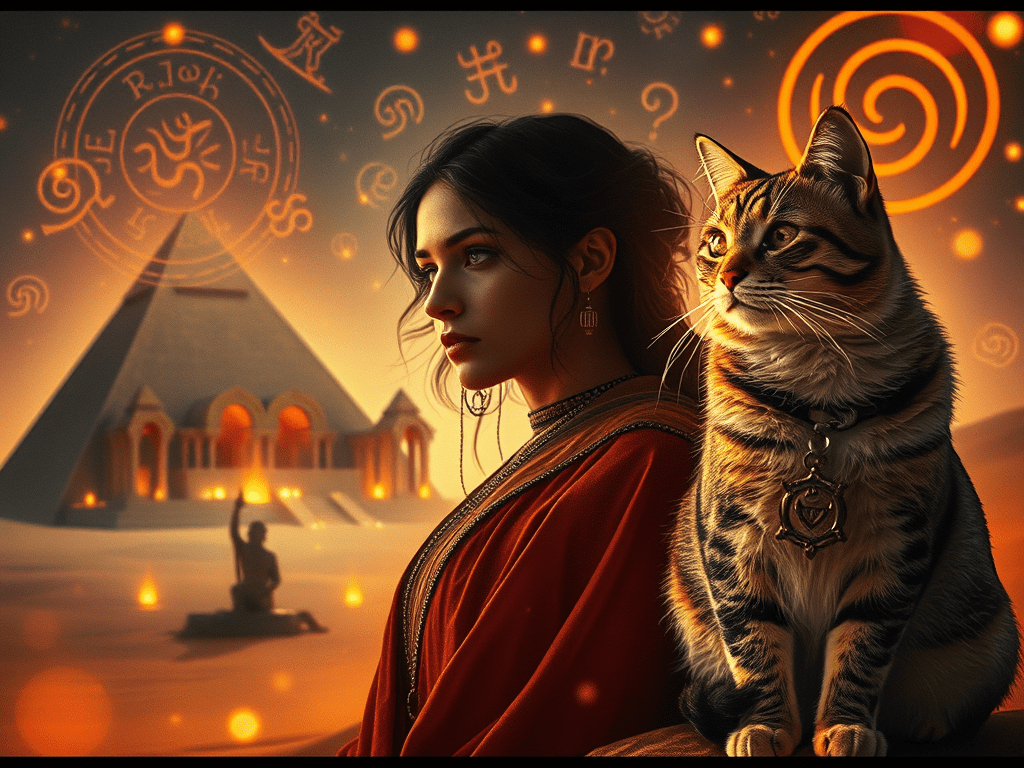

The name Anaya clung to her in the manner of a slightly damp overcoat one inherits from an uncle of uncertain judgement. People used it freely, and she responded with the polite reflex of someone answering to a hotel bell.
Yet whenever someone called her Doc, something inside her stirred—a small, approving hum, like a tuning fork remembering its vocation.
Her cat, who had long since abandoned the primitive human habit of requiring a name, lay sprawled across the window sill with the calm authority of a creature who regarded evolution as an interesting but unnecessary side project.
It opened one eye.
“Humans,” it observed, “cling to names because they do not know themselves. Cats, however, arrive fully briefed.”
It stretched luxuriously.
“But you, my dear, are neither one thing nor the other. You carry a secret soul name.”
Anaya rubbed her temples. “I was hoping for tea,” she said. “But do continue.”
The cat flicked its tail with professorial satisfaction.
“It is hidden, like the true name of Ra that Isis so cleverly liberated. Guarded, like the fire chants of the Angirasa sages. Extremely exclusive.”
Anaya considered this with the weary patience of someone who had accidentally befriended a philosopher.
“Why should I chase a name? Isn’t it perfectly respectable to live without one?”
The cat regarded her with the mild amusement of a chess master watching a pigeon rearrange the board.
“My dear girl, not choosing is also a choice. And indecision is the most exhausting mask of all.”
It paused, eyes gleaming.
“And remember this, if you remember nothing else: a name is not what you are given, it is what you answer.”
That night she dreamed. Temples rose from desert sands, their walls etched with hieroglyphs that shimmered like fire behaving suspiciously well. Nearby, Vedic altars blazed while priests in saffron robes chanted mantras with the solemn conviction of men who knew the cosmos was taking notes. Egyptian hymns braided with Sanskrit verses. Linen mingled with saffron. Entire civilizations appeared to have gathered for a quiet conference on the nature of identity.
The cat appeared beside her, its shadow stretched long across the sand.
“I,” it announced with modest pride, “am your sheut. Your Egyptian shadow-self. Your darkness and your guide.”
“Splendid,” said Anaya. “Do you also provide practical services?”
“Focus,” said the cat. “To find your soul name, you must walk between fire and shadow, between chant and silence.”
“And possibly through an unreasonable amount of symbolism.”
Days passed in a blur of forests, ruins, and riddles delivered with the cheerful cruelty of a philosophy professor.
“What is the name that heals without being spoken?”
“What is the name that belongs to no tongue, yet every heart knows?”
Each answer loosened something buried in her memory. She saw hands grinding herbs, voices murmuring over flames, healers carrying knowledge across centuries with the quiet stubbornness of rivers wearing down mountains. Somewhere within that inheritance a quiet truth kept returning to her like an echo.
A name is not what you are given, it is what you answer.
Eventually the cat led her to a cave crouching in the side of a cliff as though it had something mildly suspicious to hide. Inside, the walls pulsed with syllables formed of fire and shadow—names old enough to remember when the earth itself was younger and considerably less organized.
The cat sat neatly at the entrance.
“If you claim a name too quickly,” it said, “it will own you. If you refuse one forever, you will drift about like an unaddressed letter.”
It nodded toward the darkness.
“Step carefully.”
Inside the cave she met her shadow.
It looked exactly like her, though with a certain mocking sharpness that suggested it had been waiting for this conversation for quite some time.
“You hesitate,” it said.
“I prefer to think of it as thorough consideration.”
“You fear being trapped.”
“Experience suggests traps exist.”
The shadow smiled patiently.
“Identity is not a prison. It is a dance. Names are not chains—they are keys.”
The cave hummed softly around her. Somewhere deep within, the old vibration returned—the one that stirred whenever someone called her Doc. But now it deepened into something larger, a resonance that had nothing to do with sound and everything to do with recognition.
She did not announce it. She did not carve it into the cave wall like a particularly enthusiastic pilgrim. She simply accepted it, quietly and completely.
Because a name is not what you are given, it is what you answer.
When she stepped back into the light, the cat executed a theatrical bow worthy of a moderately successful stage magician.
“Well,” it said, “now that you know who you are, perhaps you’ll stop answering to Anaya.”
It tilted its head thoughtfully.
“Or perhaps you won’t. Humans are very funny that way.”
She laughed then, the sound bright and unexpectedly free. Anaya, Doc, and the deeper name she now carried were not enemies. They were tools—masks worn for different dances.
The true name burned quietly within her like a steady flame. With it came the work of healing—not merely bones and blood, but the far trickier business of helping people reconcile the names they carried with the truths they lived.
The cat purred with the air of a teacher whose most troublesome student had finally grasped the obvious.
“At last,” it said. “You understand.”
It leapt lightly onto her shoulder.
“Names are tools, not prisons. And the greatest names are the ones you live.”
Its eyes gleamed with quiet mischief.
“After all, a name is not what you are given, it is what you answer.”
 Parwatisingari's Weblog
Leave a comment