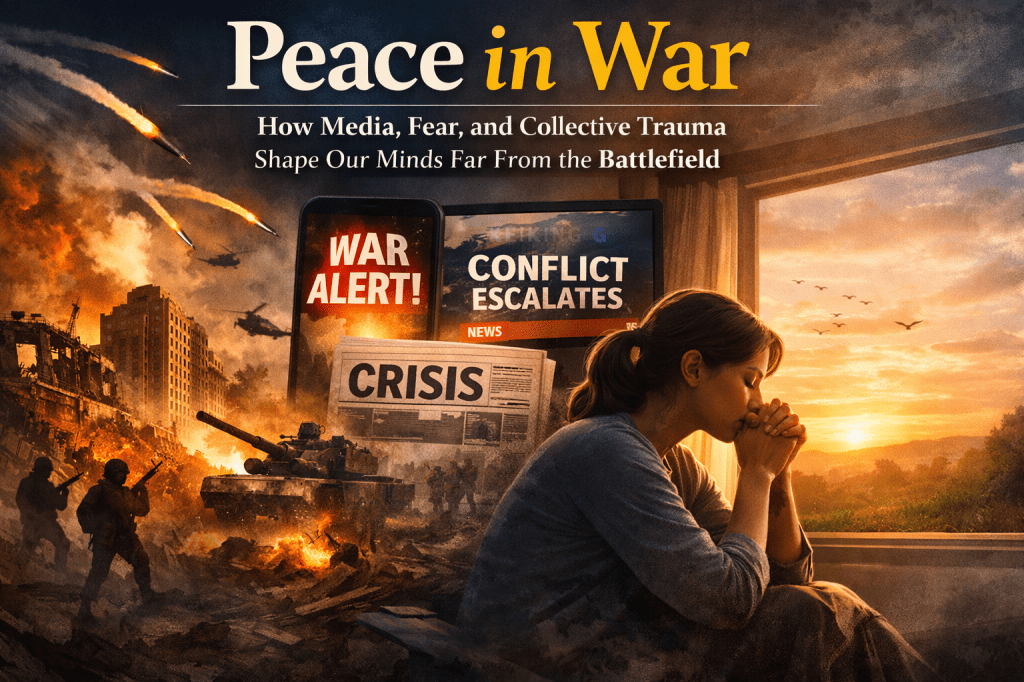
How the Trance of Fear Travels Far Beyond the Battlefield
Once upon a time we had armchair travellers—people who explored distant lands through books, stories, and imagination.
Today we seem to have something different.
We have armchair policy makers, armchair war strategists, and armchair generals. From living rooms and smartphones, battles are analyzed, alliances debated, and outcomes predicted.
Yet what we authentically have is something simpler: the armchair witness.
War no longer arrives only through marching soldiers or distant radio bulletins. It arrives through screens, headlines, notifications, and endless commentary.
Even when we live thousands of kilometers away from the battlefield, we feel drawn into its emotional gravity.
In the backdrop of the ongoing wars around the world, it is worth pausing to examine something rarely discussed in daily news cycles: the psychological ripple effect of war.
War devastates cities, structures, and bodies.
But it also reshapes something less visible—the emotional climate of societies.
Gone are the days when war affected only the soldier in the field and his immediate family. Today fear travels faster than missiles. Information crosses borders instantly, and with it travels emotion.
Fear, repeated often enough, becomes something deeper.
It becomes a trance.
A trance that spreads across societies, reinforced by media narratives that magnify danger and construct lasting memory. From the trenches of World War I to the bombed cities of World War II, history reveals that emotional health is shaped not only by the battlefield—but also by how the battlefield is described.
The Trance of Fear
War often produces what psychologists call collective hypervigilance—a state where entire populations remain alert to danger.
A hypnotherapist might describe the same process differently:
when a suggestion is repeated often enough, the mind begins to accept it as reality.
Modern media excels at repetition.
Images of destruction, urgent headlines, and dramatic commentary enter the subconscious mind again and again.
The brain reacts instantly.
The amygdala, the brain’s threat detector, activates. Heart rate increases. Muscles tense.¹
Even if we are sitting safely at home, the body behaves as if danger were nearby.
Doctors recognize the symptoms:
- insomnia
- irritability
- compulsive news checking
- anxiety
A hypnotherapist recognizes a familiar pattern: repeated suggestion shaping emotional experience.
A person wakes up and checks the news.
At lunch they watch a short video of missile strikes.
At night they scroll through social media commentary predicting escalation.
Nothing physically dangerous happened in their city that day.
Yet their nervous system spent the entire day preparing for war.
Lessons from World War I
The First World War introduced doctors to a psychological condition they struggled to understand: shell shock.
Soldiers who survived relentless artillery bombardment returned from the trenches trembling, unable to speak, sometimes unable to walk.²
At first, military commanders believed these soldiers simply lacked courage.
Eventually physicians realized something deeper: the human nervous system has limits.
A Soldier Who Could Not Stop Saluting
One widely reported case described a British soldier hospitalized after months under artillery fire.
Doctors noticed that every few minutes he raised his hand in a stiff salute—even when no officer was present.
The gesture had become automatic.
His mind was still in the trenches, responding to authority and danger that no longer existed.
Today we might describe this as trauma conditioning.
At the time it was called shell shock.
The Media War
Meanwhile newspapers at home often told a very different story.
Casualty numbers were frequently minimized, while enemy brutality was exaggerated.³
Fear mixed with patriotism, creating a powerful emotional narrative.
The war was fought not only with artillery, but also with stories.
War devastates cities and bodies. — But narratives surrounding war shape the emotional climate of the entire societies.
Lessons from World War II
By the end of World War II, the psychological consequences of war could no longer be ignored.
Millions of soldiers returned home carrying invisible wounds. Today we call this Post-Traumatic Stress Disorder (PTSD).⁴
The Veteran Who Slept on the Floor
A psychiatrist once described a returning soldier who refused to sleep in his bed.
Instead, he slept on the floor beside it.
When asked why, the soldier replied quietly:
“In the war, sleeping low to the ground felt safer.”
His body had learned survival rules that no longer applied—but his nervous system still believed the war might return at any moment.
The Power of Wartime Narratives
World War II also demonstrated the immense power of media storytelling.
Radio broadcasts warned citizens about incoming air raids. Cinema newsreels portrayed heroic soldiers and national unity.
Media generated two powerful emotional forces simultaneously:
fear of the enemy
and
confidence in collective resilience.⁵
Both shaped how societies experienced the war.
Facts vs. Frenzy
Every war produces two parallel streams of information—one grounded in evidence, the other driven by emotion.
Wartime Information: A Quick Decode
| Dimension | FACTS | FRENZY |
|---|---|---|
| Primary Sources | Medical records, verified reports, historical archives | Rumors, propaganda, speculative commentary |
| Nature of Information | Evidence-based and verifiable | Selective, exaggerated, emotionally framed |
| Typical Goal | Understanding events | Mobilizing emotion |
| Speed of Spread | Slower due to verification | Rapid through repetition and viral media |
| Psychological Effect | Reflection and informed judgment | Anxiety, outrage, emotional contagion |
| Long-Term Impact | Historical clarity and healing | Distorted collective memory |
The writer Susan Sontag observed that images of suffering can both inform and distort our understanding of violence.⁶
In other words, information can enlighten—but it can also overwhelm.
Learning to ask simple questions helps restore balance:
- Is this verified?
- Who benefits from this narrative?
- Is this fact—or interpretation?
This skill—critical media literacy—has quietly become a psychological survival tool.
The Hidden Cost: Collective Stress
When people repeatedly absorb distressing information, the nervous system can enter a state of chronic tension.
Over time this may lead to:
- emotional exhaustion
- polarized thinking
- helplessness
- anger toward imagined enemies
War may occur far away, yet its emotional consequences can quietly reshape everyday life.
Building Resilience
History shows that communities who navigate wartime stress successfully develop collective coping mechanisms.
These include:
- balanced media consumption
- open dialogue instead of rumor
- community support networks
- emotional awareness
Resilience does not mean ignoring suffering.
It means developing the capacity to remain psychologically grounded while facing disturbing realities.
As trauma scholar Cathy Caruth suggests, societies must learn to process traumatic narratives rather than simply absorb them.⁷
Pause for a moment.
Think about the last time you listened to news about war.
What did you feel?
Write it down.
Perhaps you noticed:
- anxiety
- anger
- sadness
- helplessness
- curiosity
- compassion
There are no right or wrong responses.
Simply noticing these reactions helps us step out of the trance of fear.
Building Psychological Resilience in Times of War
In times of global uncertainty, communities benefit from spaces where people can understand their emotional responses and build resilience together.
You are invited to participate in a public workshop on Building Psychological Resilience During Times of War.
The workshop will explore:
- how media narratives influence emotional states
- the neuroscience of fear and stress
- practical techniques to calm the nervous system
- strategies for balanced news consumption
- community practices that strengthen resilience
Participants will engage in discussion, guided reflection, and practical exercises designed to help people remain informed without becoming emotionally overwhelmed.
Register here: Workshop link.
War May continue to unfold on distant frontlines, but the quiet battle for emotional clarity takes place inside every mind. When we learn to seperate fact from frenzy and fear from awareness, we rediscover that peace is not only negotiated between nations. it is also cultivated within communities and within ourselves.
 Parwatisingari's Weblog
Leave a comment