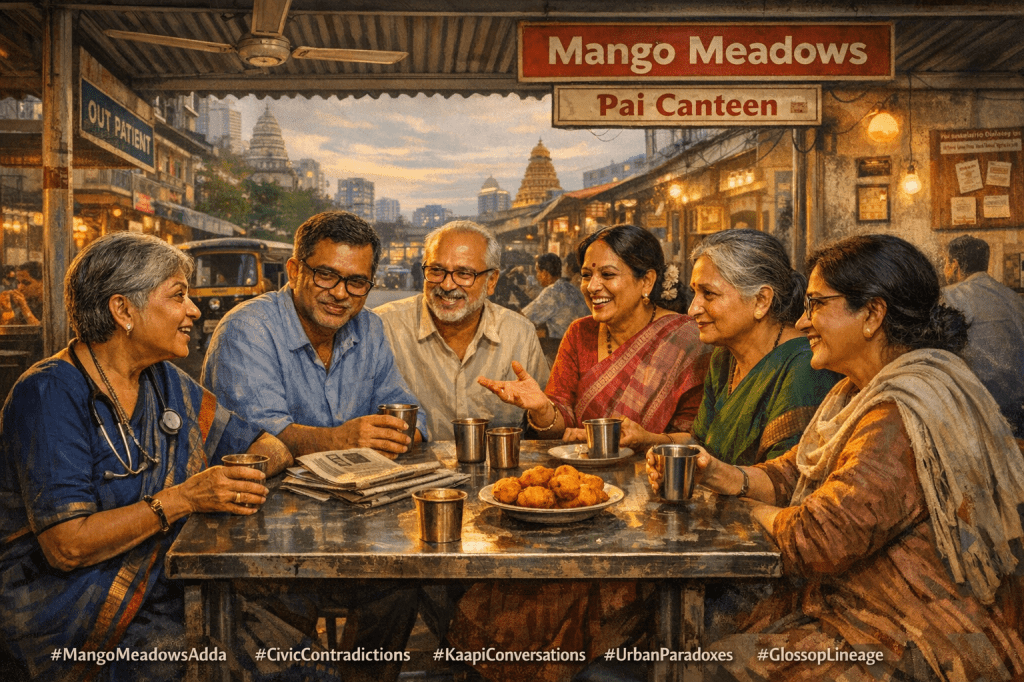
At precisely 5:30 every evening—give or take the elasticity afforded to senior medical professionals—they assemble.
Not together. Never together. Coordination would imply effort, and effort, as they unanimously agree in principle (though never in practice), is to be avoided wherever habit will suffice.
They arrive at Mango Meadows.
The name, it must be clarified at once, is a triumph of imagination over infrastructure. There are no mango trees. There are no meadows. There is, however, a hospital canteen of considerable resilience, a few benches that have seen more postgraduate angst than any therapist, and a supply of filter kaapi and goli bhaje that could outlast minor civilizational collapse.
Once, in less lyrical times, it was called the pai-canteen.
Then came Dr. Kondaje.
It was he, during their General Medicine days, who insisted—with the quiet tyranny peculiar to good teachers—that no clinical discussion worth its salt should occur without two stabilizing agents: filter kaapi and something deep-fried. The habit took. The nomenclature evolved. The canteen, quite against its will, became Mango Meadows.
There are six of them.
They have been circling one another since Mary Kutty’s second standard, where early negotiations involved erasers and moral positions on sharing lunch. They survived Danda-Nayaka’s twelfth standard physics together—a period marked by equations, existential doubt, and collective interpretation of what the man might possibly have meant. Medical school followed, which confirmed two things: that sleep is negotiable, and that some alliances, once formed, simply refuse to dissolve.
They do not meet. They resume.
Parwati arrives first on most days, though she maintains this is purely coincidental and not at all a function of curiosity. She occupies the useful position of someone who belongs entirely and yet observes slightly from the side. It allows her to notice things others are too busy arguing about.
Chits arrives as if the conversation has already been inadequately conducted in her absence. Chitra Subramanian does not so much join discussions as correct them into existence. She deals in clarity, definitions, and a brisk intolerance for anything that cannot be properly classified. If a topic is vague, she will sharpen it. If it resists sharpening, she will question its right to exist.
Chats, on the other hand, never arrives empty-handed—though what she carries is rarely visible. Charulatha Kandaswamy brings people with her. Not physically, which would complicate seating, but in the form of stories, fragments, observations. She places them into conversation with the ease of someone who understands that context is everything and individuals are merely its temporary representatives.
Sid arrives and listens just long enough to identify the weakest assumption in circulation. Sidaramiah Bellad considers this a public service. He is not unkind, but he is unsentimental about flawed reasoning. When he says, “That’s not the point,” it is less a disagreement and more a course correction.
Sarah arrives without announcement and sits without disturbance. Saraswathi Bellad has perfected the art of letting a conversation reveal itself fully before intervening. She allows excess to accumulate, watches patterns form, and then, at a moment of her choosing, removes the unnecessary with a single sentence. It is generally agreed—though never formally stated—that resisting her conclusions is both futile and mildly educational.
Raghav completes the arrangement. He looks at things as if they were designed—sometimes well, often not. Where the others see behavior, he sees structure. Where they diagnose, he quietly rearranges.
The kaapi arrives. Strong, unapologetic, and served in steel tumblers that have no patience for delicacy. The goli bhaje follow, golden and persuasive.
No one orders. No one thanks. Systems, once perfected, are best left undisturbed.
The conversation begins anywhere.
A remark. An irritation. Something witnessed in passing. It does not matter. Chits defines it. Sid questions it. Chats expands it. Raghav reframes it. Sarah resolves it—or appears to.
Parwati watches the entire thing unfold with the mild suspicion that what is being conducted here is less a conversation and more a form of diagnosis applied to the world at large.
They argue, certainly. With enthusiasm. With precision. Occasionally with alarming speed. But never with consequence. Within this group, disagreement is simply a sign that the machinery is functioning.
By 6:15, the canteen fills, the noise rises, and Mango Meadows reluctantly returns to being what it actually is. They do not conclude. They disperse.
The next evening, at 5:30, they return—separately, inevitably—and continue from wherever they last left off.
No minutes are recorded.
But the pattern holds.
 Parwatisingari's Weblog
Leave a comment