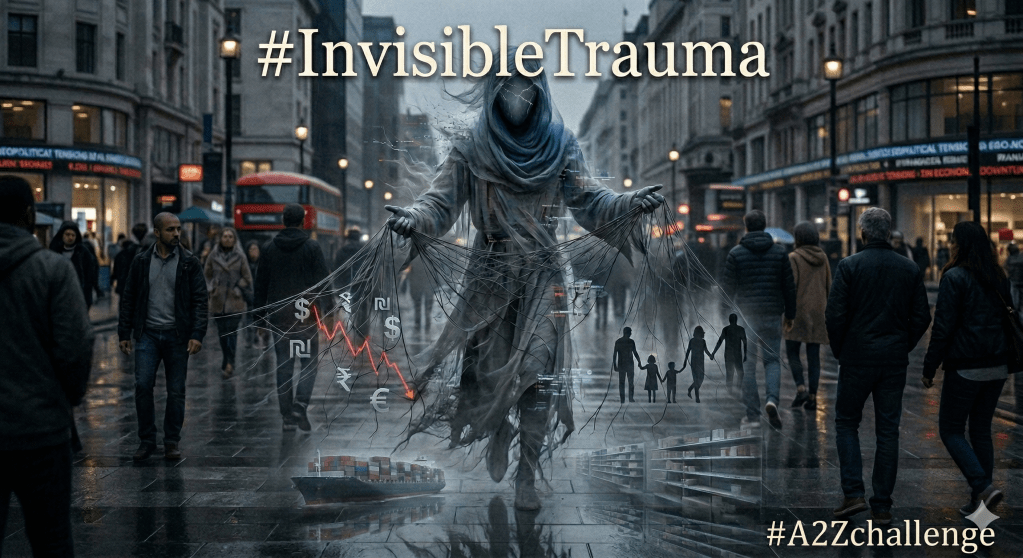
Undercover Disruptions Of War.
The clinic was unusually quiet that afternoon—the kind of quiet that makes conversations heavier. Between patient files and the hum of an old ceiling fan, three generations sat facing each other: Akhila Desai, a young, sharp-eyed career counsellor; 97-year-old Dr. Hande, who had seen more wars than most history books care to remember; and me, somewhere in between, trying to make sense of patterns that never quite repeat, yet never quite change.
Akhila broke the silence first.
“Everyone’s asking the same question,” she said. “What happens to jobs now—with Ukraine still unstable and this new Iran conflict unfolding?”
Dr. Hande smiled faintly. “Ah,” he said, “the world always thinks its crisis is unique. It never is.”
He leaned back, as if reaching into memory rather than thought.
“After World War I,” he began, “jobs appeared suddenly—factories, industry, movement to cities. Women entered the workforce, migrants moved in. But it didn’t last. The war ended, men returned, and the system snapped back. Then came recession. People forget the snap back.”
Akhila nodded. “So temporary expansion?”
“Exactly,” he replied. “War creates urgency, not permanence.”
She turned to me. “But World War II was different, right?”
“Structurally, yes,” I said. “Mass enlistment created deeper labor gaps. Women moved into skilled roles—manufacturing, engineering. Even though many were pushed out later, something shifted. The workforce didn’t fully revert. Add the GI Bill—education, housing—and suddenly you have a more skilled, more stable middle class.”
Dr. Hande tapped the table gently. “That’s the key difference. Not the war itself—but what follows. Policy determines permanence.”
Akhila leaned forward now. “So where do Ukraine and Iran fit? Are we looking at another structural shift?”
“Not at that scale,” I said. “At least not yet. Ukraine showed us something interesting—massive shock initially, but recovery followed. Globally, we didn’t see job collapse. Instead, we saw redistribution.”
“Redistribution?” she asked.
“Defense hiring increased. Energy sectors surged. Logistics adapted. Supply chains rerouted. It’s less about losing jobs and more about where jobs move.”
Dr. Hande chuckled softly. “War used to mobilize people. Now it mobilizes systems.”
Akhila paused. “And Iran?”
“Too early for definitive trends,” I said. “But the early signals are familiar—energy price spikes, hiring hesitation, some job losses tied to oil shocks. Yet paradoxically, overall hiring hasn’t collapsed. Economies today are… buffered.”
“Buffered? By what?”
“Technology, diversification, and experience—especially post-COVID. The world has learned to absorb shocks better.”
Dr. Hande added quietly, “But the anxiety remains. And anxiety shapes careers as much as opportunity does.”
That shifted the conversation.
Akhila pulled out her notebook. “So what should I tell students? What emerges from rebuilding?”
This is where patterns sharpen.
“Every conflict,” I said, “reveals vulnerabilities—and jobs grow exactly where vulnerabilities are exposed.”
She began listing.
“Energy insecurity?”
“Renewable energy, solar, wind, grid infrastructure. Also traditional energy in the short term.”
“Security threats?”
“Cybersecurity, intelligence, defense technology.”
“Disrupted supply chains?”
“Logistics, warehousing, transport systems, even local manufacturing.”
“Stressed populations?”
“Healthcare, mental health, elder care—always resilient sectors.”
Dr. Hande interjected, voice softer now. “Don’t forget rehabilitation. After every war—visible or invisible—there is healing. That creates its own workforce.”
Akhila underlined that.
“And what about the gig economy?” she asked.
“It grows in uncertainty,” I said. “Low entry barriers, quick income—but unstable. Think of it as a bridge, not a destination. The real strategy is to pair flexibility with specialization.”
She looked up. “So the future isn’t one job. It’s layers?”
“Exactly. A stable core skill, with adaptable edges.”
Dr. Hande smiled again. “In my time, we chose careers. Now you construct them.”
The room fell quiet again, but this time it felt clearer.
Akhila closed her notebook. “So if I had to summarize for someone starting out today?”
I answered carefully.
“Anchor yourself in something essential—healthcare, energy, infrastructure, security, education. Then build adaptable skills—technology, AI literacy, communication, systems thinking. Wars don’t just destroy—they redirect. If you can read the direction, you stay relevant.”
Dr. Hande added one final line, almost as a diagnosis:
“The job market doesn’t collapse in war. It rearranges itself. The real risk is not losing work—it’s being trained for yesterday’s version of it.”

 Parwatisingari's Weblog
Leave a reply to Lakshmi Bhat Cancel reply