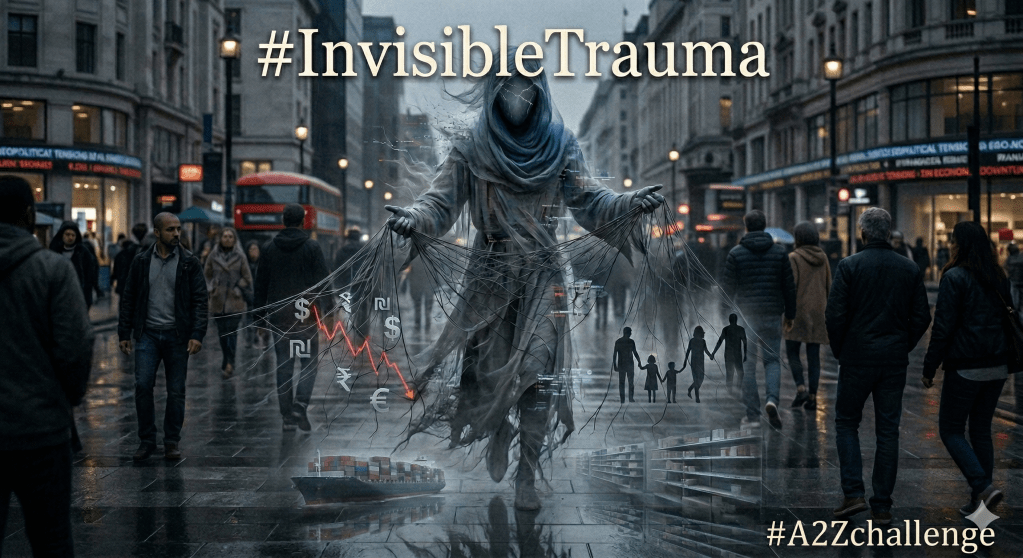
Undercover Disruption Of War
As a doctor, I was trained to examine the liver, the lungs, and occasionally the limits of human patience. I was not trained to examine society. Yet, like an uninvited relative who refuses to leave, social observation has attached itself to my practice.
Patients no longer come with just symptoms. They come with theories.
Last week, a gentleman sat across from me—not particularly ill, but visibly unsettled. He had no fever, no cough, no measurable abnormality. What he had was a head full of information—news debates, WhatsApp forwards, expert opinions that contradicted other expert opinions. He leaned forward and asked me a question I am not qualified to answer:
“Doctor, what is actually true?”
In medicine, we like our truths backed by lab values and scans. Society, unfortunately, runs on something far less reliable—narratives. And in times of war, crisis, or collective anxiety, these narratives are not just told; they are manufactured, polished, and strategically served.
This is not new. Only the packaging has improved.
In difficult times, information behaves less like a public good and more like a controlled substance. It is rationed, shaped, and occasionally spiked with intent. The result is not ignorance—that would be too simple—but something far more sophisticated: a quiet, creeping confusion about what to believe. A condition I would diagnose, if I could, as epistemic insecurity.
It is a splendidly complicated term for a very simple feeling: not knowing whom to trust.
And the human brain, poor thing, does not handle this well.
Uncertainty, from a biological standpoint, is a threat. When we cannot predict outcomes, we assume the worst. It is why a patient waiting for a biopsy result imagines cancer long before the report arrives. Now take that anxiety and apply it not to one body, but to an entire society.
People begin to look for certainty the way a dehydrated man looks for water.
And like thirsty men, they are not very particular about the source.
When official narratives clash with unofficial ones—when what is whispered contradicts what is broadcast—people do not calmly weigh evidence like judges in a courtroom. They do something far more human: they pick a side.
Not necessarily because it is correct, but because it is comforting.
Certainty, even if flawed, is easier to live with than doubt.
In my clinic, this plays out in curious ways. Patients explain their illnesses with remarkable confidence, often citing sources that range from international news channels to their neighbour’s nephew studying abroad. The conviction is impressive. The accuracy, less so.
Information today is not evaluated; it is adopted, like a political affiliation or a cricket team.
This is where skepticism, once a sign of intelligence, takes a strange turn. It becomes selective. People question only what does not suit them and accept without hesitation what does. Facts are no longer facts; they are team property.
“Our truth” versus “their propaganda.”
It would be amusing if it were not so exhausting.
Sociologists, with their fondness for tidy theories, call this social identity at work. We define ourselves by the groups we belong to. In peaceful times, this might mean your profession, your language, your favourite cuisine. In troubled times, it becomes far more primitive.
Who is with us?
Who is against us?
The shift is subtle but decisive. Disagreement is no longer intellectual; it is moral. To question the group’s narrative is to betray it. Doubt becomes disloyalty.
From an evolutionary perspective, this makes perfect sense. Our ancestors survived by sticking to their tribe. Trust the familiar, distrust the outsider—it kept them alive long enough to pass on their genes. Unfortunately, evolution did not anticipate prime-time debates or social media algorithms.
Today, the “outsider” is not a man from another village. It is your colleague, your friend, sometimes your own family member—anyone who subscribes to a different version of reality.
I have seen conversations in my waiting room grow cautious, then awkward, and finally silent. People avoid certain topics the way they avoid contagious diseases. It is easier to discuss cholesterol than convictions.
And beneath this polite silence lies something less polite—anxiety.
Not the dramatic, cinematic kind, but a slow, persistent unease. Too much information, too little clarity. The mind, unable to reconcile contradictions, grows tired. Sleep suffers. Attention fractures. A mild paranoia creeps in—not enough to alarm, but enough to linger.
People begin to distrust institutions. Then experts. Eventually, each other.
Loneliness follows, though one is rarely alone.
To cope, many retreat into echo chambers—those comfortable little corners where everyone agrees with you. It is like being in a room where all mirrors are flattering. Reassuring, certainly. Accurate, not quite.
These spaces provide relief, but at a cost. The more one hears only one’s own beliefs repeated, the less tolerable opposing views become. The world outside begins to look not just wrong, but dangerous.
And just like that, we arrive at the oldest story of all:
Us versus Them.
It is tempting to blame this entirely on propaganda, on shadowy forces manipulating information. There is some truth to that, of course. Narratives are shaped, access is controlled, and occasionally, inconvenient facts are quietly misplaced.
But let us not flatter ourselves into thinking we are merely victims.
Some of this confusion is self-inflicted. Skepticism, when taken to excess, becomes cynicism. The refusal to trust anything is no more enlightened than blind faith. Between gullibility and paranoia, there lies a narrow, uncomfortable path called discernment—and it requires effort most people would rather avoid.
As a doctor, I find this situation mildly alarming and professionally inconvenient. Medicine, after all, runs on trust. A patient must believe that the diagnosis is honest, the treatment appropriate, and the advice well-intentioned. Without that, even the best prescription is just ink on paper.
When trust erodes, everything else follows.
What worries me is not that people disagree—that is perfectly healthy—but that they no longer agree on the basics required to even have a disagreement. When reality itself is up for negotiation, conversation becomes impossible.
And yet, life goes on. Patients return. Conversations continue, cautiously. The machinery of society does not collapse; it merely creaks a little louder.
Perhaps the solution, if one exists, is not grand or revolutionary. It may lie in something rather unfashionable: the willingness to tolerate uncertainty. To admit, occasionally, “I do not know.”
It is an unsatisfying answer. It offers no immediate comfort, no clear allegiance. But it has one distinct advantage—it leaves room for thought.
As for me, I will continue to sit in my clinic, treating what I can measure and observing what I cannot. The body is complicated enough. The mind, even more so. Society, I have learned, is a different beast altogether.
It does not shout its problems.
It whispers them—quietly, persistently—until one day, you realize that the noise in people’s heads has become louder than the world outside.
Footnote:
This post was written for the A2Z Challenge by Blogchatter.
 Parwatisingari's Weblog
Leave a comment