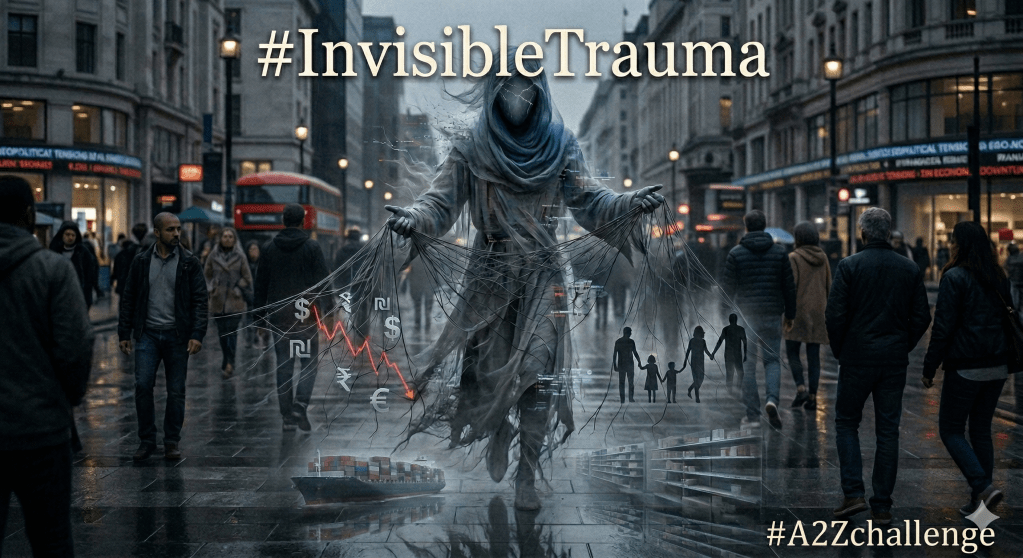
Undercover Disruptions Of War.
As a doctor, I have the misfortune of treating not just diseases, but also patterns. Sit in a clinic long enough and you realise hunger is far more disciplined than any patient—it arrives on time, stays longer than invited, and leaves behind relatives.
War, I have often suspected, has a wicked sense of humour. It does not always kill you dramatically. That would be too honest. Instead, it rearranges your food.
My grandfather, Dr. H. V. Hande, who had seen more of public health than most of us have seen of our own kitchens, used to say that epidemics are noisy, but hunger is polite. It does not shout. It simply removes one item from your plate at a time and waits for you to adjust your expectations.
Modern warfare has perfected this politeness.
You do not need to drop bombs when you can delay shipments. You do not need to invade when you can inflate prices. A port blocked here, a supply chain disrupted there, and suddenly millions of people are on what economists might call an involuntary diet plan. The Bengal Famine of 1943 was not just a tragedy—it was an administrative masterpiece in how to starve people without appearing uncivilised. Yemen, today, continues the tradition with depressing efficiency.
And the body, inconveniently, keeps accounts better than any government ledger.
Malnutrition is not merely about an empty stomach. It is about a suspicious body. When a child grows in scarcity, the body learns thrift with the seriousness of a chartered accountant. Calories are saved, fat is hoarded, and optimism is quietly removed from the system.
We dress this up in respectable language and call it epigenetics. In simpler terms, the body develops trust issues.
These “trust issues” are then generously passed on to the next generation. Children and grandchildren of famine survivors walk around with metabolisms that behave as though the next meal is uncertain—even if they are standing in front of a buffet. They develop diabetes, hypertension, and cardiovascular disease with admirable punctuality. Organs are built slightly smaller, responses slightly exaggerated. The body, once cheated, does not forgive easily.
My daughter, Dr. Sonal Koushik, who belongs to a generation that believes data more than anecdotes, would probably explain this with methylation pathways and gene expression models. I prefer a simpler explanation: the body remembers insult.
And it remembers it for generations.
We, of course, respond with our usual brilliance. We blame lifestyle.
“Eat less, exercise more,” we say to populations whose biology has been trained for famine. It is a bit like advising a man who has survived a drought to stop storing water. Logical, but slightly insensitive.
Inherited disorders, therefore, are not merely genetic inheritance. They are historical commentary. Genes provide the script; famine edits it without permission. Some conditions worsen, some emerge earlier, and some quietly wait for the right environmental cue to misbehave.
And hunger, being ambitious, does not stop at physiology. It graduates to psychology.
Scarcity produces a particular kind of mind. It is alert, anxious, occasionally aggressive, and rarely patient. Planning for the future feels like a luxury when the present is unreliable. Trust becomes negotiable. Cooperation becomes conditional. Entire societies begin to display what psychiatrists politely call maladaptive coping.
Depression, anxiety, addiction—they do not appear out of nowhere. They have ancestry.
If one looks at the ongoing tensions around Iran, the television prefers to show missiles and maps. It makes for better ratings. But the more enduring damage will not be televised. It will occur quietly, in kitchens where diets become simpler, in households where protein becomes occasional, and in pregnancies where nutrition becomes negotiable.
Disrupt the Strait of Hormuz long enough, and you do not just alter oil prices—you redesign human biology across regions. Food inflation follows fuel inflation with the loyalty of a well-trained assistant. Diets shrink in diversity. Micronutrients vanish without ceremony.
No headlines. Just consequences.
India, with its long-standing relationship with nutritional compromise, will respond in its own dignified manner. We will not starve immediately. We will economise. Which is a polite way of saying we will eat worse.
More carbohydrates, less protein. More fullness, less nourishment. We have already perfected the art of being both undernourished and overweight—a medical contradiction that would be amusing if it were not so efficient.
And then we will hold conferences on rising diabetes.
The fashionable solution these days is ancestral healing. It sounds like something that comes with herbal tea and soft music. In reality, it is embarrassingly straightforward. Feed mothers properly. Feed children better. Ensure that food is not a daily uncertainty. Reduce stress where possible.
The body, contrary to popular belief, is willing to forgive. But it has conditions.
You cannot negotiate with biology using slogans.
Epigenetic changes do soften over generations, but only when the environment stops behaving like a war zone. Consistency, nutrition, and stability do more healing than any philosophy ever will.
The real solution, unfortunately, is not glamorous. Stable food systems. Protected supply chains. Maternal and child nutrition programs that actually reach people. Mental health care that acknowledges that trauma can be inherited as efficiently as property.
And, ideally, fewer wars that pretend they are not about starvation.
Because that is the final joke—if one can call it that without losing one’s medical licence.
War does not declare hunger as a weapon. It prefers more respectable terms—sanctions, blockades, strategic pressure. Hunger, meanwhile, does its work quietly, efficiently, and without press coverage.
By the time the economists finish their analysis and the politicians finish their speeches, the damage is already seated—in the pancreas, in the blood vessels, in the anxious mind of a child not yet born.
And long after the war has been declared over, it is the grandchildren who will continue to attend the follow-up clinic.
Footnote: Indicative References for Further Reading
- Studies on the Dutch Hunger Winter and transgenerational epigenetic effects
- Research on metabolic outcomes following the Bengal Famine of 1943
- World Health Organization reports on maternal and child malnutrition
- UNICEF data on Yemen’s ongoing nutrition crisis
Government & Public Health Resources (India):
- Ministry of Health and Family Welfare – National nutrition and maternal health programs
- POSHAN Abhiyaan – Targeted initiative addressing malnutrition and maternal-child health
- Food Safety and Standards Authority of India – Guidelines on food fortification and nutrition awareness
Declaration:
This post was written for A2Zchallenge by Blogchatter


Leave a Reply