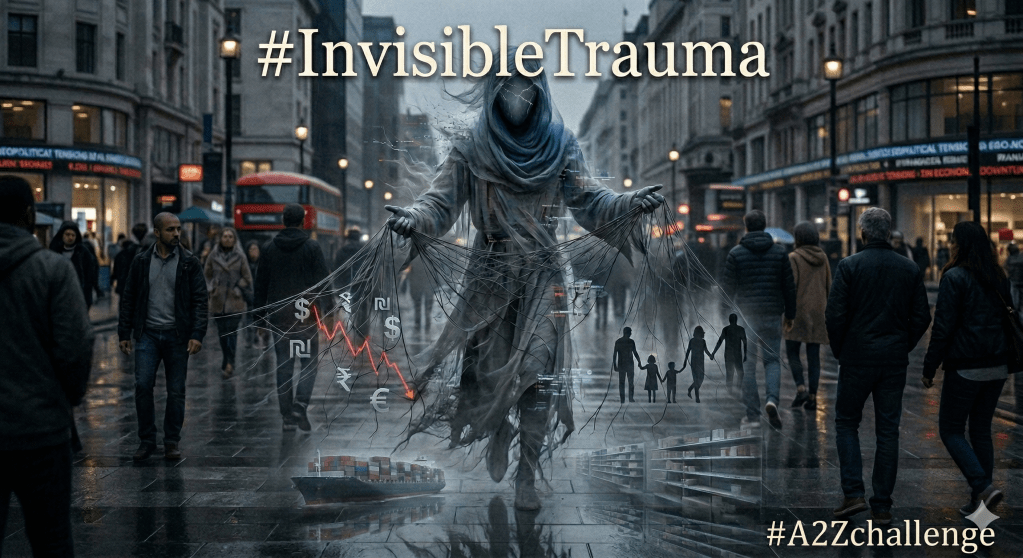
Undercover disruptors of War.
War does not end when the guns fall silent. It merely changes residence. From the battlefield, it moves into the body. From the body, into the home. From the home, into the next generation—quietly, efficiently, without paperwork. If bureaucracy functioned this well, we would have fewer complaints.
As doctors, we are trained to look for lesions, lab values, and respectable abnormalities that can be underlined in red ink. Unfortunately, some of the most persistent consequences of conflict have no such courtesy. They arrive without reports, without warning, and with a peculiar habit of saying, “Nothing has happened to me.”
That, in clinical practice, is usually when something has.
The symptoms are rarely dramatic. No operatic suffering. Just a steady parade of inconveniences that refuse to leave: hypervigilance that keeps the nervous system on permanent night duty, unexplained anxiety in perfectly safe environments, emotional numbness that dulls both grief and joy, irritability over trifles, disturbed sleep that treats rest as an optional extra, somatic complaints that baffle investigations, avoidance behaviours masquerading as preference, and an almost admirable obsession with control.
We label these efficiently—anxiety disorder, stress response, functional symptoms—and proceed with treatment, prescriptions, and the quiet hope that the patient does not ask too many questions.
But occasionally, the history refuses to cooperate. No trauma. No trigger. No scandal worth documenting.
Which is when one must consider the uncomfortable possibility that the problem is not entirely the patient’s own.
The children and grandchildren of those who lived through the World War II and the Partition of India have an irritating tendency to present with these very symptoms. Not metaphorically. Clinically. They have inherited neither the war nor the refugee train—but they have inherited something far less visible and far more durable: a predisposition to fear.
We now dress this up in respectable language—epigenetics—which, put plainly, means that severe stress teaches the body new tricks, and the body, being generous, passes on the lesson. The DNA remains untouched, but its behaviour acquires a certain pessimism. The system is calibrated not for peace, but for the expectation of disaster.
It is not weakness. It is preparedness that has overstayed its welcome.
My grandfather, Dr. H. V. Hande, had no patience for fashionable terminology. He preferred observation, occasionally sharpened with wit. He would remark, almost casually, that “some patients are frightened before the disease arrives.” At the time, it sounded like humour. In retrospect, it was diagnosis—delivered without billing.
He had seen enough of the aftermath of the Partition of India to recognise patterns. People rebuilt homes, businesses, reputations. What they did not rebuild was their relationship with safety. That remained permanently compromised. They expected loss, mistrusted calm, and treated emotional expression as an avoidable luxury.
Their children, obedient as always, inherited the atmosphere.
Trauma is an excellent parent. It teaches without speaking.
The overprotective parent who sees danger in every outing, the emotionally distant parent who has outsourced affection, the authoritarian parent who confuses discipline with survival strategy—these are not failures of character. They are adaptations. Unfortunately, they are also contagious.
Children raised in such climates learn early that the world is unreliable, that calm is temporary, and that vulnerability is an indulgence best avoided. They grow into adults who are uneasy in peace, suspicious of unpredictability, and curiously uncomfortable with happiness that arrives without warning.
The war, having retired from active service, takes up a quiet consultancy role in their nervous system.
Silence, in all this, does remarkable work. In many families shaped by the Partition of India, nothing is discussed, yet everything is understood. This is often mistaken for dignity. It is, in fact, ambiguity—and ambiguity is fertile ground for anxiety. The mind, deprived of narrative, manufactures its own.
In other households, the stories are told—repeatedly, vividly, without conclusion. Here, the next generation does not inherit silence but unfinished terror. Either way, the outcome is efficient: a psyche that reacts to shadows with professional seriousness.
Then came the COVID-19 pandemic, which, despite lacking the aesthetic drama of war, performed admirably in psychological terms. Invisible threat, prolonged uncertainty, and enforced isolation—one could hardly design a better experiment.
We observed, with clinical interest, a rise in agoraphobic tendencies, a flourishing of health anxiety, and children who displayed social regression, withdrawal, and behaviours that briefly alarmed everyone into suspecting neurodevelopmental disorders. Most of these were not pathology in the traditional sense. They were adaptations to abnormal circumstances—which is another way of saying the mind was doing its job a little too well.
And, as always, children absorbed not just the event, but the parental response to it. Fear, when demonstrated consistently, is an excellent teaching tool.
Which brings us to the slightly controversial corner of regression therapy. Medicine regards it with the same expression it reserves for distant relatives—polite, cautious, and faintly skeptical. Yet, in practice, certain structured forms of regression attempt something fundamentally sensible: to give shape to emotional material that has been carefully avoided.
Patients often uncover fears that have no clear origin, responses that seem disproportionate, and recurring themes—loss, abandonment, threat—that behave like uninvited guests who refuse to leave. One may argue about mechanisms, but the clinical observation remains stubborn: what is unnamed tends to persist; what is examined occasionally loses its authority.
As doctors who double up as reluctant social observers, we are forced to admit that this pattern is neither new nor rare. From the trenches of the World War I to the upheaval of the Partition of India to the sanitised paranoia of the COVID-19 pandemic, the conclusion is tediously consistent: unprocessed fear does not disappear; it reorganizes.
It becomes a parenting style, a cultural habit, a baseline physiology, and eventually, a diagnosis respectable enough to enter medical records.
There are a few inconvenient truths worth underlining, if only to irritate ourselves productively. Not all anxiety is personal; some of it is historical. The absence of direct trauma does not imply the absence of inherited stress responses. Families transmit emotional climates with greater efficiency than they transmit values. Silence is not protection; it is simply a more elegant form of confusion. And healing, inconveniently, requires articulation, not avoidance.
The good news—because one must offer some—is that this transmission is not irreversible. It can be interrupted. Not dramatically, not instantly, and certainly not without effort. But it can.
Through conversation where there was silence, context where there was distortion, therapy where there was suppression, and occasionally, through the radical act of allowing oneself to feel without immediately apologising for it.
If my grandfather were here, he would likely dismiss half of this as unnecessary elaboration. He would reduce it, with clinical efficiency, to a single line: “The body remembers what the mind avoids, and the next generation pays the interest.”
Dry. Economical. Entirely inconvenient.
War, it appears, is an excellent teacher. It ensures that its lessons are neither forgotten nor confined to those who attended the original class.
This post is written for the A2Z Challenge by Blogchatter.
Read more at: https://www.blogchatter.com/


Leave a Reply