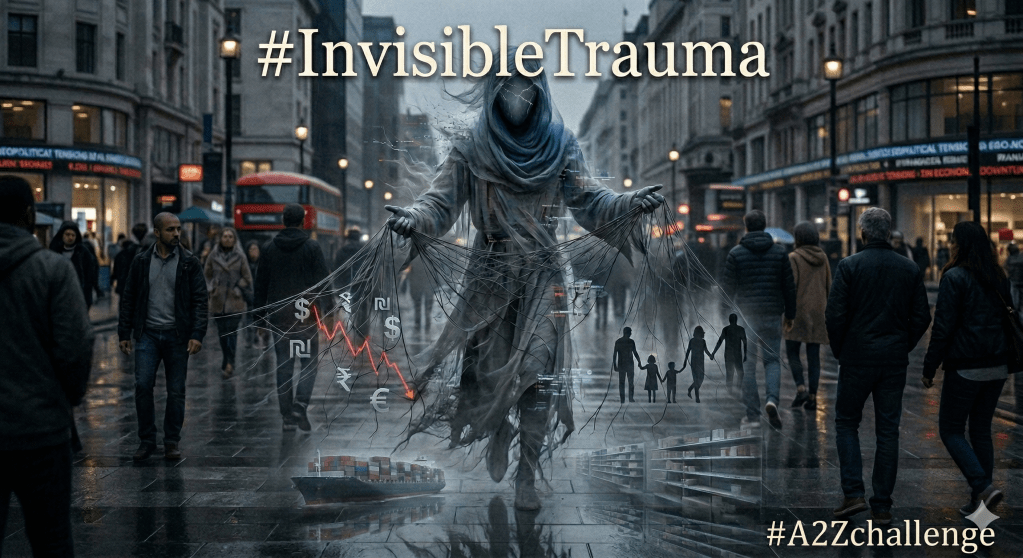
Invisible Disruptions of War
I have learnt, in clinics more than in conferences, that war does not always arrive with the decency of gunfire. Sometimes it comes dressed as discipline, carrying files instead of rifles, and speaking in the polite language of national interest. No explosions. Just an eerie, well-administered silence. As a doctor, I have always found silence more ominous than screaming—it usually means something vital has already shut down.
During the The Emergency (India), I was ten years old. An age when one is ideally concerned with cricket scores and चोरी of mangoes. Instead, I was introduced early to the fine art of not saying things out loud. I remember being told—firmly, repeatedly—that opinions were best kept indoors, like expensive crockery. We had friends whose parents simply… disappeared. No explanations, no closure. Just an absence that adults refused to discuss and children were expected to ignore. It was my first lesson in state-sponsored vanishing acts—far more efficient than any magician.
Looking back now, with a stethoscope and some cynicism, I see the Emergency not just as politics, but as a clinical condition. A nation under sedation. Fundamental rights withdrawn like oxygen. The patient did not scream—it complied. On paper, the vitals were stable. In reality, the soul was on assisted ventilation.
And yet, like any organism unwilling to die politely, society developed its own bypass mechanisms. What we now call quiet resistance—a phrase so gentle it almost hides its own courage.
This was not the stuff of patriotic cinema. No background music. No slow-motion marches. Just pamphlets slipped under doors, meetings disguised as bhajans, and conversations conducted at a volume slightly above a whisper and slightly below paranoia. As a clinician, I would classify these as micro-survival responses—small, persistent, and annoyingly difficult to suppress.
The underground press functioned like a back-alley dispensary. Questionable hygiene, unreliable equipment, but absolutely essential. Cyclostyle machines hummed in hidden corners, producing literature that people consumed the way one consumes contraband medicine—quickly, discreetly, and with a constant eye on the door. Information became a controlled substance. Possession could be risky. Distribution, positively heroic.
We like to imagine resistance as dramatic. In reality, it is often people pretending to agree while quietly refusing to comply. A nation mastering the fine distinction between obedience and agreement.
I see echoes of this in Apartheid in South Africa, where dissent hid in songs and sermons, and in Pinochet dictatorship, where grief was stitched into fabric because saying it aloud was bad for one’s longevity. Even after the Tiananmen Square protests, resistance did not die—it simply learnt better manners. It stopped shouting and started speaking in code.
And then there is Mahsa Amini protests—a modern case study in how quickly loud defiance is replaced by quieter, more sustainable disobedience. A headscarf removed here, a rule ignored there, a joke circulating online with no author but many admirers. If an invasion were to complicate matters, it would not create resistance—it would merely refine it. Make it more subtle. More domestic. More difficult to diagnose.
Power, I have noticed, prefers spectacle. It knows how to crush crowds. It is far less effective against habits.
Under such conditions, society develops what I can only describe as a functional split personality. The public self becomes cautious, compliant, almost theatrically obedient. The private self remains alert, critical, occasionally subversive. Not hypocrisy—just survival with good manners.
We learn to:
- Speak carefully
- Trust selectively
- Remember strategically
Truth becomes a prescription-only drug—dispensed in small doses, to trusted recipients, with strict instructions not to share.
But this adaptation is not without side effects.
Clinically, what emerges is not breakdown, but compression. A tightening of the mental space. People develop hypervigilance—the ability to read danger in pauses, glances, and unfinished sentences. Anxiety becomes chronic, like untreated hypertension—rarely dramatic, always damaging. There is moral injury, particularly among those tasked with enforcing rules they privately disagree with. And families absorb it all, quietly, efficiently, passing it down as intergenerational caution.
Children, especially, learn fast. I did. Not through lectures, but through silences.
And yet, curiously, those who engaged in even the smallest acts of quiet resistance seemed… better off. Not safer, certainly, but psychologically sturdier. Give a person a leaflet to distribute, a meeting to attend, a truth to whisper—and you restore something medicine struggles to manufacture: agency.
It is not the scale of the act. It is the message it sends inward:
I am not entirely powerless.
That, in my experience, is a far superior antidepressant than anything in my prescription pad.
So we arrive, inevitably, at the paradox.
Quiet resistance is both a symptom of a sick system and a therapy for those trapped within it. It does not topple regimes overnight. It does something far more inconvenient—it refuses complete surrender.
And if there is one thing both medicine and history agree on, it is this:
You can silence people.
You can censor print.
You can make individuals disappear.
But you will fail—repeatedly, predictably—to eliminate small, stubborn acts of defiance.
They look insignificant.
They sound like whispers.
But collectively, they are how a society keeps its pulse going—quietly, defiantly, and just out of reach of those trying to stop it.
This post is written for A2Zchallenge by Blogchatter.


Leave a Reply