Undercover Disruption Of War
Ration Cards: A Clinical Inheritance
In my clinic, scarcity does not arrive as empty shelves. It arrives as symptoms.
A middle-aged man who insists on storing rice in three different containers—“just in case.” A young woman who cannot tolerate an empty fridge, even for a night. An elderly patient who eats half a meal and quietly saves the rest, though there is more than enough at home. I diagnose anxiety, sometimes obsessive traits, occasionally disordered eating. But if I am honest—and age, or perhaps my grandfather, has made me more honest—I am often diagnosing memory disguised as behavior.
My grandfather, a doctor and reluctant social activist, never spoke dramatically about hardship. He had the irritating habit of understating history. His stories of World War II were not about war. They were about ration cards. According to him, ration cards were very civilized instruments. They allowed governments to distribute scarcity with dignity. You stood in line, you received less than you needed, and you thanked the system for its efficiency. Starvation, he implied, was best managed administratively.
As a child, I thought he was joking. As a clinician, I am no longer sure.
What my grandfather described casually, I now see clinically. Hoarding that masquerades as preparedness. Food preoccupation that patients call “being careful.” Irritability that has no obvious trigger but a long invisible history. A quiet, persistent loss of trust—in systems, in supply, sometimes even in tomorrow. These are not random pathologies. They are patterned. Predictable. Almost textbook—if one bothers to read the right textbook.
The Minnesota Starvation Experiment documented it decades ago with uncomfortable precision: obsession with food, ritualistic behavior, social withdrawal, emotional volatility. The body was semi-starved; the mind was entirely occupied. What interests me is not the experiment itself, but how often I encounter its echoes in patients who have never been formally starved.
My grandfather used to say, with a straight face, that scarcity is the most efficient teacher of discipline. He said this as someone who had lived through systems where coupons dictated appetite. What he did not say—but demonstrated—was that scarcity also teaches suspicion. Suspicion that supply will fail. Suspicion that others will take more. Suspicion that rules are negotiable, especially if survival is at stake.
In clinical language, we call this hypervigilance. In ordinary language, it is simply not trusting abundance.
I see it in patients whose parents or grandparents lived through shortages. They have never queued for food, yet they behave as if the queue is merely delayed. This is not metaphorical. It is intergenerational conditioning—part learned, part observed, possibly even biological.
Then came COVID-19, and for a brief, fascinating period, the entire population behaved like a controlled experiment. No formal ration cards, yet widespread rationing behavior. No famine, yet intense food anxiety. No war, yet unmistakable scarcity psychology. Patients who had never worried about food began to stockpile irrationally. Others developed binge-restrict cycles, alternating between control and loss of control. Many described a constant, low-grade unease—what they called “stress,” but what looked suspiciously like anticipatory deprivation.
The World Health Organization reported a 25% rise in anxiety and depression. Useful statistic. But numbers, like ration cards, are tidy representations of untidy realities. What I observed was simpler: people had lost their sense of predictability. And the human mind, when deprived of predictability, begins to ration—not food—but certainty.
My grandfather never used psychiatric terminology. He preferred observation, often delivered with a dryness that bordered on mischief. He once told me, “When the system cannot provide, the citizen will improvise. When the citizen improvises too well, the system calls it corruption.” At the time, I thought it was political commentary. Now I recognize it as behavioral insight.
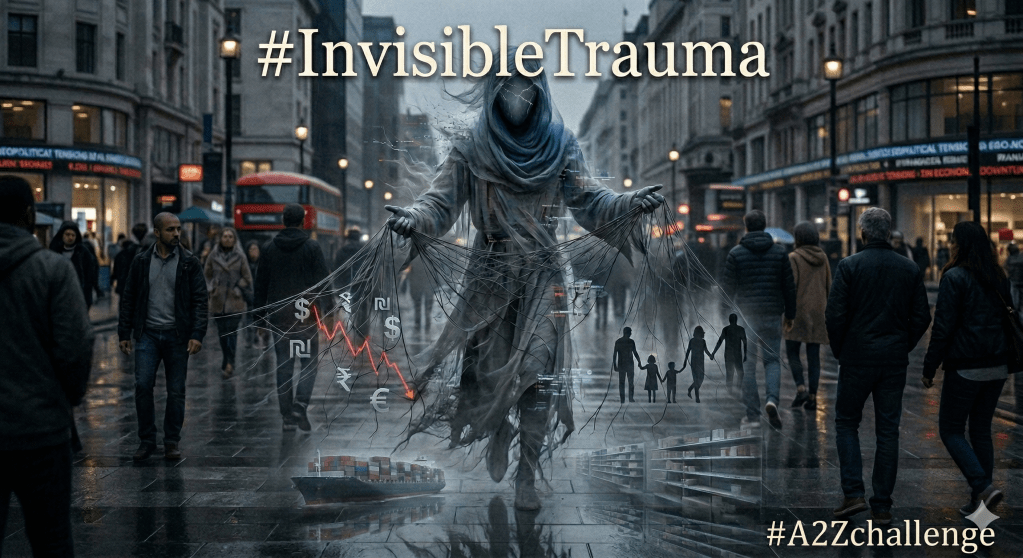
Rationing systems—whether wartime coupons or modern LPG limits—do not just distribute goods. They reshape behavior. They normalize queueing, legitimize hoarding, and quietly encourage parallel economies. From Venezuela’s structured shortages to India’s LPG delays, the pattern is tediously consistent: where official supply falters, informal systems flourish. The patient adapts. The system pretends not to notice.
With ongoing disruptions around the Strait of Hormuz, I find my grandfather’s stories becoming less historical and more predictive. Fuel is limited. Gas is delayed. Electricity is rationed politely. The tools have improved—QR codes instead of paper cards—but the psychology remains stubbornly analog.
Patients now report irritability linked to fuel queues, anxiety over rising costs, and a subtle reduction in social engagement. They travel less, meet less, trust less. Scarcity, even when partial, has a way of shrinking life.
If I were to summarize my grandfather’s lifelong lesson in clinical terms, it would be this: scarcity is not an event; it is a condition. And like most conditions, it leaves residual symptoms. We treat anxiety, but not always its origin. We manage behavior, but rarely its history.
The ration card—whether physical or psychological—persists long after it is officially withdrawn.
My grandfather carried one in his pocket. My patients carry one in their minds. And I, sitting between them, occasionally suspect that what I call a diagnosis is merely a well-preserved memory of not having enough—disguised, as always, in perfectly reasonable behavior.


Leave a Reply