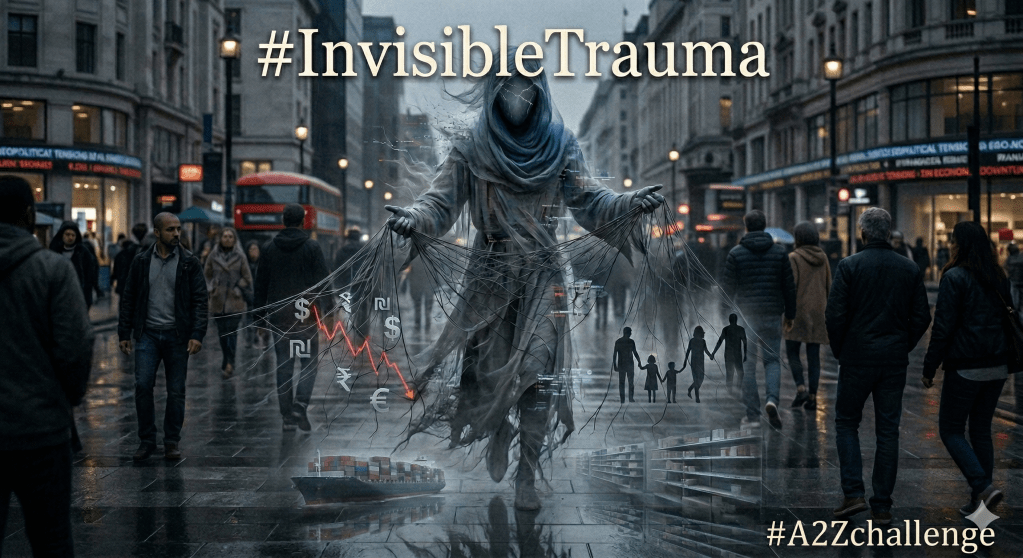
This post is Written for #A2Zchallenge by Blogchatter:
Undercover Disruptions Of War
Supply chain fragility is not something most people discuss over dinner—unless the dal is missing, the gas cylinder is delayed, or the onions have suddenly acquired the status of gold jewellery. Then, like all great philosophies in India, it becomes intensely practical.
What we call “just-in-time” systems—that elegant global ballet of ships, trucks, and warehouses—works beautifully until it doesn’t. It is a system designed by accountants: minimal inventory, maximal efficiency, no room for sentiment or запас (forgive the intrusion of a non-English word; scarcity has a way of making languages porous). The trouble is, reality is not an accountant. Reality is a virus, a submarine, a санкция, or a politician with a tariff chart.
My father, Dr. Srinivasa Rao P.N., would occasionally remind us—usually while carving a mango with surgical precision—that during World War II, ships did not arrive because other ships were busy sinking them. My grandfather, Dr. H.V. Hande, added that rationing was less about fairness and more about making sure panic did not outrun supply. People adjusted. They always do. Hunger is an excellent teacher; it has no patience for ideology.
Fast forward to COVID-19, when suddenly the world discovered that masks and gloves were not grown on trees (though we tried very hard to behave as if they were). Production was concentrated in a few geographies, borders stiffened, and logistics choked. The result was predictable: scarcity, followed by panic buying, followed by the quiet realization that toilet paper, like dignity, is not guaranteed in a crisis.
Here in Goa, the response was less dramatic but more instructive. When supply chains hesitated, backyards cleared their throats. Jackfruit, papaya, chilies, tomatoes—nothing exotic, nothing Instagram-worthy, just stubborn, local abundance. We discovered barter again, not as a nostalgic hobby but as a working system. One neighbour’s excess became another’s dinner. No invoices, no GST, no quarterly earnings call—just trust and the mild suspicion that someone might be getting a better deal.
This is the thing about disruption: it exposes the fiction of permanence. We assume that because something is available today, it will be available tomorrow. But whether it is a U-boat blockade, a pandemic lockdown, or the hypothetical closing of the Strait of Hormuz, the effect is the same. Energy prices jump, transport costs follow, fertilizers sulk, and food politely becomes unaffordable. Civilization, it turns out, runs on diesel and assumptions.
My aunt—Paddu, retired central services, a woman who can reduce any ideological argument to a file noting—would say this is a failure of policy imagination. We optimized for efficiency and forgot redundancy. We built systems that work brilliantly in good times and collapse theatrically in bad ones. Her prescription is simple: diversify supply, stockpile essentials, and never trust a single point of failure. In other words, treat global logistics the way a cautious Indian family treats marriage alliances—always have a backup.
But policy is only half the story. The more interesting transformation happens at the level of behaviour. Scarcity begins with individualism—people hoard, queue, and eye each other suspiciously. Then, if the shortage persists, something shifts. Cooperation sneaks in. You borrow, lend, exchange recipes, share seeds. You become, reluctantly, part of a community.
Psychologists call this the scarcity mindset—a narrowing of attention, a constant mental arithmetic of “how much is left.” It is exhausting. Decisions become harder, tempers shorter, sleep lighter. Yet, paradoxically, when people begin to act—to grow, fix, trade—the mental fog lifts a little. Agency returns. You are no longer waiting for the system; you are quietly bypassing it.
During COVID, there were studies—very serious ones, with graphs and p-values—that showed home gardening reduced stress and improved well-being. One could have told them this without the statistics. There is something deeply reassuring about putting a seed in the ground and getting food out of it. It feels like cheating the system, which, in a way, it is.
War, of course, is less forgiving. The psychological toll—anxiety, depression, trauma—is well documented. But even there, human beings display a perverse resilience. In bombed cities, in ration queues, in disrupted lives, people find routines, humour, and occasionally even joy. My grandfather used to say that after a certain point, fear becomes boring. One must get on with lunch.
The larger lesson is uncomfortable. Our global systems are fragile by design. They are efficient, yes, but brittle. When they fail, they fail quickly and widely. Yet the response to that failure is not merely suffering; it is adaptation. Local systems emerge, social ties strengthen, and individuals rediscover skills they did not know they possessed.
So the next time the supermarket shelves look a little uncertain, it may be worth remembering that resilience does not arrive in containers. It grows in backyards, travels across fences, and occasionally sits down at your dining table disguised as a conversation.
And if all else fails, there is always jackfruit. It is impossible to eat gracefully, smells faintly suspicious, and yet, in a crisis, becomes indispensable. Much like most of our systems.
Notes / References (indicative, for credibility framing):
[1] Ivanov, D. & Dolgui, A. (2020). Viability of supply chain systems under pandemic disruptions.
[2] World Bank (2022). Global Economic Effects of COVID-19 and Supply Chain Disruptions.
[3] Tooze, A. (2021). Shutdown: How COVID Shook the World’s Economy.
[4] UK National Archives. WWII Rationing and Civilian Supply Systems.
[5] FAO (2021). Impacts of Energy Prices on Food Systems.
[6] Soga, M. et al. (2021). Gardening is beneficial for health: A meta-analysis.
[7] Mullainathan, S. & Shafir, E. (2013). Scarcity: Why Having Too Little Means So Much.


Leave a Reply