Undercover Disruptions Of War
There is something almost mischievous about war. It destroys loudly, but it builds quietly. While men argue over borders and egos, technology slips out the back door, changes its clothes, and returns years later as a polite guest in our homes.
Take radar—once busy spotting enemy aircraft, now helping you decide whether to carry an umbrella. Or that indispensable companion of modern life, the internet, which began as a nervous Cold War experiment called ARPANET, designed less for cat videos and more for surviving nuclear fallout. One cannot help but admire the irony.
History, if you pay attention, has a wicked sense of humour.
Penicillin, for instance, did not emerge from a moral desire to heal humanity—it was hurried into mass production because too many soldiers were dying inconveniently. Today, it sits casually in pharmacies, as if it had always belonged there. The jet engine, once roaring across war-torn skies, now delivers honeymooners to Bali. Even GPS, that calm voice telling you to “recalculate,” was originally meant to guide missiles, not lost drivers with fragile egos.
War, it seems, is an excellent but deeply unethical venture capitalist.
Then came COVID-19, a crisis without uniforms but with all the urgency of one. Suddenly, the world discovered mRNA vaccines, not as a slow academic curiosity but as a necessity. Doctors began appearing on screens instead of in clinics—telehealth became less of an option and more of a habit. Offices dissolved into Zoom calls, and the dining table acquired a new identity as a workstation. Society did not evolve—it was shoved forward, slightly breathless.
Now we watch the unfolding tensions of the Iran conflict in 2026, and though it is too early to write its obituary, the patterns are already familiar. There is talk of AI-driven warfare, of algorithms making decisions that once required human hesitation. Companies like Palantir Technologies sit quietly in the background, turning data into strategy. Meanwhile, the invisible battlefield—cyberspace—has proven that you do not need bombs to disrupt a nation; a well-placed attack on systems like Amazon Web Services can do the job just as effectively, and with far less noise.
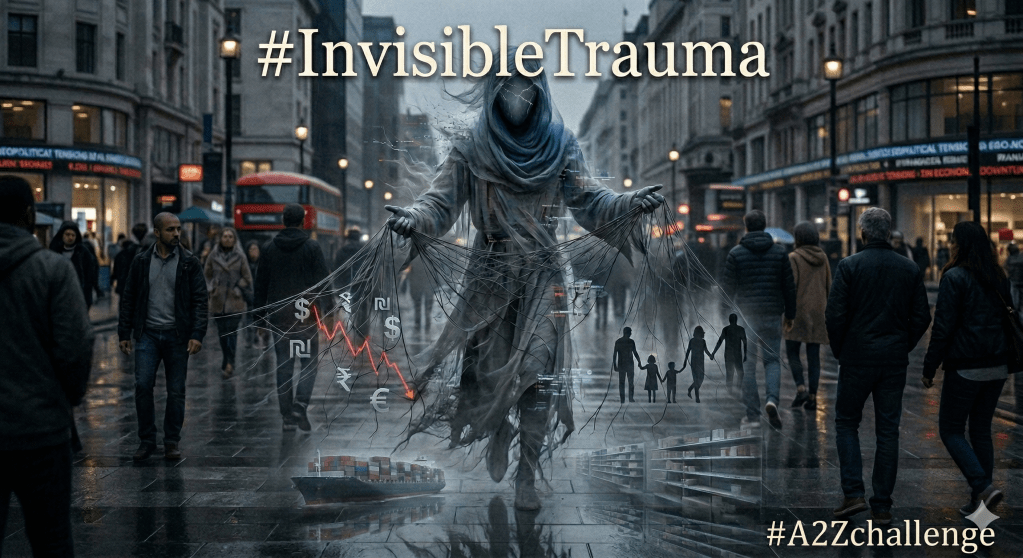
What spills into civilian life is not always visible at first. It rarely is.
Instead, it arrives as convenience. Faster networks. Smarter systems. More “secure” platforms. And before long, we are dependent on them—checking maps, trusting algorithms, storing our lives in clouds we do not quite understand.
But beneath this shiny layer lies a quieter transformation.
Society becomes efficient, yes—but also uneven. Those with access to technology surge ahead; those without are left squinting at a future that arrived too quickly. Social behaviour shifts subtly. Conversations move online. Privacy becomes negotiable. Surveillance—once a necessary evil of war—starts to feel like a routine inconvenience.
And then there is the matter of the mind.
We are more connected than ever, yet curiously more restless. There is a new habit—doomscrolling—a word that would have baffled our grandparents. We consume crises in real time, as if anxiety were a form of participation. Mental health becomes the silent casualty: not dramatic enough for headlines, but persistent enough to shape a generation.
The truth is, these technological gifts come with memory. They remember the urgency, the fear, the chaos that created them. We inherit the benefits, but also the tempo—the speed at which they demand we live.
Khushwant Singh might have chuckled at this point and poured himself a drink. He would have noted, with characteristic bluntness, that humanity has an odd habit of producing its finest inventions at its worst moments.
And perhaps he would have added, with a raised eyebrow, that while we celebrate progress, we rarely pause to ask—progress towards what?
Because if history has taught us anything, it is this: war may end, but its ideas do not. They linger, adapt, and eventually make themselves comfortable in our daily lives—quiet, efficient, and just a little unsettling.
This post is written for Blogchatter A2Zchallenge.


Leave a Reply