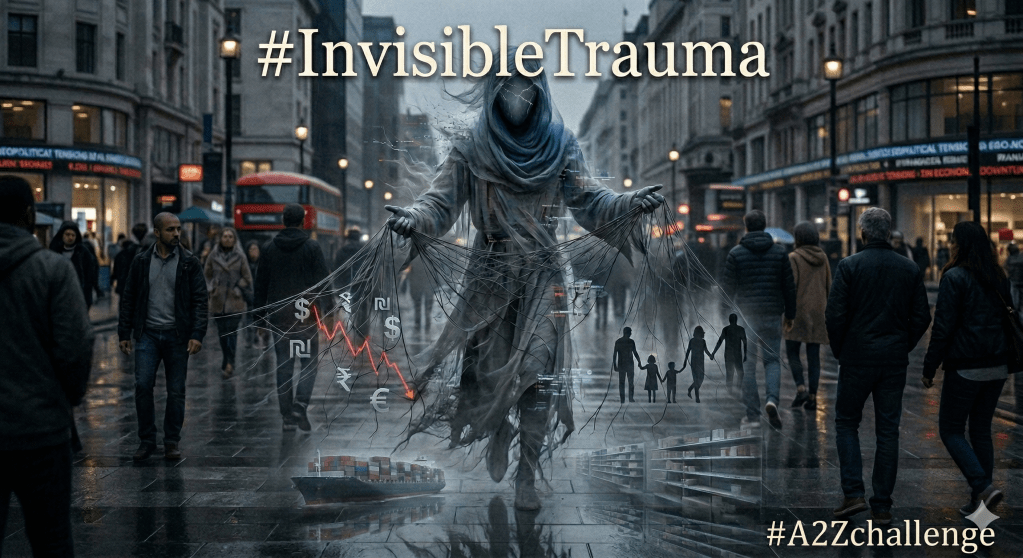
Undercover Disruptor Of War
Wars don’t just break cities; they quietly rearrange the contents of our cupboards and, more dangerously, our conscience. Somewhere between ration cards and missing fabric, a value reset took place—one that taught people not merely how to survive, but how to use, reuse, and then reuse the reuse until even guilt had no waste left in it.
I suspect I am a late beneficiary of that disruption, because my daughter and I are now engaged in what I can only describe as a domestic aftershock. She declutters. I preserve. She resets. I remember.
The other day she held up a slightly faded dupatta like it had personally offended her. “This doesn’t go with my aesthetic anymore,” she declared, which in modern parlance means it has failed to keep up with trends faster than political loyalties. Into the discard pile it went. I nearly intervened with the urgency of an emergency physician.
You see, I come from the Make Do and Mend civilization—an ancient order where objects were not discarded, they were reassigned duties. This wasn’t frugality; it was strategy. My parents inherited it from theirs, who had lived through war and scarcity, when throwing things away wasn’t minimalism, it was borderline insanity.
I still remember my mother and her friends from the Mahila Samaj, sleeves rolled up, packing parcels for war-ridden areas. There was no grand speech, no social media documentation—just quiet efficiency. Things were sent not because they were surplus, but because they could be spared. That distinction mattered. A slightly worn sari, a serviceable utensil, blankets that had seen better winters—all packed, labeled, and dispatched with a kind of dignity that required neither gratitude nor acknowledgment. Giving was not charity; it was continuity.
Even the idea of organizations like the Salvation Army carried that same wartime ethic—redistribution without drama. The donor did not feel virtuous. The receiver was not diminished. Objects simply moved along the chain of need, like well-trained soldiers reporting to their next posting.
And then there was my grandfather, who managed to summarize an entire philosophy with disarming elegance. Praising his sister, he said, “She converts kasa to rasa.” Scrap to essence. Waste to worth. Today we would call it upcycling and charge a consultancy fee. Back then, it was just considered good sense and better upbringing.
My daughter, however, belongs to a more ruthless economy of objects. If it doesn’t align—with the room, the mood, or the algorithm—it must go. There is a chilling efficiency to it. No nostalgia, no second chances. I watch perfectly usable items being dismissed like underperforming interns.
And yet, I am forced to admit, we are not entirely innocent either. Our generation celebrated abundance with the enthusiasm of survivors who had finally found a buffet. We bought more than we needed, just to prove we could. Perhaps her “junks” are merely a counterattack to our “just in case” hoarding.
Still, I maintain there is a difference between editing and erasing. Between thoughtful curation and reckless amputation. One asks, “Does this serve me?” The other forgets to ask, “Could this serve someone else?”
As a doctor, I see the metaphor too clearly. Remove too much, and the system collapses. Retain everything, and it suffocates. Balance is not instinctive; it is learned—and apparently, unlearned within a generation.
As a mother, I exercise restraint, which is to say I mutter internally while smiling externally.
As a daughter, I remain loyal to a lineage that saw potential where others saw redundancy.
And as a quiet watcher of my own tribe—especially now, with the tensions around Iran simmering into something far less polite than diplomacy—I notice my peers and contemporaries gently returning to the old instinct: the cupboard expands, the extra bag of rice appears, the “just in case” creeps back in. Not panic, not yet—but memory stirring. (Reuters)
I find this darkly reassuring.
We have moved from “Use it up, wear it out” to “Throw it out, it doesn’t match the cushions”—and now, perhaps, inching back to “Keep it… just in case the world remembers how fragile it is.”
My daughter calls it decluttering. I call it a well-documented case of selective amnesia.
Somewhere between her cardboard boxes and my overstuffed cupboards lies a fragile ceasefire. Though I suspect it will collapse the day she discovers my collection of perfectly functional plastic containers—which, much like wartime values, refuse to die quietly.
This post is written for #A2Zchallenge by @Blogchatter
 Parwatisingari's Weblog
Leave a comment