Undercover Disruptions Of war
There is a certain kind of conversation that unfolds at the dining table—where history is not distant, but clinical; where war is not strategy, but aftermath.
My grandfather, Dr. H. V. Hande, would begin with epics. My father, Dr. Srinivasa Rao, would quietly translate them into physiology.
After the Mahabharata, Yudhishthira did not inherit power as much as he inherited absence. A land emptied of men. Homes reorganized around widowhood. A society anxious about continuity, but curiously silent about the expanding burden of caregiving.
Repopulation becomes duty in such narratives. Caregiving does not.
That silence is not ancient. It repeats.
My grandfather moved easily from epics to patients. Rukmini was one such story—a young woman engaged just before war. The household celebrated, but beneath it lay calculation. Not just of death, but of survival altered—injury, disability, dependency.
The anxiety in her family was not abstract. It was logistical. Who would care, and for how long?
Rukmini’s question lingered longer than the answers. If the same fate had occurred after marriage, the debate would have disappeared. The burden would have settled—quietly, decisively—on her.
That is how caregiving is assigned. Not negotiated, but absorbed.
Across wars, across geographies, the pattern holds.
After World War II, millions of women entered widowhood, rebuilding families with no language for the labour they carried. In modern conflict zones, healthcare collapses, and women become the default system—nursing the injured, raising children, sustaining households.
Even biology begins to reflect this burden.
After the Atomic bombings of Hiroshima and Nagasaki, there were measurable disruptions in women’s reproductive health—menstrual irregularities, ovarian damage in high exposure groups, and stress-mediated fertility changes. Yet fertility did not collapse uniformly. Many women conceived and rebuilt families.
The body endures.
But endurance is not the same as well-being.
War affects fertility not only through radiation or toxins, but through stress, trauma, and systemic collapse. When healthcare systems fracture, women lose access to maternal care, reproductive services, and even basic safety in pregnancy.
So fertility becomes paradoxical.
It may persist biologically.
But it becomes socially and physically more dangerous.
And caregiving expands alongside it.
If one were to project this pattern onto a potential conflict involving Iran, the trajectory is not difficult to anticipate.
Not because of speculation, but because the template already exists.
An increase in widowhood, immediate or delayed. A rise in chronic caregiving—for the injured, the disabled, the aging. A healthcare system under strain, shifting the burden of care into homes.
Disruptions in menstrual health and fertility—not necessarily collapse, but irregularity, delay, risk. More complicated pregnancies. More silent losses. Not always because bodies fail—but because systems do.
Layered onto existing structural constraints, this becomes a compounded care burden.
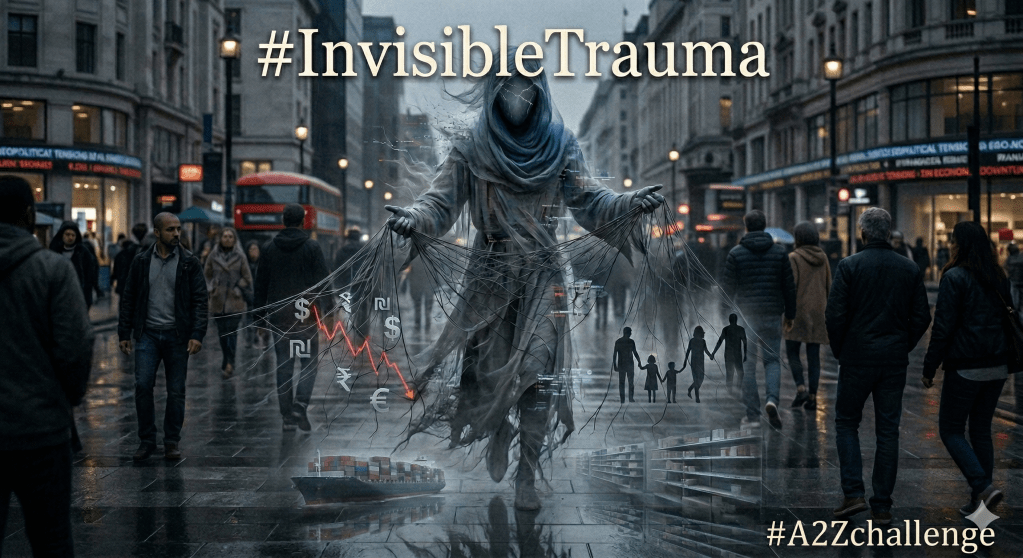
The visible narrative will remain geopolitical.
The invisible one will be biological and domestic.
Women will hold together families, absorb trauma, sustain reproduction, and compensate for institutional absence—all at once.
This is where the idea of war as an event fails.
War is a redistribution mechanism.
It redistributes death visibly.
It redistributes care invisibly.
And that invisible redistribution has consequences.
Chronic stress becomes disease.
Unpaid labour becomes economic distortion.
Widowhood becomes a long-term social condition, not a moment of loss.
Societies appear to recover because this labour exists. But that recovery is built on depletion—of bodies, of time, of mental resilience.
At the dining table, this never needed dramatic language.
It was understood quietly.
That the real aftermath of war is not counted in casualties.
It is carried—in kitchens, in sickrooms, in the bodies of women who continue to function long after systems have failed.
And the question is no longer whether they will endure.
It is how much more they can absorb before that endurance itself becomes the next fracture.
Footnote & Sources
- Studies on conflict and reproductive health: Armed conflict and reproductive health outcomes, PubMed indexed research.
- Healthcare system collapse and maternal risk in conflict zones: SpringerOpen public health analyses.
- Long-term fertility and genetic outcomes: Research by the Radiation Effects Research Foundation on atomic bomb survivors.
This post is part of the Blogchatter A2Z Challenge. Explore more voices and narratives here: https://www.blogchatter.com


Leave a Reply