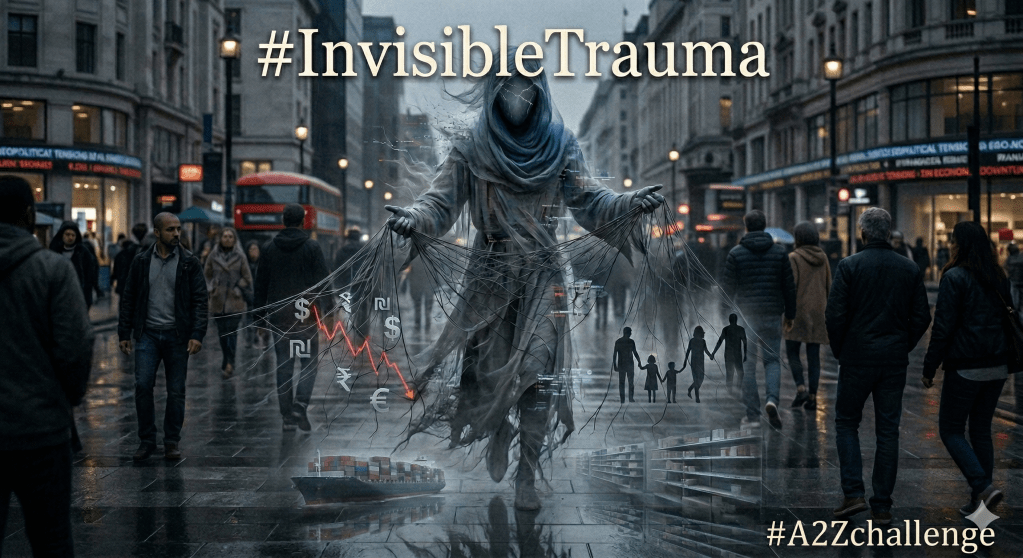
Undercover Disruptor Of War
XENOPHOBIA: The Undercover Disruptor of War
It never walks into the clinic calling itself XENOPHOBIA.
It prefers aliases. Insomnia. Irritability. A vague sense that the world has become… untrustworthy. Patients don’t say, “I fear outsiders.” They say, “Something feels off.” Which, clinically speaking, is how most large problems introduce themselves—politely.
At the dining table, the diagnosis is less delicate.
My grandfather, Dr. Hande, treats conversation the way he treated patients in his years of practice and public office—no rush, no drama, just a slow peeling back of symptoms. He has little patience for grand theories. Patterns, however, interest him.
And this one, he has seen before.
Post–World War I, for instance. Anti-German sentiment wasn’t just a political mood; it was a full-blown social diagnosis masquerading as justice. The Treaty of Versailles didn’t just punish Germany—it quietly rebranded Germans as a recurring problem. Turns out, when you pathologize an entire population, they don’t respond with gratitude. They respond with history.
After 9/11, the same clinical picture re-emerged with a different patient. Islamophobia—though no one liked using the word then—performed the same trick. Entire populations were recoded as risk factors. In medicine, we’d call that a catastrophic overgeneralization. In geopolitics, it gets you surveillance programs, invasions, and a generation of people explaining themselves at airports.
In the clinic, I see what that does to the body.
Fear, once normalized, doesn’t stay in the headlines. It migrates. It settles into muscle memory. It shortens tempers, disturbs sleep, and sharpens suspicion. The nervous system, much like foreign policy, doesn’t do nuance particularly well.
My grandfather listens to this, mildly amused.
He has always maintained that fear is the most efficient epidemic nobody wants to declare. No funding required, excellent transmission rate.
The 2026 Iran conflict, he says, feels “familiar”—which is not a comforting word when used diagnostically.
It isn’t quite a war in the old-fashioned sense. No boots marching endlessly across borders—at least not yet. Instead, we have airstrikes, assassinations, and economic strangulation. A sort of minimalist warfare. Efficient. Almost elegant, if you ignore the consequences.
But the real tell, as always, is the language.
Iran is no longer discussed as a country with factions, contradictions, or people trying to get through their day. It becomes something larger and conveniently simpler—a civilizational threat. Nuclear ambition, religious identity, proxy networks—all folded neatly into the figure of the dangerous “other.” The regime and the people blur into one convenient silhouette.
Groups like Council on American-Islamic Relations have pointed out, with admirable restraint, that this is usually where things begin to slide—from political critique into something that starts sounding suspiciously like a cultural diagnosis.
At the dining table, this is where the cutlery slows.
Because we know the next set of symptoms.
Since the February strikes, the usual pattern has reappeared on schedule. Harassment. Social media turning inventive in its cruelty. Workplace unease. Children asking questions they didn’t invent but now have to carry. Muslim, Arab, and Iranian communities—regardless of their politics—become convenient receptors for a conflict they didn’t design.
In the clinic, it shows up as vigilance.
Not paranoia exactly—just a persistent sense of being measured. Watched. Interpreted. The kind of low-grade psychological inflammation that doesn’t make headlines but alters behavior all the same.
My grandfather, predictably, is less interested in the primary injury and more in what he calls the secondary infections.
Because XENOPHOBIA, once it settles in, does something quite useful for war: it lowers the bar.
Assassinations become strategy. Sabotage becomes necessity. Proxy conflicts become prudent planning. All of it easier to justify when the target has already been stripped of complexity. If the “other” is dangerous enough, almost anything starts to look like prevention.
The early phases of the Iran conflict fit this pattern with uncomfortable precision. Targeted killings. Infrastructure strikes. Economic blockades. Quick, deniable, wrapped in the language of inevitability. Public scrutiny softens—not because people stop caring, but because they’ve already been taught what to expect from the subject.
Fear, after all, is an excellent editor.
At some point between the clinic and the dining table, a stray thought slips in—uninvited, but persistent.
I wonder if Google doctors and AI researchers ever get diagnosed with XENOPHOBIA. Not the dramatic kind—nothing so obvious. Just the quieter version: mistrust of the unfamiliar input, overcorrection in the face of perceived threat, a tendency to classify the “unknown” as risk before it has a chance to be understood. Different lab, same reflex.
My grandfather would probably call that a stretch.
Or he might not.
At some point, the conversation returns—as it always does—to what happens after.
He has a long memory for these things. Post–World War I resentment didn’t dissolve; it fermented. Post-9/11 fear didn’t fade; it institutionalized itself. And now, with Iran, the question isn’t just whether the conflict escalates or pauses politely at a ceasefire.
It’s what is being sedimented.
Civilian suffering, infrastructural damage, the quiet suggestion that an entire culture is suspect—these don’t disappear when diplomacy resumes. They settle into collective memory. They harden into identity.
Iran’s internal diversity complicates the picture further. External fear has a way of turning inward. Ethnic and sectarian fault lines become easier to manipulate when a society feels under siege. Economic pressure reframes ordinary survival as global disruption. Even trade begins to look suspicious if you squint hard enough.
At the table, no one feels the need to conclude anything too neatly.
Patterns don’t require conclusions. They repeat.
Fear becomes narrative. Narrative becomes policy. Policy becomes action. Action leaves residue.
And that residue—my grandfather would say, almost clinically—is what eventually turns up in quieter places. Clinics. Classrooms. Dining tables.
Never calling itself XENOPHOBIA.
But behaving exactly like it.
Footnote:
Xenophobia: an intense or irrational dislike or fear of people perceived as foreign or “other,” often leading to dehumanization, exclusion, and justification of unequal or violent treatment.
This post is written for Blogchatter’s A2Zchallenge.


 Parwatisingari's Weblog
Leave a comment