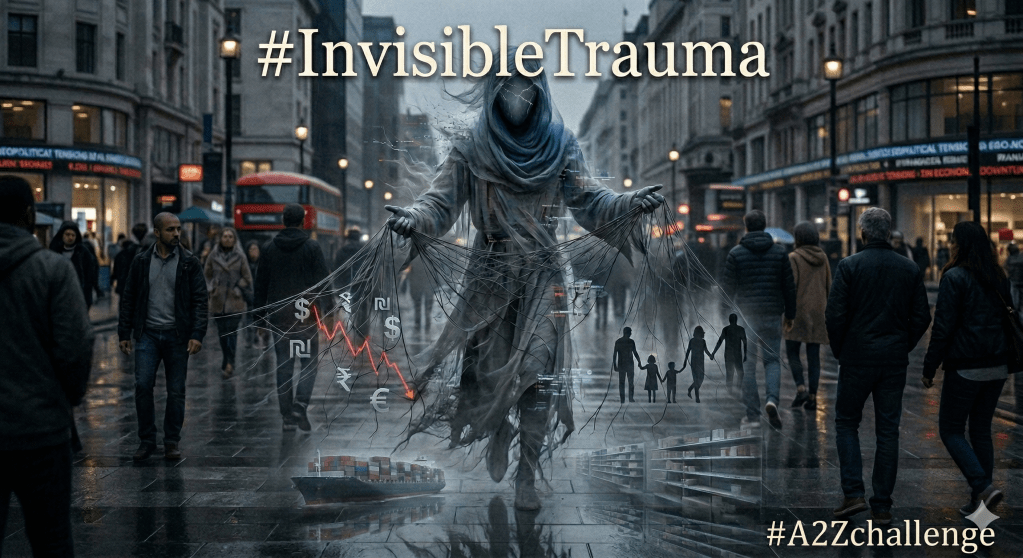
Undercover Disruptions of War.
War has a way of announcing itself loudly—bombs, borders, brave speeches—but it does its most efficient work quietly, almost politely, like an uninvited guest who rearranges the furniture of your life and leaves before you notice what’s missing. What it steals most effectively is not land or governments, but childhood—and it does so without paperwork, compensation, or apology.
Consider the aftermath of the World War I, which produced what we now grandly call the “Lost Generation.” Lost, as if they had misplaced themselves between Paris cafés and existential despair. In truth, they were not lost; they were interrupted. Boys who should have been worrying about exams learned instead about trenches and funerals. They grew up quickly, which is society’s polite way of saying they grew up damaged. Naturally, they turned to literature and art, because when reality becomes unbearable, one either writes about it or drinks excessively—many managed both. Their aspirations did not vanish; they simply curdled into cynicism and a lifelong suspicion that progress was a well-dressed lie.
Now shift to the rather more chaotic episode known as the Partition of India, where millions discovered overnight that their homes had developed political opinions. Children who had been memorizing multiplication tables suddenly had to memorize escape routes. Families fractured with an efficiency that bureaucrats could only envy. The young adapted, as the young inconveniently tend to do—through community rebuilding and migration networks—but their ambitions became modest, almost embarrassingly so. No one spoke of conquering the world; surviving it seemed quite achievement enough. Stability became the new success story.
The story repeats itself with the Kashmiri Pandits, who left their homes in the 1990s with the unsettling realization that nostalgia travels lighter than furniture. Their children inherited not houses, but memory—and memory, unlike real estate, appreciates in emotional value while offering no shelter. They adapted cleverly, as displaced communities often do, building diaspora networks and clinging to education like a life raft. Their aspirations look impressive on paper—professional success, mobility—but beneath it runs a quiet footnote: a longing for a place that exists more vividly in stories than in geography.
And then there are the children of the Syrian Civil War, who have mastered the art of growing up in installments. Schooling becomes optional, trauma compulsory. They learn resilience, which is a word adults use when children have no other choice. Informal classrooms emerge, families tighten ranks, and life goes on in a manner that would be admirable if it were not so tragic. Their aspirations undergo the most efficient downsizing imaginable: from dreams of becoming doctors or engineers to the far more attainable goal of staying alive. It is difficult to pursue ambition when survival is a full-time occupation.
For clarity—since we like our tragedies organized—the pattern looks something like this:
| Group | Childhood Impact | Survival Strategies | Long-term Aspirations |
|---|---|---|---|
| WW1 Lost Generation | Education interrupted, mass casualties, disillusionment | Literature, art, political activism | Cynicism, existential questioning, reshaping culture |
| Partition Children (India/Pakistan) | Sudden displacement, violence, fractured families | Community rebuilding, migration networks | Aspirations narrowed to stability, education, economic survival |
| Kashmiri Pandits | Forced exodus in 1990s, loss of homeland | Diaspora networks, emphasis on education | Identity preservation, professional mobility, nostalgia for homeland |
| Syrian Child Refugees | Trauma, disrupted schooling, malnutrition | Informal schooling, resilience through family bonds | Aspirations altered—focus on safety, basic livelihood, deferred dreams |
What unites these otherwise different histories is not just suffering—that is far too common—but a particular kind of undercover disruption. Childhood is not abruptly ended; it is gradually edited. Play is replaced by precaution, curiosity by caution, and imagination by inventory: food, safety, escape routes. Children begin to behave like sensible adults, which should alarm any sensible adult.
Psychologists would diagnose much of this as Post-traumatic stress disorder, along with its companions—anxiety, depression, and the general inability to believe that tomorrow will behave itself. But diagnoses are tidy things; lived experience is not. Trauma becomes less an event and more an atmosphere—something you breathe in daily, like polluted air. Over time, it settles into identity, producing individuals who belong simultaneously to the past they lost and the present they do not fully trust.
There is also the small matter of ambition. War does not eliminate ambition; it edits it ruthlessly. Grand plans are replaced by practical ones. Why aim for greatness when stability itself feels like a luxury item? Societies emerging from such experiences often develop a collective personality: cautious, pragmatic, occasionally suspicious of optimism. Risk-taking becomes unfashionable. Survival, after all, has proven more reliable than hope.
And yet, humanity insists on carrying on. People rebuild, write poetry, educate their children, and even laugh—sometimes at the absurdity of having survived at all. This is called resilience, a word that sounds heroic until one realizes it is often just endurance in better clothing.
The real tragedy is not only what war destroys, but what it quietly replaces. A generation that might have dreamed expansively learns instead to think defensively. A child who might have imagined possibilities learns instead to calculate probabilities—of danger, of loss, of escape.
War, in its efficiency, does not merely create victims. It manufactures adults too early, and in doing so, it steals the one resource no society can replenish: the luxury of an unbroken childhood.
This post was written for the Blogchatter A2Z Challenge.


Leave a Reply