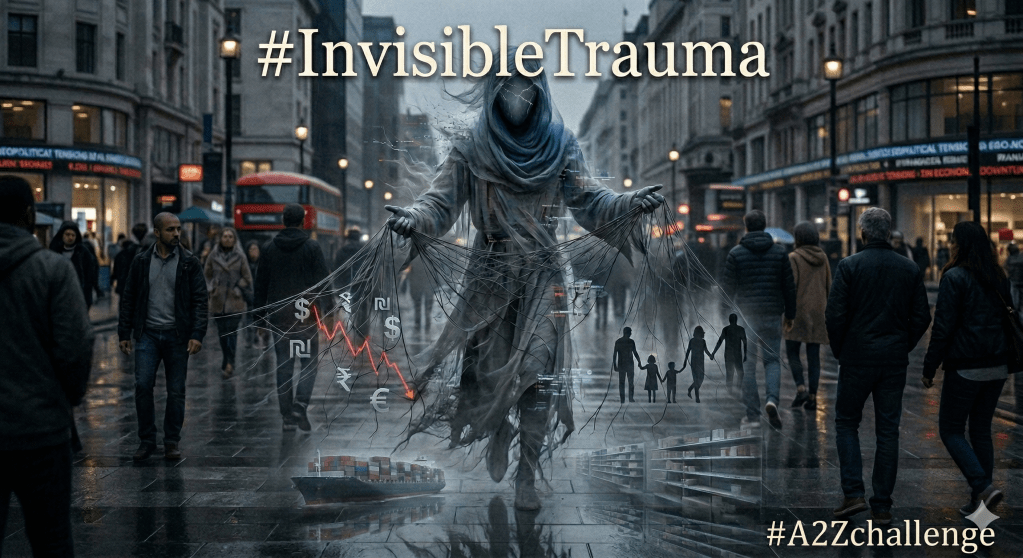
The Undercover Disruption of War
I have seen many illnesses in my time. Some come with a cough, some with a complaint, and some—like this one—arrive quietly, sit in the mind, and refuse to leave. We call it the zero-sum narrative. A respectable name for a rather uncivilized habit: your gain is my loss. Like neighbours fighting over a mango tree neither of them planted.
War, of course, is the most efficient teacher of such bad manners. Not the loud wars with tanks and headlines, but the quieter ones—the covert disruptions, the proxy games, the sabotage that never signs its name. These do not just break nations; they rearrange the mind. They teach people to doubt first and verify never. Paranoia, I have often thought, is the most successful export of modern conflict.
I grew up in the polite anxiety of the Cold War. Nobody fired a bullet at me, yet everyone behaved as if the world might end before dinner. Nations hoarded weapons like misers hoard gold, each convinced the other fellow was planning something unpleasant. Security became a limited commodity—like good whisky—best stored privately and never shared.
Then came the pandemic, and I had a front-row seat in the hospital. If the Cold War taught suspicion, vaccine nationalism perfected selfishness. Countries grabbed doses as if they were the last vials on earth. It would have been amusing if it weren’t so tragic—like passengers fighting over lifeboats while drilling holes in the ship. In trying to secure themselves, they prolonged the crisis for everyone. A fine example of intelligence misapplied.
From a doctor’s standpoint, the symptoms are familiar. Under stress, the human mind does not expand—it tunnels. Patients stop thinking of next month and focus on the next hour. Societies behave no differently. Cooperation, that sensible and efficient mechanism, is discarded for immediate self-preservation. Trust evaporates. Institutions begin to look like distant relatives—technically related, but not to be relied upon.
The psychological bill, as always, arrives later. Chronic scarcity breeds anxiety, depression, and a peculiar inability to feel happy for others. I have had patients who measure their worth entirely by what the neighbour owns. It is an exhausting way to live, rather like running on a treadmill that someone else controls.
Biology, unfortunately, keeps score. The body does not care whether the threat is real or imagined—it responds all the same. Cortisol rises, sleep declines, and the system remains on edge. And then comes the part that would have sounded like fiction when I was a young doctor: epigenetics. Trauma, it seems, is an inheritance. Not in stories alone, but in the very regulation of genes—NR3C1, FKBP5, those tongue-twisting custodians of our stress response. Alter them long enough, and even the next generation begins life slightly on edge, like a child born into a room where the argument never quite ended.
I have seen this in the children—no war stories of their own, yet a readiness for danger that feels rehearsed. War, famine, pandemics—they do not merely pass through populations; they linger in biology.
What fascinates me, in a grim sort of way, is how neatly this all feeds itself. The scarcity mindset creates behaviors—hoarding, distrust, competition—that generate actual scarcity. Less cooperation, fewer solutions. Fewer solutions, more fear. It is a perfect circle, the kind bureaucrats admire and patients suffer.
And yet, it is not incurable. The diagnosis is half the treatment. When one recognizes the narrowing of thought, the reflex to guard rather than share, there is a chance—just a small one—to behave differently. Cooperation, contrary to popular belief, is not charity. It is efficiency in its most elegant form.
But if we persist in teaching each generation that life is a contest with limited prizes, we should not be surprised when they inherit more than our anxieties. They inherit our biology of fear, neatly packaged and quietly active.
In medicine, we have a simple rule: untreated conditions tend to worsen.
In society, they do something far more ambitious—they replicate.
This post was written for the A2Zchallenge by Blogchatter.


Leave a Reply