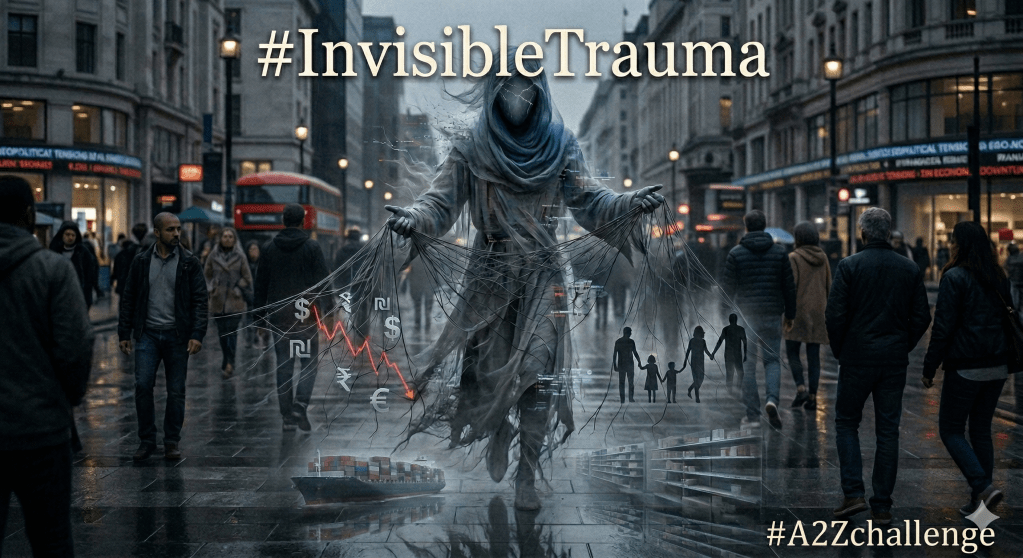
The Undercover Disruptions that are our Cope mechanism.
The end of April. And what a month it has been. I began with the tidy ambition of “writing a series” and ended up excavating a lifetime of borrowed fears, inherited instincts, and quietly rehearsed survival tricks. Somewhere between World War I, World War II, COVID, and the distant rumble of an Iran invasion, I realised I wasn’t just writing about wars. I was writing about us—how we bend, adjust, and occasionally pretend nothing is happening while everything is clearly on fire.
I submitted my anthology. I survived the A2Z Challenge. But more importantly, I stumbled upon an uncomfortable truth: disruption doesn’t arrive dramatically with tanks and sirens alone. It seeps in. It rearranges behaviour. It rewires what we consider “normal.”
Take our favourite inherited philosophy—adjust maadu. A phrase so harmless on the surface, so devastating in practice. We didn’t invent it. We absorbed it. From parents who lived through scarcity, uncertainty, and systems that rewarded compliance over curiosity. Adjustment became a virtue. Questioning became a luxury.
And then came the obsession with jobs. Not work. Not craft. Jobs. Stable, respectable, monthly salary jobs. The kind that allow you to sleep peacefully, even if you wake up uninspired. So we collected degrees like ration cards—proof that we deserved a place in the queue. Skills? Enterprise? Risk? Those were for other people.
But if I trace this mindset back, it doesn’t begin in classrooms or offices. It begins at the dining table.
Before television hijacked our evenings, we had conversations. Real ones. Grandparents, parents, children—everyone sat together. Food was served, but more importantly, stories were passed around. Observations, warnings, casual cynicism, and the occasional unsolicited wisdom. That was our first classroom in human behaviour.
And then there were the printed companions—the Illustrated Weekly and The Indian Express. Between them, they shaped how we saw the world. The Weekly gave us narrative, colour, a sense that stories mattered. The Express gave us sharpness, a suspicion of authority, and the habit of reading between the lines. Together, they trained us to observe—but not necessarily to act.
Because action, as it turns out, is complicated.
Consider the Indo-Pak war of the 1970s. For many in Bombay, war wasn’t a headline—it was a siren. It was the hurried movement underground, into safe spaces that felt anything but safe. It was darkness, both literal and psychological. Lights off. Voices low. Anxiety high.
And what did that do to people?
It didn’t just create fear. It created a mindset.
A belief that safety is temporary. That stability is fragile. That at any moment, something larger than you can disrupt everything you’ve carefully arranged. So you plan. You hoard. You comply. You don’t rock the boat.
Scarcity, of course, brought its own theatre. Where there is shortage, there is ingenuity—and where there is ingenuity, there is also opportunism. Contraband trade flourished. Customs officers became unlikely gatekeepers of luxury. And their homes? Well-stocked islands in a sea of limitation.
I remember the subtle pride of it all. The unspoken hierarchy. “My husband is in customs.” Translation: we have access. Items that were out of reach for most somehow found their way into these households. And the wives carried that distinction like a quiet status symbol. Not loud enough to invite scrutiny, but visible enough to establish rank.
It wasn’t corruption in the dramatic, cinematic sense. It was softer. Socially negotiated. Almost… acceptable.
And then there is something we rarely speak about—the freeze response. We are all familiar with fight or flight. They make for better stories. Heroes and escapees. But freeze? That’s the silent majority.
Wars, pandemics, disruptions—they don’t always provoke action. Often, they create paralysis. People continue routines, not because they are unaware, but because acknowledging reality demands a response they are not prepared to give. So they pause. They wait. They hope the storm will pass.
Sound familiar?
Across this series, I thought I was studying history. In truth, I was diagnosing patterns. The wars were different. The contexts changed. But the behavioural scripts remained eerily consistent.
We adjust.
We seek security.
We normalise scarcity.
We create micro-hierarchies to feel in control.
And when overwhelmed—we freeze.
There’s a certain dark humour in all this. We like to believe we are evolving, becoming more aware, more informed. Yet, scratch the surface, and you find the same instincts, dressed in modern language.
Perhaps the real disruption isn’t war. It’s the quiet inheritance of behaviour we never question.
And perhaps, just perhaps, the bravest thing we can do is not adjust. Not freeze. Not blindly comply.
But that, of course, would be terribly inconvenient.
I should probably say QED:
we look at patterns, beliefs, that we have absorbed and how that effects our behavior.


Leave a comment