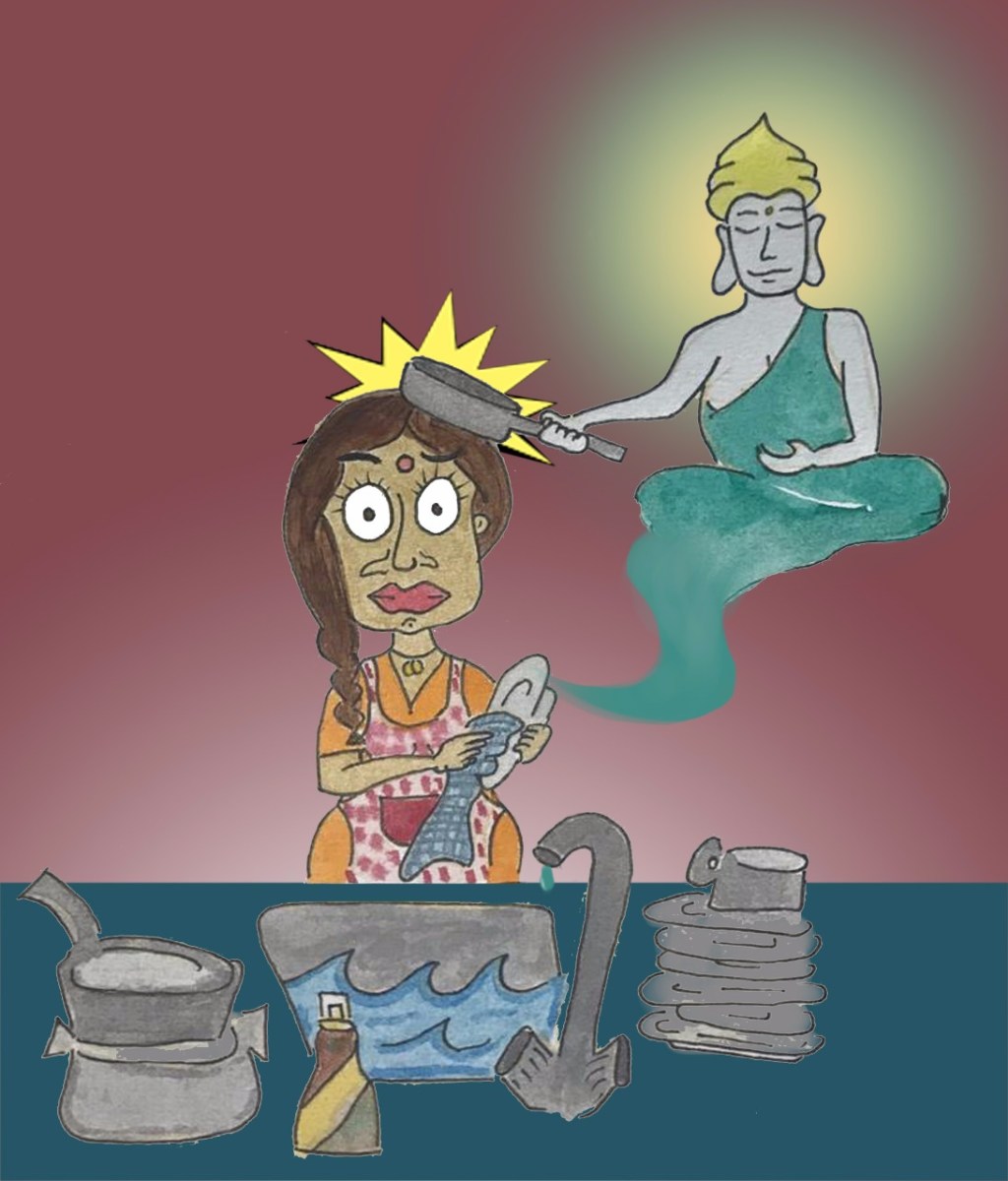
I stand in front of my fridge like it’s a battlefield and I am losing territory by the minute. One more Mother’s Day cake shoved into the second shelf, one more cupcake balancing dangerously on top of yesterday’s leftovers, one more thermacol flower arrangement pretending to be sentiment while silently occupying prime real estate next to the pickle jars.
Beautiful. Sacred. Maternal.
I close the fridge door and it pops open again like even the appliance refuses this emotional overload.
And suddenly I think of Jijabai. Of course I do. Every Indian mother eventually drags Jijabai into her private suffering. The original Rajamata. The gold standard. The woman whose son handed her forts and empires instead of buttercream frosting and a succulent from a mall kiosk.
Lucky woman.
No, not lucky. Strategic. Focused. Ruthless even. We polish motherhood until it gleams like sacrifice, but underneath it is ambition wearing a sari and speaking the language of duty. Jijabai pours stories of dharma and resistance into Shivaji’s ears until the boy becomes her unfinished sentence marching on horseback. And history applauds. “Great mother.” “Visionary mother.” “Mother of Swaraj.”
Meanwhile I ask for one thing — please don’t buy more cake — and my children look at me as if I’ve insulted civilization itself.
Oh yes, crown me with cupcakes.
And then I remember cleaning my grandmother’s house after she died. Not grieving. Sorting. Dusting. Opening cupboards swollen with decades of carefully preserved importance. Letters tied in bundles. My brother’s handwriting. Mine. Little notes written neatly for my mother. Evidence of orbit. Evidence of hierarchy.
Because even then, my mother was not queen.
Rajmata was alive.
My grandmother sat at the center like the original sun and everyone else revolved around her gravitational pull. Amma cooked, managed, sacrificed, adjusted — all the approved feminine verbs — but she did not inherit the throne while the older queen bee still breathed. That’s the thing nobody says about motherhood: power in families is feudal. Women don’t escape hierarchy; we inherit positions within it.
First daughter. Then wife. Then mother. Then maybe, if you survive long enough, Rajmata.
Promotion through endurance.
And suddenly all these famous sons look less heroic to me. Forget Shivaji for a second. Look at Prince William endlessly carrying Diana, Princess of Wales like a glowing relic through public life. The dead mother becomes eternal emotional currency. Look at Rajiv Gandhi, propelled into power literally over Indira Gandhi’s dead body. History calls it tragedy. Politics calls it succession. Motherhood calls it the final transfer of capital.
The mother’s body itself becomes infrastructure.
And still we pretend motherhood is soft. Nurturing. Pure.
Please.
Motherhood is strategy disguised as devotion. It is emotional empire-building with lullabies in the background. Every mother wants her child to become proof that her own life mattered. Some do it subtly with report cards and polite guilt. Some do it with kingdoms. Some do it with dynasties.
And children know it. Why else do they keep bringing offerings? Cakes, flowers, phone calls, achievements, grandchildren, promotions. Every child eventually learns motherhood is part devotion and part taxation system.
Pay tribute to the queen.
I hear Dr. Yuvraj Kapadia’s voice floating around with that soul contract theory. Souls choose their mothers before birth. Fine. Wonderful. Cosmic administration. So Shivaji chose Jijabai. Rajiv chose Indira. William chose Diana. My children apparently chose me, exhausted guardian of refrigerated desserts and emotional clutter.
What exactly was this contract?
“Dear soul, your karmic growth this lifetime will involve cupcakes, projection, inherited guilt, and chronic fridge management.”
Excellent. Sign me up.
Maybe that’s all motherhood is — a long negotiation between projection and love. We call it destiny because manipulation sounds harsh. We call it sacrifice because control sounds uglier. Every mother says, “I only want my child to be happy,” while quietly arranging the architecture of that happiness to resemble her own unfinished hunger.
And daughters watch this more carefully than sons. Sons get crowned. Daughters get trained.
I watched my grandmother rule without apology. I watched my mother wait for space that never fully became hers. And now I stand in my own kitchen, inheriting both irritation and entitlement, pretending I am above all this while emotionally auditing cake boxes like they are tribute from loyal subjects.
Hindavi Swaraj, but make it frosting.
I laugh at myself while shoving another cake tray into the freezer because suddenly I see it clearly: history edits out the clutter. Nobody wrote about Jijabai standing in a palace muttering, “Where am I supposed to keep all this?” Nobody recorded Indira Gandhi worrying whether her sons loved her or merely inherited her. Nobody preserved the small domestic humiliations of powerful mothers.
History removes the mess and keeps the halo.
But I live in the mess. I live in sticky fridge shelves and collapsing cardboard boxes and the absurdity of crying because people love me too much in edible forms. I live in the humiliation of realizing I still crave symbolic worship while complaining about its logistics.
I say I don’t want cakes. I mean I don’t want the burden attached to being loved.
Too late for that.
I am already standing in line for Rajmata — barefoot in my kitchen, conducting emotional archaeology through frosting and old memories, fully aware that motherhood is not sainthood. It is succession planning.


Leave a Reply