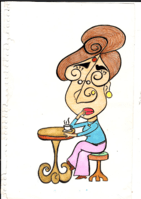
HERMIT ECONOMY AND MORE
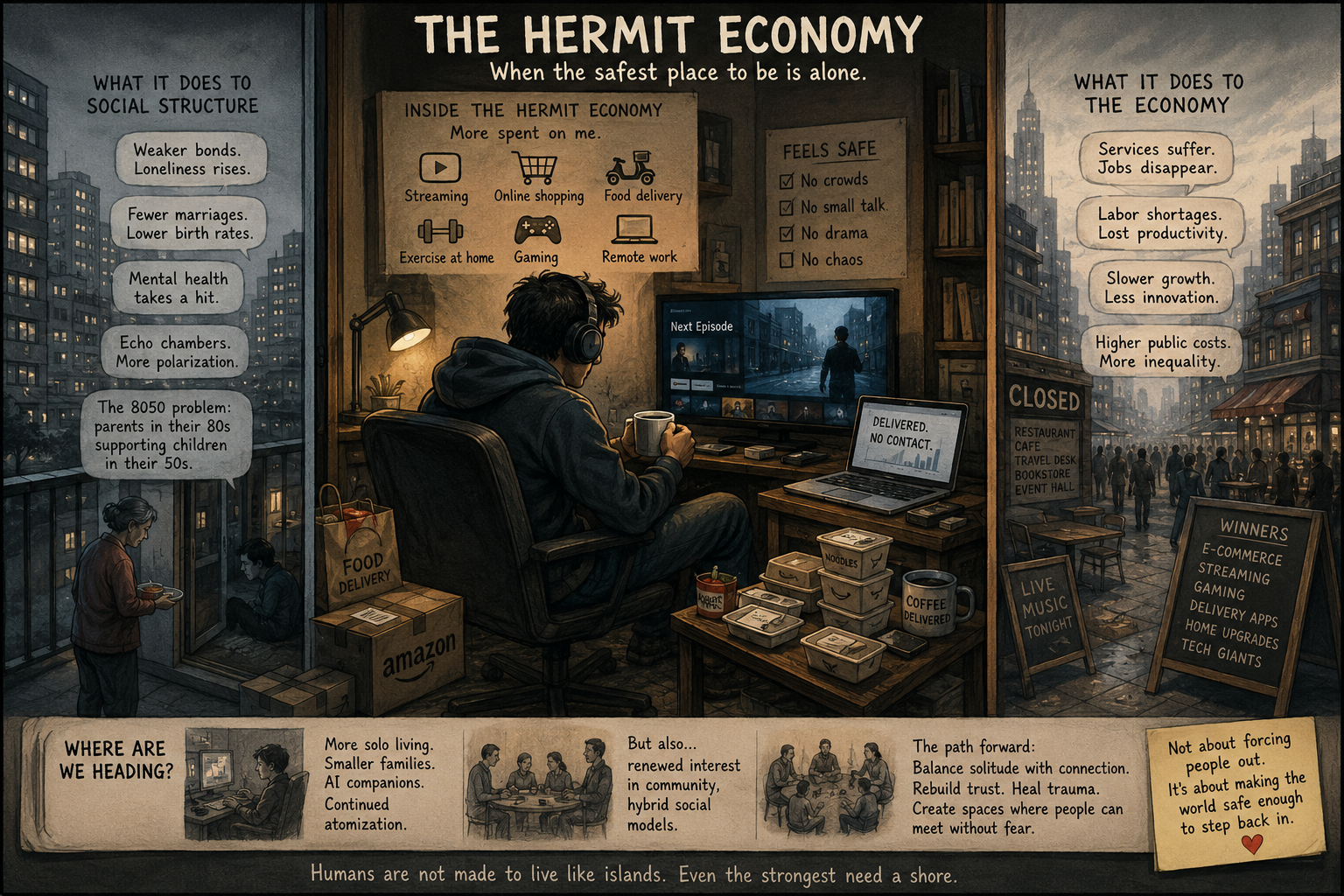
The experts are at it again. This time, they have discovered something called the “Hermit Economy.” I read about it in a heavy foreign magazine, the kind that costs fifty rupees and makes you feel illiterate by page three. It says that ever since the virus went away, people have stopped going out. They are staying at home, buying exercise bicycles they will never ride, and ordering food through little buttons on their telephone screens. They call it a structural shift. Six hundred billion dollars, they say, has been redirected away from human beings and toward cardboard boxes.
I do not know about six hundred billion dollars, but I know about my friend, the retired deputy accountant from Mylapore. He used to be a man of the world. Every morning at six, he would put on his crisp white veshti and go to the corner mess to discuss the rainfall deficit and the state of Carnatic music. Now, he sits in his armchair under a whirring fan, wears his lungi all day, and watches moving pictures from America on a screen. He tells me he is practicing “voluntary isolation.” I told him that in my day, we just called it being lazy.
The magazine says this is a very serious matter. It connects to something called Hikikomori in Japan, where grown-up children lock themselves in their bedrooms for twenty years and their eighty-year-old parents have to slip thin slices of ham under the door to keep them alive. It is a terrible thing. But in Japan, they have the space to hide. In a Chennai flat, if you try to withdraw from society, you will only end up bumping into your brother-in-law who is trying to do the same thing in the same passage.
“They say social isolation is as harmful to health as smoking fifteen cigarettes a day. I told this to the regular gentleman at the local tea stall. He looked at his midday medu vada, took a long sip of his strong filter coffee, and said he preferred the old-fashioned way of dying.”
There are major economic consequences, of course. The big companies that sell things in plastic wrappers are becoming richer than the old kings of Tanjore. Meanwhile, the small shops are suffering. The messes are half-empty because everyone wants their sambar-rice delivered in a silver pouch by a young man on a motorcycle who looks like he is racing for the Grand Prix down Mount Road.
The experts ask: Is it a healthy trend? Where are we heading?
They say we are heading toward a hybrid future. By the end of the decade, they tell us, we will all have artificial companions made of computer code to talk to, instead of real friends. I do not think this will work in India. If I have an artificial companion, my aunt from Mambalam will still ask why it hasn’t married a nice boy from a good family.
The trouble with the Hermit Economy is that it feels very safe until you actually need someone. You can buy everything from a machine—your clothes, your books, your cold drinks—but a machine cannot tell you a good piece of gossip. A machine cannot argue with you about the cricket match at Chepauk. And when the December monsoon comes and the water enters your ground-floor living room, a digital streaming service will not help you lift your steel cupboard onto the dining table.
The path forward, according to the wise men, is to rebuild our social infrastructure. We must encourage people to go back to the “third places”—the clubs, the temple tanks, the benches by the sea.
I took the Bolshoi Boxer for a walk along Marina Beach yesterday evening to see if the social fabric was truly eroding. There were three hundred people trying to buy sundal from one single cart, four boys playing cricket with a plastic bat on the wet sand, and an elderly gentleman arguing with an auto-rickshaw driver over two rupees.
The Hermit Economy may have conquered the rich countries. But I think it will have a very difficult time on the streets of Chennai. There is simply no room to be a hermit.


Leave a Reply