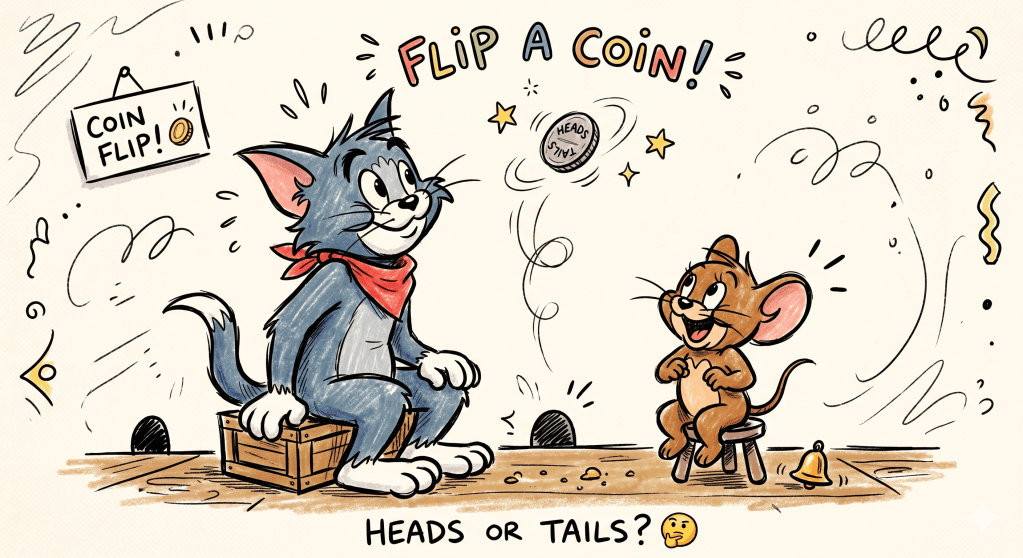
On flip the coin day.
Aryamba’s son was watching a cricket match with the seriousness usually reserved for budget meetings and heart surgery. The toss was on. The captain called. The coin went up, came down, and television experts immediately began discussing pitch conditions, dew factors, wind direction and perhaps, if given enough airtime, the mating habits of migratory birds.
“This toss looks manipulated,” declared the young man.
From the corner of the dining table, where he was peacefully attacking a dosa, Ananth looked up and said, “Maybe they are using the Sholay coin.”
“What is a Sholay coin?” asked Shankar.
This was all the encouragement the parents needed. Indian parents can explain history, mythology, economics and cinema with equal confidence, whether asked or not.
So they told him about the famous double-headed coin from the film. A coin designed to remove uncertainty while pretending to embrace it. The perfect invention for people who want destiny to agree with them in advance.
Aryamba, who possesses the rare ability to connect any conversation to a calendar event, said, “Incidentally, today is Flip a Coin Day.”
“You mean there is a day dedicated to flipping a coin?”
“Well, not exactly. It is more about the philosophy behind it.”
“What philosophy?” said Shankar. “Flipping a coin and life lessons? No chance.”
This is the tragedy of youth. They think wisdom must arrive in a thick book or an expensive seminar. They do not trust a small metal object worth a few rupees.
Yet a coin toss is a remarkable performance. You place a question upon a tiny disc of metal, throw it into the air and, for a few seconds, watch it spin between possibilities. Heads and tails become equals. Certainty takes a short tea break.
Perhaps that is why watching a coin turn in the air has a strangely calming quality. For that brief moment, nothing is decided. Everything is possible. The coin dances between outcomes without anxiety. It does not worry about quarterly targets, cholesterol levels or social media opinions.
Modern life is built on control. We organise, schedule, plan and optimise. We have applications that tell us when to sleep, drink water and stand up. Some people probably require a reminder to enjoy a sunset.
A coin toss quietly rebels against all this. It reminds us that uncertainty is not a design flaw in life. It is part of the design.
Sports use the toss because it is fair. Neither captain can negotiate with gravity. At least in theory. Folklore uses coins differently. People toss them into fountains, rivers and shrines. A coin becomes a messenger carrying a wish. Sometimes it is an offering, sometimes a prayer, sometimes simply hope wrapped in metal.
The coin becomes a small ambassador travelling between human desire and cosmic mystery.
There is another curious thing about flipping a coin. The moment it lands, you discover something about yourself. If you are disappointed with the result, you suddenly know what you really wanted.
The coin did not make the decision. It merely introduced you to your preference.
Not bad for a small circular object.
The Japanese have a beautiful idea called wabi-sabi, which finds beauty in imperfection and impermanence. A coin toss belongs comfortably in that philosophy. The outcome is uncertain, the moment is fleeting and the result is accepted. No appeals. No review committee.
Coincidentally, today is also Say Something Nice Day.
Now there is an interesting combination.
Imagine flipping a coin to decide whom you will compliment today. Heads, you appreciate a colleague. Tails, you call an old friend. Or perhaps one side means kindness to a stranger and the other means gratitude to family.
Randomness has an unexpected virtue. It sends kindness into places we may otherwise overlook. Left to ourselves, we tend to follow familiar routes. Chance occasionally takes us down a different street.
Of course, life is not entirely chance. Nor is it entirely choice. We live somewhere between the two. We make plans, and then reality edits them. We work hard, and outcomes still surprise us.
The old wisdom of the Gita remains stubbornly relevant. Do your duty. Do your best. Leave the result behind.
Or, as countless grandmothers have translated it into practical language: stop worrying after you have done what you can.
Perhaps that is the lesson hidden inside a coin toss. Not gambling. Not prediction. Surrender.
Flip a coin. Offer a kindness. Accept the outcome. Somewhere between purpose and randomness, between effort and acceptance, between heads and tails, life quietly reveals its balance.
And if the coin happens to be a Sholay coin, then all philosophy must be suspended immediately.


Leave a Reply