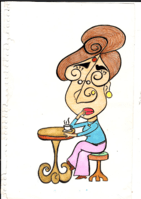
Forgotten Mothers and Silent fathers. A2Z of care and legitimacy
Legitimacy beyound Care giving.
Societies have a peculiar habit. They celebrate the people who arrive at the finish line holding the trophy while quietly forgetting those who carried the runner when he could not walk. We claim to worship love, sacrifice, and care, yet whenever inheritance, bloodlines, and surnames enter the room, love is politely escorted out through the back door.
As a vidhūṣaka, I have always found this amusing. Not funny in the cheerful sense, but amusing in the way a doctor finds it fascinating that a patient can insist he is perfectly healthy while clutching an X-ray that looks like modern art. My role is to stand at the edge of the stage and point at the elephant that everyone has collectively agreed is invisible. As a physician, I diagnose symptoms. As a hypnotherapist, I listen for the stories hidden beneath consciousness. As a vidhūṣaka, I simply ask inconvenient questions at the wrong moment.
Take adoption.
The moment the word appears, society becomes strangely nervous. We insist that love makes a family. We print it on greeting cards. We frame it on living-room walls. We repeat it in motivational speeches. Then someone asks, “Who is the real parent?” and suddenly the room fills with genealogists.
The absurdity is ancient.
Consider Grusha from Bertolt Brecht’s The Caucasian Chalk Circle. A woman risks everything to save a child abandoned during political chaos. She feeds him, protects him, and sacrifices her future for him. Then, when the danger passes, the biological mother returns to claim the child. Brecht’s genius was not merely theatrical; it was diagnostic. He exposed a contradiction embedded deep within social consciousness. The person who nurtures the child is expected to surrender him to the person who merely produced him. The play asks a dangerous question: if motherhood is sacred, what exactly makes it sacred? Biology or responsibility?
The answer makes many people uncomfortable.
The same discomfort appears in Indian mythology. Everyone remembers Devaki because she gave birth to Krishna. Entire festivals celebrate her suffering. Yet it was Yashoda who soothed fevers, tolerated mischief, chased after stolen butter, and performed the exhausting daily labour known as parenting. If parenthood were measured in hours worked, Yashoda would qualify for overtime benefits. Yet cultural memory often treats her as a beloved caretaker rather than the mother who actually raised the child.
Apparently, in the accounting department of mythology, labour and love are recorded under “miscellaneous expenses.”
Cinema is no different. In Baahubali, audiences weep, cheer, and debate lineage with remarkable enthusiasm. Yet somewhere in the shadows stands the tribal mother who nurtures the child before royal identities are revealed. She becomes a temporary bridge, useful until bloodline resumes its rightful place on the throne. History, mythology, and cinema repeatedly perform the same trick. Caregivers are essential to the story but optional to the legacy.
The pattern extends beyond myth. In George Eliot’s Silas Marner, the lonely weaver finds redemption through raising an abandoned child. His identity becomes intertwined with fatherhood. Yet the arrival of biological claims immediately destabilizes the legitimacy of his devotion. The question lurking beneath the narrative remains familiar: can years of love compete with a shared genetic sequence?
Modern science, interestingly, seems less sentimental about blood than culture does.
Research in developmental psychology has consistently shown that secure attachment relationships are among the strongest predictors of emotional resilience, psychological well-being, and social functioning. The pioneering work of John Bowlby and later Mary Ainsworth demonstrated that children are shaped profoundly by the quality of caregiving relationships rather than merely biological connection. More recent studies in epigenetics have complicated the old nature-versus-nurture debate even further. Environmental experiences, stress, affection, and caregiving practices influence gene expression itself. DNA may provide the script, but nurture edits the performance.
As biologist Matt Ridley famously observed, nature works through nurture.
Yet society remains stubbornly attached to what might be called genetic romanticism. We speak of “blood relations” as though chromosomes possess moral superiority. It is an elegant illusion. Blood is measurable. Care is not. DNA fits neatly into legal documents. Sacrifice does not.
Perhaps this obsession reveals something deeper.
Patriarchal societies have always depended on certainty of lineage. Property, inheritance, succession, caste, clan, and dynasty all require one question to be answered with confidence: whose child is this? The elevation of biological parenthood was never solely about affection. It was also about accounting. Love entered the conversation later, after the paperwork had already been completed.
The child, meanwhile, becomes a curious object around which adults negotiate ownership.
Ownership is another fascinating word. We use it so casually. “My child.” “My son.” “My daughter.” Yet children are not houses, bank accounts, or ancestral jewellery. They arrive as independent consciousnesses entrusted temporarily to adult care. Stewardship would be a more accurate term than ownership, but stewardship lacks the emotional drama that ownership provides.
Names reveal this instinct beautifully. A name is rarely just a label. It is a declaration of belonging. To name someone is to place them within a narrative. Yet lineage repeatedly overrides lived experience. The person who gave identity through daily care can be erased by the person who provides ancestry through biology.
Perhaps that is why societies forget caregivers so easily. Care is repetitive. It lacks spectacle. No one erects statues to the person who packed lunch boxes, stayed awake through fevers, or listened patiently to fears at midnight. Heroism receives monuments. Caregiving receives expectation.
And so adoption becomes a mirror held before civilization itself. In that reflection we discover an uncomfortable truth. We claim to value love above all else, but when love collides with blood, blood usually receives the better lawyer.
As a vidhūṣaka, I laugh at this contradiction because satire is often the shortest route to truth. As a doctor, I recognize it as a cultural pathology. As a hypnotherapist, I suspect it reveals a collective unconscious still haunted by ancient anxieties about inheritance, identity, and belonging.
The child standing at the centre of these stories may ultimately be asking the simplest question of all: not “Who created me?” but “Who stayed?”
And history, mythology, literature, and neuroscience increasingly seem to agree that the answer to that question matters far more than society is willing to admit.
References
Bowlby, J. (1969). Attachment and Loss, Vol. 1: Attachment.
Ainsworth, M. D. S., Blehar, M. C., Waters, E., & Wall, S. (1978). Patterns of Attachment.
Meaney, M. J. (2010). “Epigenetics and the Biological Definition of Gene × Environment Interactions.” Child Development.
Ridley, M. (2003). Nature via Nurture: Genes, Experience, and What Makes Us Human.
Brecht, B. (1948). The Caucasian Chalk Circle.
Eliot, G. (1861). Silas Marner.


Leave a Reply