Armane Kathe.
“Nothing major,” she said, almost apologetically. “It’s actually rather embarrassing. I thought perhaps a past life regression might help.”
People rarely begin therapy by talking about the wound. They begin with the symptom.
I looked at the woman sitting opposite me. She was in her forties, with an open, round face framed by an unruly halo of curls. Some days she appeared in faded jeans and a cotton kurta; on others she arrived draped in an elegant Mysore silk sari—the kind that rustles with distinct, quiet authority. There was one constant, however.
“I refuse to wear a salwar kameez,” she had once declared with surprising, almost fierce conviction.
It had seemed an odd, petty preference then. Later, it would become one of those tiny details that make a therapist lean back in their chair and wonder.
For this account, I shall call her Aryamba.
She interpreted my subtle nod as permission to continue.
“I cry whenever someone narrates the history of Mysore.”
I waited.
“And…” She hesitated, wringing her hands in her lap. “I become irrationally, blindingly angry whenever someone glorifies Sardar Patel.”
The sentence hung heavy in the air.
This wasn’t political disagreement. It wasn’t ideological debate. It was visceral, bodily anger—the kind that tightens the jaw and turns the stomach into a hard knot. Aryamba herself admired modern India, carried no regionalist grudge, and had never studied the integration of princely states beyond school textbooks. She wasn’t trying to prove a historical point; she simply couldn’t explain what was happening inside her own chest.
“So,” she said sheepishly, “I thought… maybe a regression?”
A week later, she returned—exactly on time, as always.
Once she had settled into a light trance, I asked her not to go hunting for a grand past life. Instead, I asked her to anchor herself in the physical sensation of that anger.
“Stay with the heat in your chest,” I murmured. “Focus on the anger that arises when you hear the name Patel.”
Her breathing shifted, deepening. The tight, modern tension around her eyes softened.
“What is happening?” I asked softly.
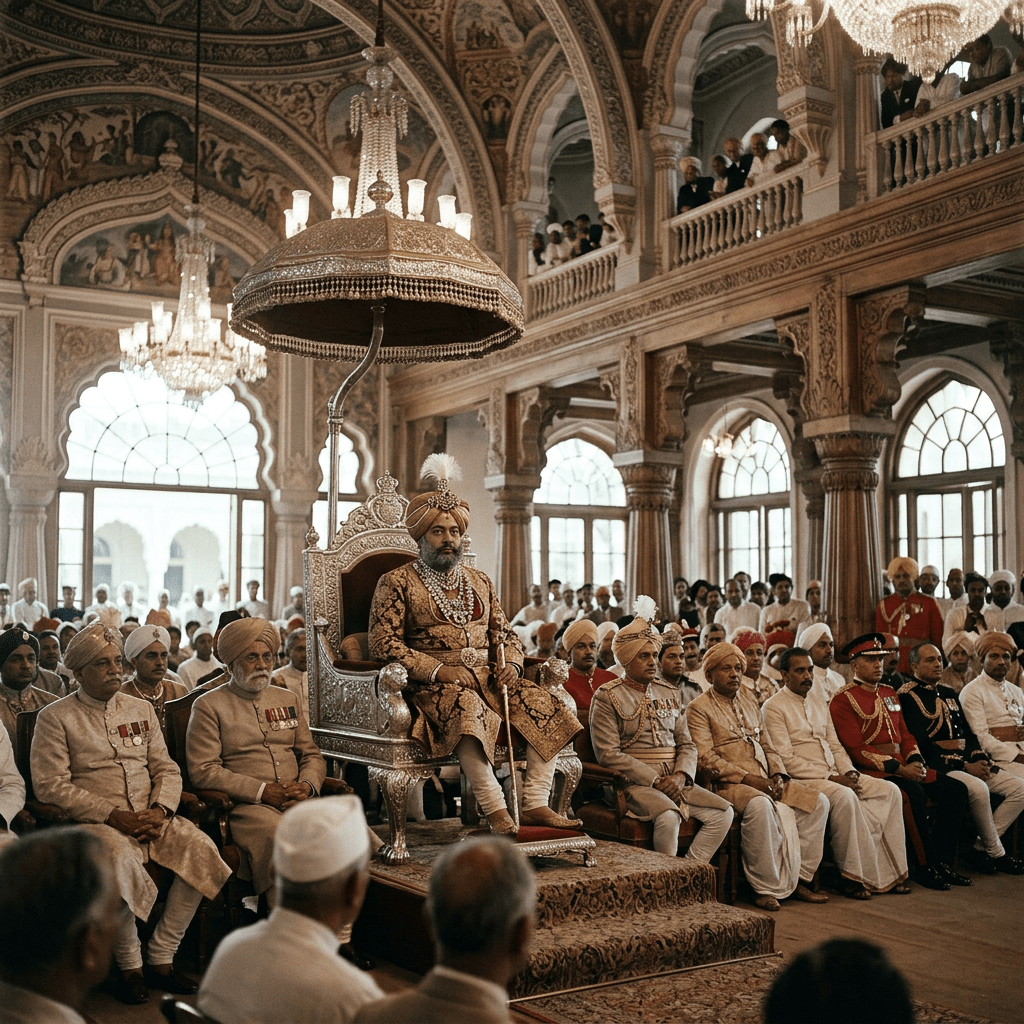
“I am standing in the Durbar Hall,” her answer came without a second’s hesitation.
“Where?”
“Mysore Palace. The air smells of wet jasmine, stale beeswax, and rain.”
“What year is it?”
“…1947. The first week of August.”
As therapists, we learn never to lead, never to project, and never to offer a script. So I simply followed her lead.
“What is the mood there?”
“Waiting,” she whispered. “A suffocating amount of waiting. They say Patel’s men are coming. Or a telegram. Or both.”
Her voice had lost all of Aryamba’s gentle, urban warmth. It had acquired a rigid, aristocratic restraint, as if every syllable were being vetted by a royal courtier before being allowed into the room.
She described a palace caught between grandeur and an impending, quiet hum. Outside, newspapers were turning Mahatma Gandhi into a moral tidal wave no kingdom could resist, framing princely states as dusty, extravagant relics of a bygone era. Inside, mahogany doors were closed tightly, but the silk drapes couldn’t muffle the tension. Courtiers walked with hushed urgency, silver tea sets clinked nervously, and every glance toward the courtyard felt charged.
“Who are you?” I asked.
A long silence followed. Then, a tiny, self-deprecating laugh escape her lips.
“Oh… no one important.”
I have learned over the years that “no one important” is almost always the doorway to the most devastating stories.
“What do you do?”
“I help… Kempananjammanni Ammani.” She paused, her throat moving as she swallowed. “And Tripurasundari Ammani.”
“And your name?”
“Vyjayanthi Raje Urs.”
What unfolded over the next hour was not a sweeping historical epic of treaties, map-drawing, or geopolitical chess. It was a story of domestic royalty—a story of women in a house that was about to be swallowed by history.
Vyjayanthi moved silently through the private quarters, balancing silver trays of filter coffee and damp linen, attending to the Maharani and the Queen Mother. She watched the private conversations the official history books forgot to record.
In one corner of the inner chambers, the Maharani, Tripurasundari Ammani, sat with an posture so straight it looked painful, watching servants carefully fold hereditary silks into heavy wooden trunks.
“Must we act as though the house is on fire?” the Queen Mother, Kempananjammanni, remarked dryly, eyeing a panicked servant who had almost dropped a silver puja vessel. “The British took fifty years to take our power; Mr. Patel’s men will at least take fifty minutes to write a receipt.”
Yet beneath the dry, aristocratic humor lay an overwhelming grief.
It wasn’t fear of losing wealth or lands; it was the sickening taste of erasure.
Outside the private quarters, Sir A. Ramaswami Mudaliar, the Dewan, paced the corridors. His diplomacy was brilliant, his tone measured, his arguments immaculate. He spoke to the Maharaja of pragmatism, of democratic transitions, and of securing a dignified place in the new Union.
“Only the Maharaja’s signature carries the legal weight, Maharani Sahib,” the Dewan’s voice echoed in Vyjayanthi’s memory, polite but firm. “The ministry in Delhi deals in constitutional mandates, not matriarchal lineage.”
The women listened. The men negotiated.
The Regent Queen, who had once held immense, quiet authority over the realm’s cultural and social soul, watched as the state was reduced to a singular signature on a piece of paper. No one consulted the women about the end of the world they had spent generations building. History was marching forward in heavy boots, and they were expected to pack up the heritage, smile gracefully, and step out of the frame.
“It is the humiliation of invisibility,” Vyjayanthi said, her voice trembling in the therapy room, tears leaking from the corners of Aryamba’s closed eyes. “To watch men decide the fate of your home in language you aren’t invited to speak.”
As the session reached its peak, another vivid image surfaced—sharp, strange, and precise.
“An aircraft…” she whispered, her brow furrowing. “A Dakota. It is being offered… so Patel can travel. A grand gesture. A gift to smooth the transition.”
She described the young Maharaja, Jayachamarajendra Wadiyar, not as a weak ruler surrendering a throne, but as a deeply pragmatic, almost heartbroken intellectual. He knew accession was right for India. He knew the kingdom’s future lay with the Republic. But he also knew that signing the Instrument of Accession meant trading away something intangible—an entire way of understanding duty, dignity, and memory—for a line item in a new government budget.
When Aryamba finally opened her eyes, the room was quiet.
She sat up, wiped her face, and blew her nose into a tissue. The fierce, burning rage that had brought her to my office had dissipated, leaving behind a deep, peaceful sadness.
“The anger was never really about Sardar Patel, was it?” she said softly, looking at her hands. “It was about the sheer, quiet fury of being swept aside. Of being spoken over. Of having your dignity packaged away while everyone tells you it’s for the greater good.”
Whether Vyjayanthi Raje Urs ever existed, or whether her name is recorded in some forgotten royal census, is a question for historians.
My work as a therapist lies elsewhere. I am interested in why the human psyche chooses a specific historical tapestry to give voice to its unspoken pain. Perhaps regression unlocks genetic memory; perhaps it constructs a brilliant, unconscious metaphor to process modern wounds of being silenced, ignored, or made to feel invisible.
We may never know for certain. But as Aryamba wrapped her Mysore silk sari tightly around herself, stood up, and walked back out into the noise of modern India, one thing felt clear:
Our deepest emotional reactions are rarely rational arguments. They are echoes—and sometimes, the psyche borrows the ghosts of history just to help us finally hear ourselves.
This post is a fiction, written for Blogchatter Bloghop.


Leave a Reply