
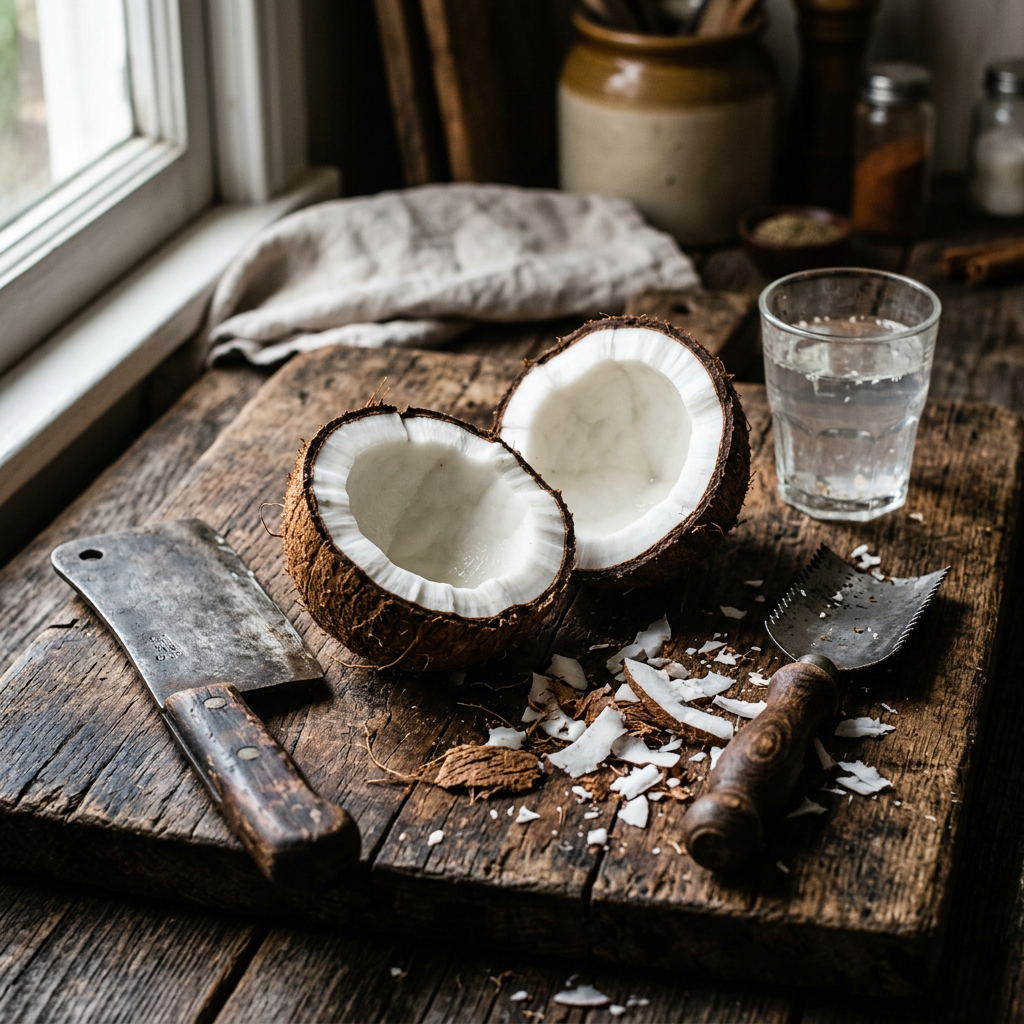
The heavy cleaver came down on Aunt Selvi’s wooden cutting board with the sound of a pistol shot.
A crack formed across the equator of the brown sphere. Clear water bled into the groove of the board, running straight toward the edge.
“Careful!” Aunt Selvi lunged with an empty steel tumbler to catch the dribble. “Every drop. That is two hundred millilitres of pure coastal hubris you are spilling.”
Sheshu-mama didn’t even flinch. He adjusted the blade of the traditional foot-grater—the iron bird with a serrated beak bolted to a wooden plank—and squinted through his bifocals.
“It’s not hubris, Selvi. It’s an endosperm. Stop anthropomorphizing oilseeds. It is the second of September, the United Nations has declared it World Coconut Day, and suddenly everyone with a kitchen knife thinks they are a maritime philosopher.”
“I am merely stating a biological fact,” Selvi retorted, holding the severed half up to the tube light like a jeweller assessing an uncut diamond. “Look at it. It perches thirty feet above common sense, encases itself in armour that requires heavy artillery to breach, hides a pint of sweet water inside salty gale winds, and demands to be worshiped. If that isn’t a career politician, what is?”
From the wicker armchair near the window, RamaBai aunt broke into a dry, fluttering laugh. “A politician? Please. A politician promises you water and leaves you with the dry husk. At least the coconut delivers on the kernel.”
“Don’t encourage her, Rama,” Sheshu-mama grumbled. He wedged the pale half against the grater’s teeth. Scritch-scritch-scritch. Snow began to pile in the stainless steel basin below. “Before you know it, she will declare that Narali Poornima is the national festival of coastal Karnataka, and I will have to spend my afternoon suffering historical embarrassment.”
Aunt Selvi’s chin went up. “I was not going to say it was Tulu.”
“You had that pan-coastal gleam in your eye,” Sheshu-mama said ruthlessly, not breaking the scraping rhythm. “People see a coastline and an ocean, and instantly assume everyone from Kochi to Karachi is singing the same hymn into the surf. Let me save you the trouble: Tulu Nadu does not fling coconuts into the Arabian Sea to bribe Varuna. That is Maharashtra and the upper Konkan.”
“And what do we do, according to your high authority?”
“We endure Aati,” Sheshu-mama barked. “We drink bitter decoction from the bark of the devil tree to keep our guts from rotting, we stay inside while the downpour tears the tiles off the roof, and we respect the Bhutas. We do not toss our harvest into the breakers to announce that the fishing boats can go back out. In Tulunadu, the sea during the monsoon is not an unruly trade partner you mollify with an offering. It is a locked door.”
“Well, in Canacona, we unlocked it,” RamaBai aunt said softly.
The rhythmic scritch of the grater stopped.
RamaBai leaned her chin on her palm, her gaze sliding past the kitchen window toward the overcast horizon. “Seventy years ago, mind you. But you could smell Narali Poornima three days before the full moon. It smelled of boiling jaggery and fresh cardamom for the narali bhaat, and that foul, magnificent stink of wet coir drying along the Talpona river.”
She closed her eyes, and the kitchen fell unusually quiet.
“The sea had been roaring like an angry beast since June—grey, filthy with froth, throwing logs back onto the sand. Then came the Poornima. The Koli and Kharvi boys would line up at the water’s edge. Gold-bordered dhotis soaked in seconds. The coconut had to be husked completely smooth, smeared with vermilion. When you threw it into the white foam, you weren’t feeding the fish; you were daring the ocean to take the offering and let the dugout canoes return alive. My uncle always said: the sea takes the nut, but she respects the shell.”
“Naturally,” Aunt Selvi murmured, setting down the tumbler. “Because the boat that went into the surf was held together by the very same shell’s cousin.”
Sheshu-mama resumed grating, his tone grudgingly approving. “At least you remember the coir. Modern people think coconuts exist purely to be milked into Thai curries or smeared over influencers’ faces. They forget the entire Indian Ocean was tied together with coconut hair.”
“Literally tied,” Rohit chimed in from the doorway.
He was holding a laptop in one hand and a half-eaten banana in the other, wearing the triumphant expression of a postgraduate who has just found an academic footnote to ruin a family argument.
“You’re talking about the stitched-plank boats, right?” Rohit pulled a stool up with his foot. “The traditional manji and dhows. Europeans spent three centuries being terrified of our boats because Indian shipbuilders refused to use iron nails. Iron rusts in tropical brine; iron rips wood apart when it swells. So what did the coastal shipwrights use? Coconut coir twisted into three-ply cordage, steeped in fish oil, and stitched straight through the planks. The hull was flexible. It could ride over a sandbar that would crack a Portuguese caravel like a walnut.”
“So the tree feeds you, gives you water, provides the timber for the keel, the thatch for the deck, and the thread to sew the whole ship together,” Selvi said, nodding vigorously. “And then we dress up one of its fruits in turmeric and throw it back into the water to say thank you for not drowning us.”
“A complete circular economy,” Rohit said, “until the lawyers got involved.”
Sheshu-mama stopped his hand midway through a sweep of the scraper. “What lawyers? Don’t drag high court rulings into my kitchen, Rohit. Coconut oil already has enough trouble with Western cholesterol propaganda.”
“Not the oil, Mama. The tree itself. 2016.” Rohit set the laptop on the marble counter, carefully avoiding the wet patch. “The Goa legislative assembly amended the Daman and Diu Preservation of Trees Act. They officially removed Cocos nucifera from the definition of a tree.”
Selvi stared. “They un-treed the coconut?”
“Demoted it,” Rohit grinned, clearly enjoying the bureaucratic madness. “Legally speaking, it became a palm or a giant grass. You see, under the Act, if it’s a ‘tree,’ you need written permission from the Forest Department to fell it, which takes months and involves actual scrutiny. But if it’s merely an overgrown monocot without branches—presto! You can clear whole groves for distilleries, housing projects, and highway expansions without a forester looking sideways at you.”
“Sacrilege,” RamaBai aunt gasped, genuinely scandalized. “In Goa? The entire state runs on fish curry, feni, and the shadow of coconut fronds, and the government woke up one morning and declared the Kalpavriksha is just tall grass?”
“They claimed it didn’t branch, so technically it didn’t fit the botanical definition of a tree under the 1984 statute,” Rohit said. “It triggered protests from Margao to Panaji. Folk singers wrote satires, environmentalists walked with coconut saplings through the streets, and opposition leaders asked if the ministers were planning to classify cows as large dogs next. The backlash was so vicious the government had to swallow its pride and re-classify it as the state tree by 2017.”
“Bureaucrats,” Sheshu-mama muttered, tapping the iron grater clean against the rim of the steel vessel. Ting-ting-ting. “They look at three thousand years of maritime survival, timber engineering, food security, and medicine, and reduce it to a clause about lateral branching.”
He picked up the empty half-shell. It was scraped immaculate—bare brown wood showing through the pale white scrapings.
“Take this,” he said, brandishing the fibrous husk like an exhibit in court. “Ayurveda calls the water sheetala—cooling, diuretic, balancing the pitta that our humid coast brews in everyone’s liver. The shell makes charcoal that filters poison. The dried kernel gave the coast its lamps before the British brought kerosene. And people call it a wish-fulfilling tree because they think you sit underneath it and wait for diamonds to drop on your head.”
“No,” Aunt Selvi said, finally pouring the saved coconut water into three small glasses. “It is the Kalpavriksha because it doesn’t waste our time. It gives you rope, wood, oil, and dinner, and then it watches you figure out how not to starve.”
She handed a glass to RamaBai aunt, one to Sheshu-mama, and took the third herself.
“Happy World Coconut Day,” she toasted, holding up the cloudy liquid. “May our politicians grow half as much backbone as the grass they tried to prune.”
Sheshu-mama took a deliberate sip, smacked his lips, and glanced back at the cutting board.
“Good water,” he conceded. “Now don’t just stand there making speeches. The grater is free. Go bring the green chillies and the tamarind—or do you expect the state tree to grind its own chutney?”


Leave a Reply