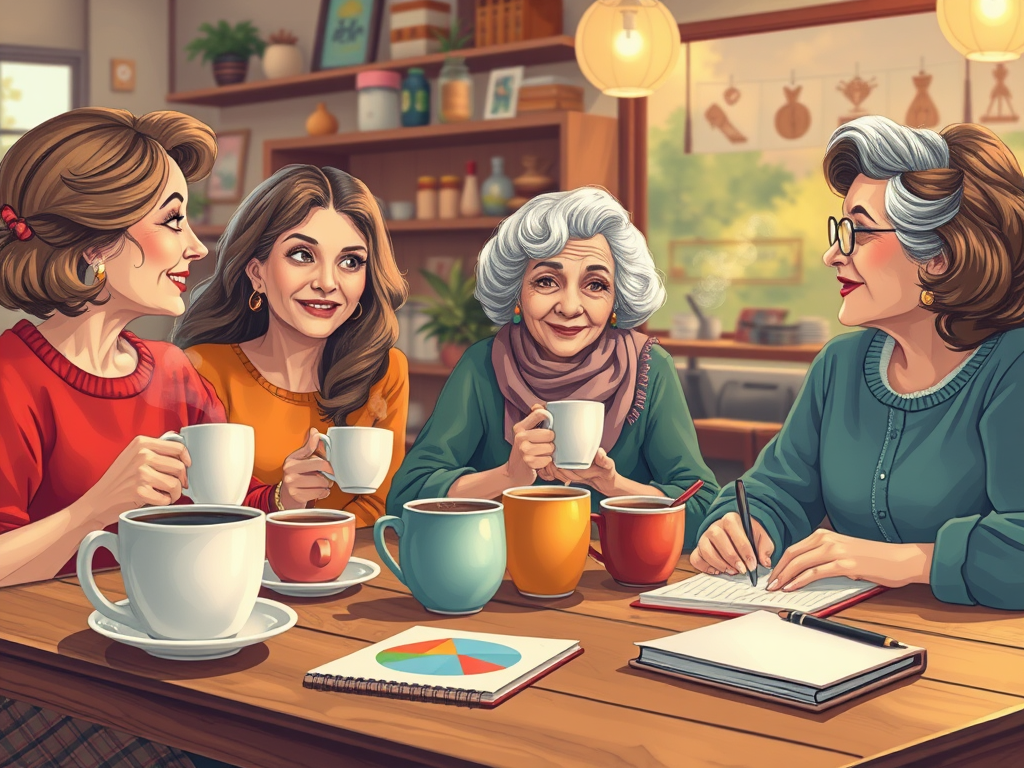
For those who drop by this journal with any regularity, you know the broad strokes of my domestic geography. Yet I must confess to having been a remarkably derelict niece. I have sketched the living room without properly introducing the formidable pillars that keep the roof from caving in.
Whenever family history is chronicled, men tend to occupy the footnotes like comfortable garden ornaments. Uncles saunter in the periphery, nodding sagely behind broadsheet newspapers, clearing their throats with immense self-importance before vanishing toward the veranda. The real theater—the command center, the courtroom, the supreme editorial board—has always belonged to the aunts.
Take Aunt Selvi. She is the uncontested matriarch of our pedagogical clan, a retired teacher who wrangled three strapping sons while drafting primers for primary school children. If you harbor the illusion that penning a second-grade textbook is light work, I strongly advise keeping that opinion to yourself. Every Mary Kutty wielding a red pencil in lower primary will come after you with a hatchet. The syllabus decreed six-word sentences, exactly one per page, alongside an impossible thicket of pedagogical mandates designed by bureaucrats who had clearly never spent five minutes with an actual child.
In her heyday, I watched Aunt Selvi pace the dining room, clutching a stack of proofs, tugging at her hairpins, and muttering imprecations under her breath. “One more syllable out of place,” she would declare, waving a red pen like a baton, “and I shall personally ensure the Education Board learns the meaning of absolute despair.” Her signature color is unapologetic rose pink, but do not let the pastel fool you. Her lifeline is filter kaapi—steaming, viscous, decoction-heavy. Tea she dismisses as a pale tonic meant strictly for milksops, while hard liquor is left to undisciplinable uncles and incorrigible sons. When life inevitably refuses to yield to her red pen, out comes her supreme curse, hissed through gritted teeth: “Shamath!”
Then stands Aunt Whilma, another heavyweight in our domestic teacher brigade. Amma, too, belongs to this sisterhood of the blackboard, but where Aunt Selvi ruled over syntax, Whilma’s territory was social sciences. Her peculiar genius lies in narrative transformation. A mundane excursion to the taluk office—an errand you or I would summarize in two flat sentences—becomes a two-hour Odyssey when filtered through Aunt Whilma’s tongue. She will chart the humidity levels, sketch the genealogy of the clerk, dissect the postman’s second cousin, and finish with such theatrical grandeur that you walk away utterly persuaded you were the one who braved the dust and the heat.
“Listen to me,” Aunt Whilma likes to warn when anyone dares question a detail, “facts are merely the scaffolding; the truth requires proper lighting.” Cross her on a matter of regional topography or historical sequence at your own peril. Her preferred armor is deep emerald green, her weapon is a terrifyingly candid eye, and her fuel is, naturally, strong kaapi. When someone commits a spectacular act of foolishness, she delivers her verdict with devastating economy: “Katai!” or, if the transgression involves genuine cunning, a low, drawn-out “Khadeema.”
Aunt Paddu, by contrast, is the quiet diplomat of the clan. She managed a miraculous escape from the B.Ed trap, steering clear of lesson plans and chalk dust to seek the saner pastures of government service. Perhaps because she operates outside the classroom, she has happily abandoned the family orthodoxy. She switched her allegiance from kaapi to milky office chai, traded the traditional crispy golibhaje for plump samosas, and became the aunt who brings easy laughter into a room.
Paddu is the keeper of confidences, possessing that rare, uncanny gift of delivering a fierce motherly embrace one minute and scheming like a wicked, conspiratorial sister the next. “A family secret,” she once whispered to me over a paper cup of tea, “is simply currency waiting for the right moment to be spent.” Being the youngest, she remains fluent in the language of mischief, gently cushioning the blow whenever the grand matriarchs begin their thunderous pronouncements.
And then there is Aunt Jalaja, Papa’s sister—the quiet dark horse of the dynasty. To watch her leave for the evening temple visit, pallu neatly tucked, you might mistake her for a conventional devotee, wrapped up in routine piety. But quiet waters conceal whirlpools. Aunt Jalaja was the first Hindu woman to secure a teaching post in a conservative Christian school, and just to make her mark entirely clear, she taught Hindi in the deep South. In a landscape bristling with cultural and linguistic friction, she didn’t pick noisy fights or wave banners. She simply occupied the space, smiled pleasantly, and went about her business with stubborn excellence. “Let them argue about who owns the gate,” she once remarked with a mild shrug, adjusting her bangles. “The door was open, so I walked in.”
Ask Jenny and Andy, and they will tell you the ranks are expanding—my sister Ella-akka and I are already being drafted into the council. Looking at the iron will and dry wit running through this tribe, I can only wonder: whoever had the nerve to claim this was a man’s world?


Leave a comment