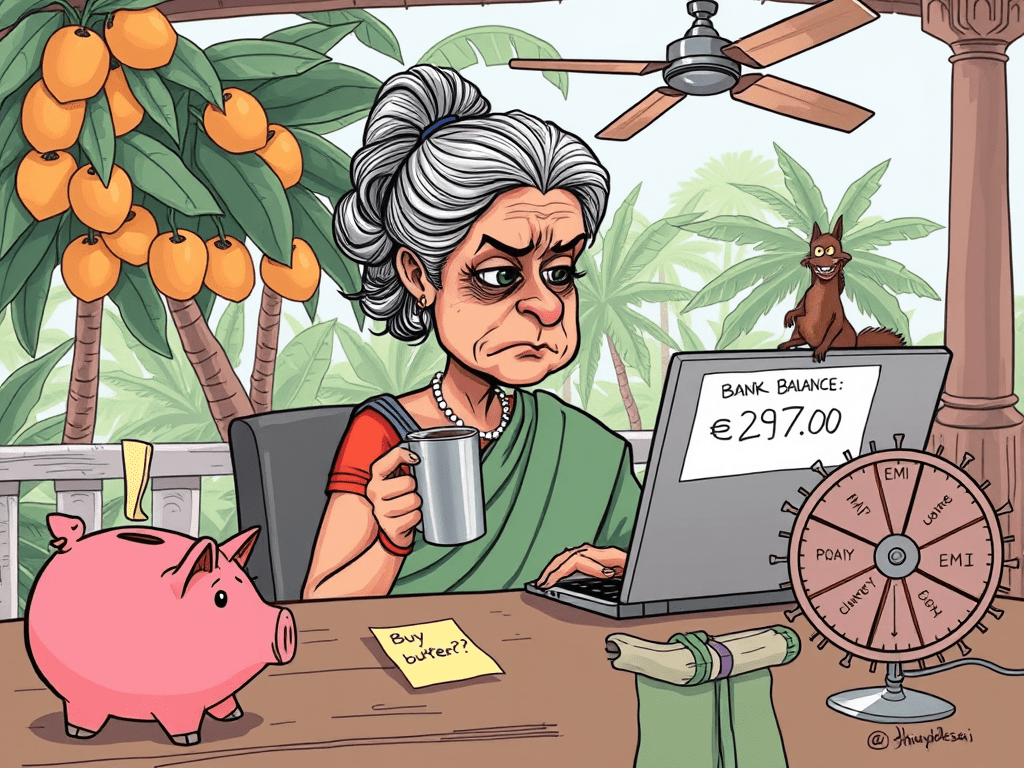
They told us Chumbak is a comedy. I sat through it with my jaw clenched, waiting for the joke to land, only to realize the joke, as always, is us.
Alzheimer’s, to begin with, is not a laughing matter. Anyone who has wiped up the spills, navigated the terrifying blank stares, and endured the slow, soul-crushing erosion of a parent’s mind knows there is no punchline in caregiving. But what made my blood boil wasn’t just the clumsy handling of dementia. It was Rajni.
Let’s bypass the cinematic witchcraft of her appearance for a second. The woman is gliding through domestic hellfire in starch-crisp sarees, not a single pleat out of alignment, not a drop of sweat on her brow, managing a full circus with zero house help. Complete Bollywood balderdash, but fine, we swallow television fiction every day.
What I could not swallow—what made me want to fling my chappal through the screen—was the sheer ridicule aimed at her when she dared to breathe the word separation.
We are supposed to giggle because, even while walking out the door to reclaim an inch of her own existence, she is still managing her husband. She cannot just step out; she has to make sure his dinner is cooked, plated, and sitting dutifully on the table before she leaves. Look at the adorable, helpless man! Marvel at the endlessly accommodating Indian wife!
That isn’t cute. It is bone-deep, calcified exhaustion.
Rajni is trapped in the classic Indian female tragedy: a nervous system so brutally conditioned by decades of unpaid domestic labor that she cannot stop caretaking even while trying to walk away. She is terrified that if she drops the ball for five seconds, the man will starve next to a cold stove and society will send her the bill. She doesn’t even have the luxury of walking out clean; she’s too busy setting the table for the man she is leaving.
Because heaven forbid a woman past fifty should want a life of her own.
First, you wipe bottoms and nurse infants. If you try to build a career while doing it, some well-meaning guru will pat your hand and say, “Focus on the baby now, beta. You can always return to your clinic later.”
Lies. All lies. Because “later” is an ambush.
The moment the children are tall enough to feed themselves, the elder-care relay begins. If it’s your parents-in-law, you walk on eggshells while your husband silently audits your devotion, keeping mental tabs on whether his mother’s khichdi had the correct proportion of ghee.
If it’s your own parents, the long-distance critics clock in. A patient of mine is currently coming apart at the seams, completely broken while dealing day in and day out with her father’s geriatric aberrations. And what is her support system? A sister calling in from the Middle East, safely perched thousands of miles away, cross-examining her over the phone to check if Daddy is being “adequately taken care of.” It is always the ones who don’t change a single adult diaper who have the most opinions on the quality of the care.
I am sick of the daily domestic tribunal. I don’t want to wake up at 5:30 AM to the existential dread of “Mummy ko breakfast mein kya denge?” And I certainly don’t want to be yelled at because Mommy Dearest received her toast at 9:00 AM instead of 8:30 AM.
And after four decades of being the unpaid shock-absorber in the family machinery, what is your grand reward?
A Mother’s Day cake. Covered in hideous blue fondant, bought out of guilt, accompanied by a dinner reservation for “exotic, artisanal, semi-cooked Asian fusion.”
Keep your fucking cake.
And take that half-raw bowl of cold noodles somewhere else. Indian food is Asian too, and unlike this trendy rubber, my sixty-year-old dentition can actually chew it and my aging gut can actually digest it. I don’t want your performative Instagram tributes, and I don’t want to pretend I enjoy swallowing unchewed lemongrass just because it looks modern on a reel.
I want five minutes of quiet. I want someone else to figure out the porridge. I want thoda sa aasmaan.
Instead, women in their fifties and sixties wake up to a fresh layer of domestic twilight zone:
- You retire, but your kitchen doesn’t. The career tapers off, and the domestic vacuum promptly swallows you whole.
- You look across the dining table at a spouse who has become a polite roommate, estranged not by dramatic betrayals, but by decades of parallel tracks, exhaustion, and zero bandwidth to fix whatever was left behind.
- Your children are supposedly “settled,” yet you find yourself cooking, scrubbing, and picking up after a 35-year-old adult child who views your labor as part of the home’s ambient Wi-Fi.
- And just as the parent-care marathon winds down, the whispers start: “Grandma can easily manage the baby when the new couple goes to work!”
Thank god for my best friend. The minute her son and daughter-in-law started dropping hints, she looked them dead in the eye and drew a line in permanent black marker: “Do not expect me to babysit your child. I raised mine. Now you raise yours.”
It sounded like blasphemy to the relatives, but it was pure self-defense.
It reminded me of my sister. When she was widowed at just thirty-two, the family mourners swarmed her with the usual pious rubbish: “You have to be strong now. You have to live entirely for your children.”
She waited until they walked away, turned to me, and muttered: “The kids will grow up, pack their bags, and live their own damn lives. I have to live for myself.”
She was thirty-two and she saw the trap. Most of us take until our sixties to realize that martyrdom does not come with a pension, a monument, or even a grateful nod.
Rajni on screen was treated like a comedy sketch for wanting out while still serving dinner. But out is the only sensible destination left. Reclaiming your time, locking your bedroom door, and refusing to be the designated caregiver for three generations isn’t an eccentricity—it’s an overdue jailbreak.


Leave a comment