
Clinical Notes on a Sick Paradise
Every time a marketing guru gleefully declares that an idyllic hamlet has “gone viral,” my clinical reflexes kick in. I reach for the thermometer and check for an emergency airway.
In digital parlance, “viral” is treated as the holy grail—a rapturous downpour of likes, algorithm-fueled footfall, and easy money. But to anyone trained in pathology, a viral outbreak is never benign. It is an aggressive, opportunistic inoculation that overwhelms natural defenses, induces acute swelling, and leaves the host wheezing in triage.
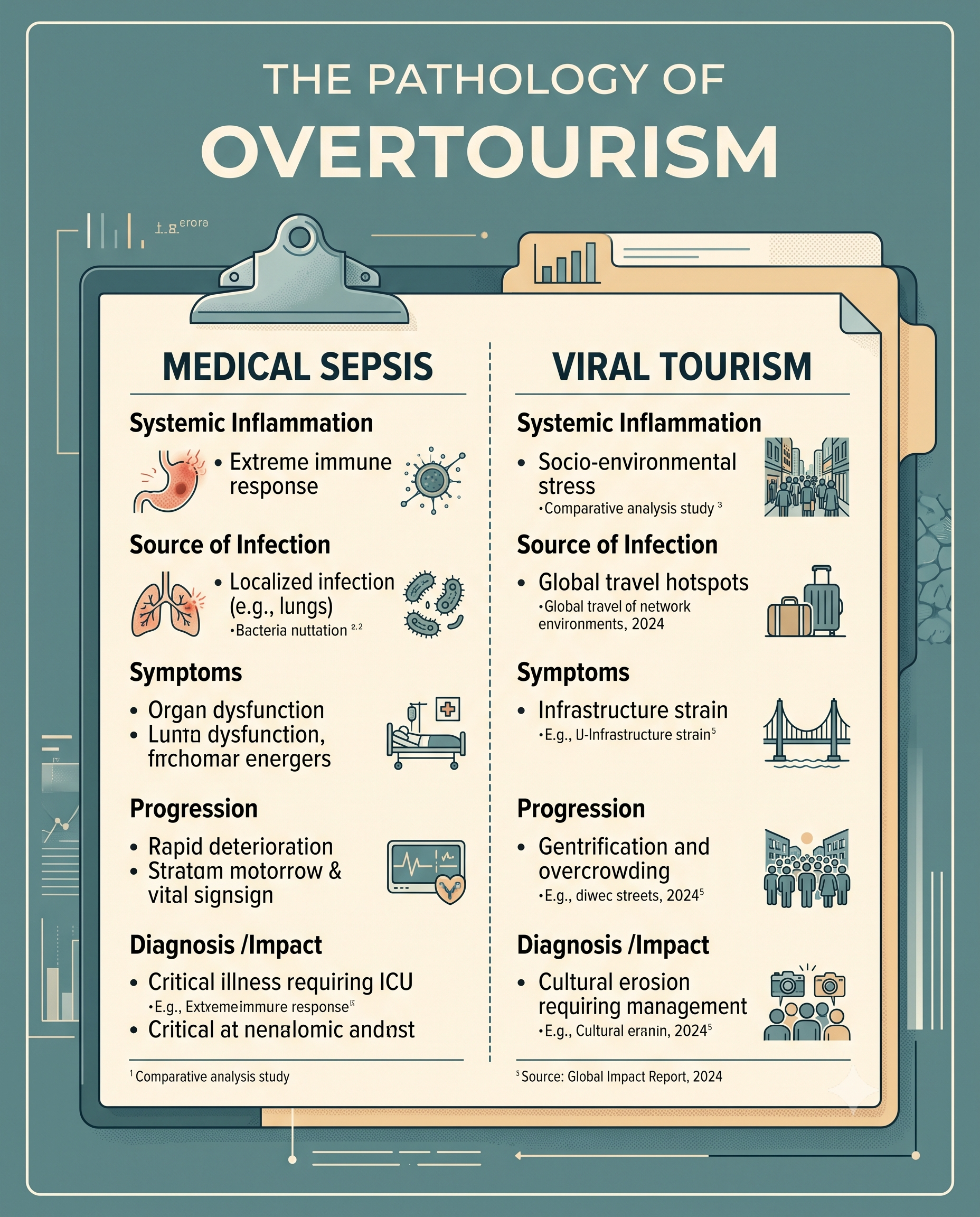
Lately, as I watch what we politely term “overtourism,” I don’t see an economic boom. I see a textbook case of sepsis.
The Pathology of Overtourism: A Diagnostic Chart
To make sense of the carnage, I found myself drafting a differential diagnosis. The parallels between a patient crashing in an ICU and a vacation hotspot trending on Instagram are, frankly, uncanny:
| Tourism Dynamics | Physiological Equivalent | Clinical Manifestation |
| Visitors & Influencers | External micro-organisms | Exposure / Acute microbial inoculation |
| Local culture & residents | Healthy tissue & native host flora | Homeostatic baseline; symbiotic ecosystem |
| Regulated economic exchange | Normal, healthy immunity | Nourishment, balanced circulation, vitality |
| Severe overcrowding | Acute localized inflammation | Rubor, tumor, calor, dolor (Redness, swelling, heat, pain) |
| Degraded ecology & infrastructure | Cellular necrosis & tissue injury | Structural micro-trauma, resource depletion |
| Unregulated hyper-tourism | Sepsis | Deregulated systemic response; host self-destruction |
A fever, as any medical student will tell you, is not a design flaw. It is a desperate siren—a systemic shout that the host’s compensatory reserves are utterly spent.
And right now, Goa is running a temperature of 104 degrees.
Case History: The Morbid Anatomy of Parra
You don’t have to fly to Venice or Barcelona to observe the syndrome. Just drive through North Goa.
Consider the quiet village of Parra. For generations, it was a tranquil stretch of church-flanked paddy fields and tall, stoic coconut palms where locals strolled at sunset to nurse their susegad. Then cinema discovered it, the reels followed, and the algorithmic pathology set in.
Almost overnight, the road was inoculated with an uncontrollable swarm. It ceased being a residential artery and mutated into an outdoor photo-studio. Tourists park hired hatchbacks squarely in the middle of oncoming traffic, climb precarious scooter seats to mimic Bollywood heroines, and throw mini-tantrums when an ambulance or a local bread-vendor dares to ring a bell.
The local panchayat’s immune response? Utter bewilderment, followed by the introduction of a “cleanliness cess”—the municipal equivalent of high-dose paracetamol prescribed to treat a compound fracture.
Look across the state, and the clinical symptoms are unmistakable:
- Socioeconomic Necrosis (The Rents): Like healthy cells starved of oxygen by a runaway growth, local Goan families are quietly priced out of their ancestral neighborhoods. Quaint Portuguese homes are hollowed out to make way for boutique villas with plunge pools, transforming vibrant neighborhoods into gated weekend dormitories.
- Tissue Ischemia (The Infrastructure): Every holiday weekend brings severe vascular congestion. The arterial highways clot. The groundwater tables are suctioned dry by private tankers to fill hotel hot tubs, leaving native taps sputtering dry air.
- Psychological Morbidity (The Zoo Phenomenon): There is a distinct, measurable neurosis that develops when your morning porch-coffee becomes part of someone else’s 4K B-roll footage. Daily living is commodified into an ethnic prop.
The Sepsis Cascade: When the Cure Cannibalizes the Host
The cruellest medical irony of sepsis is that the body isn’t killed by the germ; it is killed by its own immune system.
The host mounts such a furious, deregulated response to the foreign load that its inflammatory mediators turn inward. Capillaries leak. Tissues starve. Organs shut down.
That is precisely what unregulated tourism does to a community. It begins as a therapeutic tonic—a promise of jobs, foreign exchange, and cultural preservation. But without dosage control, the host community ends up cannibalizing its own vital organs to survive the crowd. Civic budgets that ought to maintain rural health clinics and schools are spent clearing beer bottles and plastic wrappers from sand dunes. The tranquil beauty that drew travelers in the first place is paved over with multi-level parking lots.
The treatment has become the toxin.
Writing the Prescription: Toward Conscious Tourism
When a patient presents with an overactive immune response, a good clinician does not advocate for biological extinction. You don’t “cure” an autoimmune condition by killing off the patient’s immune cells.
Likewise, the answer to overtourism isn’t building a moat around Goa, declaring war on luggage bags, or forbidding outsiders from ever tasting a prawn curry again. Travel expands the human spirit, sustains livelihoods, and connects disparate worlds.
What we need is what medicine calls immunomodulation—a measured, intelligent regulation of the system:
- Calculate the Carrying Capacity: Just as a human kidney can only filter so many milliliters per minute, an ecosystem has a rigid threshold. When an area’s capacity is exceeded, triage is mandatory.
- Break the Algorithmic Monoculture: The world is vast, yet three million people queue up to take the identical photo in the identical five square meters. Travel with curiosity, not an algorithmic checklist. Step into the hinterlands, eat at the family-run bhojanalaya, and leave the stressed coastal fringe room to breathe.
- Remember the Host is a Human Being: A destination is someone’s home, not a disposable film set. If your vacation leaves behind an empty water tank, a trail of litter, and a gridlocked village, you aren’t an explorer—you’re a pathogen.
This World Tourism Day, let us retire the giddy celebration of “going viral.” A healthy destination isn’t one burning up in a glamorous, short-lived digital fever. It is one that maintains its homeostatic balance, breathing easily for generations to come.
“The goal is never to stop travel. The goal is to practice conscious tourism—just as medicine aims not to eliminate our immunity, but to regulate it.”


Leave a comment